
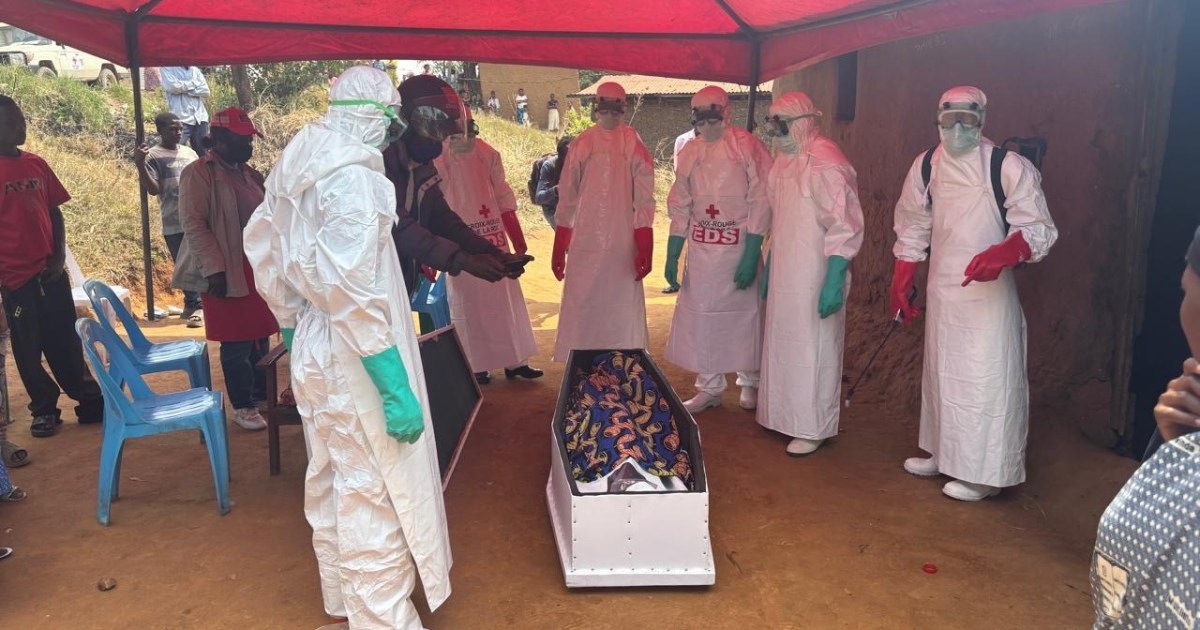

The true number of Ebola cases in the Democratic Republic of the Congo (DRC) is likely at least double the official tally, according to a World Health Organization (WHO) official.
The WHO has confirmed at least 1,963 cases, and at least 719 have died.
- list 1 of 3Ebola death toll in DR Congo surpasses 500
- list 2 of 3Confirmed Ebola deaths in DR Congo hit 600
- list 3 of 3Staff at DR Congo Ebola centre strike as virus continues spreading
end of list
Speaking after visiting the region, Chikwe Ihekweazu, the Executive Director of the WHO’s Health Emergencies Programme, said most deaths occurred in the family environment and not in medical centres.
“We think, with some of our support and modelling, the scale of the outbreak is at least 2-4 times the number of cases we are finding,” Ihekweazu told reporters in Geneva on Tuesday.
As of July 12, 727 patients were being treated in Ebola treatment centres across the areas affected by the epidemic, which experts say is the fastest-growing Ebola outbreak ever recorded on the continent.
Healthcare workers threaten to strike
Efforts to contain the outbreak face growing challenges as doctors and health workers in the affected areas in the DRC threatened to go on strike over the non-payment of their salaries.
At the Ebola treatment centre in Rwampara, one of the hardest-hit areas, healthcare workers burned a tyre in protest on Monday and temporarily blocked access routes, the AFP news agency reported.
The facility is located in Ituri province, the epicentre of the Ebola outbreak, where at least 384 cases have been confirmed, including 89 deaths.
DRC’s National Institute of Public Health said healthcare workers accounted for a significant number of Ebola cases, including 112 transmissions and 35 deaths by Sunday.
“Since May 15, we have been caring for Ebola patients without pay. We continue to treat them because of our oath, but we are working under very difficult conditions,” Pascal Bahoya, a physician at the Rwampara centre, told AFP on Monday.
Advertisement
“Some colleagues are disheartened, but we continue to carry out our mission out of professional conscience,” said Jeremie Bataga, another doctor at the centre.
The doctors explained that after a “48-hour ultimatum” for the payment of their salaries and bonuses, they would go on a “total strike”, meaning a work stoppage with no minimum service until changes were seen.
“We don’t know how it is possible to not have been paid for two months,” Bahati Claude, a health worker at the hospital, told The Associated Press news agency. “We don’t want to give up the job.”
Congolese Health Minister Samuel Roger Kamba acknowledged “payment delays” and blamed an “organisational issue”.
During a visit to Ituri last week, Kamba said the government is verifying a list of those working to control the outbreak, as some unrelated names have been added to the payroll, AP reported.
“We must ensure that these payments reach the right people,” Kamba said. “We have faced a few challenges, notably changes to the lists, which have led to complaints from people saying they are not being paid even though they are working. We have the means to sort this out.”
No vaccine for Bundibugyo strain
The DRC declared its 17th Ebola epidemic on May 15.
The ongoing outbreak is caused by the Bundibugyo virus, for which there is neither a vaccine nor a treatment.
International partners and African nations have mobilised $1.5bn to support the health response in the DRC.
A clinical trial involving two treatments is currently under way.
Five provinces in eastern Congo are affected, including Tshopo and Haut-Uele, where the latest cases were reported. Twenty cases, including two deaths, have also been reported in Uganda, which borders the DRC.
Related News
Israeli attack in Gaza kills three, including a child
US heatwave to test power grid amid soaring AI-driven energy demand
Balogun, Garrincha and Pinochet: FIFA’s controversial World Cup decisions