


News Americas, NY, NY, Tues. Mar. 3, 2026: Every March, Women’s History Month invites reflection. It asks us to consider who shaped our world, who challenged injustice, who built institutions, and who carried culture across borders. Too often, those narratives center the same global capitals and the same familiar names.
But to understand modern political leadership, diasporic activism, literary authority, and cultural power, we must look to the Caribbean.
Caribbean women have never been confined by geography. From small island states and colonial territories emerged leaders, thinkers, artists, and organizers whose work reshaped the 20th and 21st centuries. Their influence moved across oceans. Their ideas crossed languages. Their leadership challenged assumptions about race, gender, power, and nationhood.
As we begin Women’s History Month, we highlight just a few of the women whose lives demonstrate a larger truth: Caribbean women are not peripheral to global history. They are central to it.
And this list is only a beginning.
Political Power: Rewriting the Image of Leadership
When Eugenia Charles became the first woman prime minister in the Caribbean in 1980, it was a defining moment for the region. Leading Dominica during a period of political instability and economic strain, she earned a reputation for firmness and resolve. Internationally, she stood alongside world leaders at a time when female heads of government were still rare.
Her leadership disrupted long-standing assumptions about who could command authority in post-colonial Caribbean politics. She was not symbolic. She was decisive.
Years later, Portia Simpson-Miller would rise to become Jamaica’s first female prime minister. Her story mattered not only because of her gender, but because of her journey. Coming from working-class roots, she expanded the image of national leadership. She embodied possibility for women who had never seen themselves reflected in the highest office.
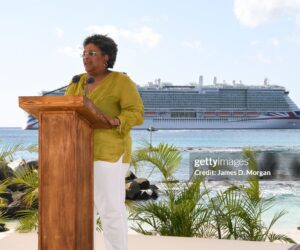
Today, Mia Mottley represents a new phase of Caribbean political influence. Under her leadership, Barbados transitioned to a republic, formally removing the British monarch as head of state. Beyond regional milestones, her advocacy on climate justice has positioned her as one of the most respected voices on the global stage. In international forums, she has spoken with urgency about the vulnerabilities of small island developing states, insisting that global financial systems account for historical inequities.
Together, these women illustrate a clear progression. Caribbean women are not merely participating in governance. They are shaping international policy conversations, redefining sovereignty, and expanding what political leadership looks like.
Social Justice and Diasporic Vision
Long before “intersectionality” became common language, Caribbean women were articulating the connections between race, gender, labor, and empire.
Amy Ashwood Garvey, co-founder of the Universal Negro Improvement Association, was instrumental in shaping early 20th-century Pan-African thought. While often overshadowed in popular history, she advocated for women’s leadership within global Black liberation movements and worked to ensure that women were not relegated to supportive roles.
Her activism traveled across continents, from the Caribbean to the United States and the United Kingdom. She understood that Caribbean identity was inseparable from the wider African diaspora.
Similarly, Claudia Jones carried Caribbean radical thought into international spaces. Born in Trinidad and later active in the United States and Britain, she confronted racism, economic inequality, and gender discrimination head-on. She argued that the liberation of Black communities required attention to the unique experiences of women.
Jones also founded what would become the Notting Hill Carnival in London, transforming Caribbean culture into a powerful symbol of resistance and pride in the diaspora. What began as community expression evolved into one of the largest cultural festivals in Europe.
Through activism and institution-building, these women reshaped not only political discourse but cultural memory. They demonstrated that Caribbean women were theorists, strategists, and movement architects.
Literature and Intellectual Authority
If politics shapes policy, literature shapes imagination. Caribbean women have long insisted on telling their own stories.
Maryse Condé confronted colonialism and its aftermath through novels that explored identity, displacement, and womanhood. Her work complicated romanticized images of the Caribbean, revealing the layered histories of slavery, migration, and resistance. In 2018, she received the New Academy Prize in Literature, an acknowledgment of her global literary impact.
Edwidge Danticat has similarly ensured that Haiti’s history and the experiences of Haitian women are preserved in global consciousness. Through fiction and essays, she addresses migration, memory, political violence, and resilience. Her work bridges homeland and diaspora, reminding readers that Caribbean narratives extend far beyond tourism brochures and simplified stereotypes.
These writers expanded intellectual space. They challenged dominant narratives written about the Caribbean and replaced them with narratives written from within it. In doing so, they reshaped how the world understands Caribbean history and womanhood.
Culture as Global Power
Cultural influence is one of the Caribbean’s most visible contributions to the world. And women have been central to that influence.
Rihanna emerged from Barbados to become one of the most recognized entertainers and entrepreneurs in the world. Beyond music, her business ventures in beauty and fashion disrupted industries long criticized for limited representation. When she was declared a National Hero of Barbados, it symbolized more than celebrity recognition. It marked the elevation of cultural entrepreneurship as national pride.
Before and alongside contemporary icons, artists like Celia Cruz carried Afro-Caribbean music onto international stages. Known as the “Queen of Salsa,” her voice became synonymous with joy, defiance, and cultural affirmation. Through performance, she preserved and amplified Afro-Caribbean identity across borders.
Culture, in this context, is not entertainment alone. It is diplomacy. It is economic power. It is narrative control.
Caribbean women have used it to shift perceptions and claim space in industries that once excluded them.
More Than a List
It is important to say clearly: this is not an exhaustive roster. For every internationally recognized figure, there are countless Caribbean women shaping academia, grassroots activism, public health, environmental policy, education, and community development.
Women’s History Month offers an opportunity to widen the lens. To move beyond token recognition and toward deeper acknowledgment of sustained impact.
The Caribbean’s history is one of colonization and resistance, migration and reinvention. Within that history, women have always been central. They organized communities during independence struggles. They preserved language and culture under colonial rule. They built businesses, led classrooms, and carried families across borders in search of opportunity.
The 21st century did not create Caribbean women leaders. It revealed them to a wider audience.
Why This Moment Matters
Beginning Women’s History Month by honoring Caribbean women is not about regional pride alone. It is about correcting perspective.
Global history often flows through powerful nations and dominant narratives. Yet many of the ideas shaping today’s conversations about climate justice, diasporic identity, intersectional activism, cultural entrepreneurship, and post-colonial sovereignty have deep Caribbean roots.
The women highlighted here did not wait for permission to lead. They entered political chambers, literary circles, protest movements, and global industries with clarity about who they were and what they represented.
They shifted the image of the Caribbean woman from background figure to global force.
As this month unfolds, there will be space to explore their stories individually and to highlight many others whose work deserves equal attention. But at the outset, the message is simple.
Caribbean women have shaped the modern world.
Women’s History Month gives us language to celebrate that truth. The Caribbean gives us generations of women who made it undeniable.
Support NewsAmericas

Related News
Trump Confuses Bahamas And Bermuda At White House Black History Month Event
Here’s What Marco Rubio Offered CARICOM Leaders At St. Kitts Summit

Antigua’s Sir ‘Red’ Robin: Fifty Years of Leadership, Vision And Unmistakable Trust