

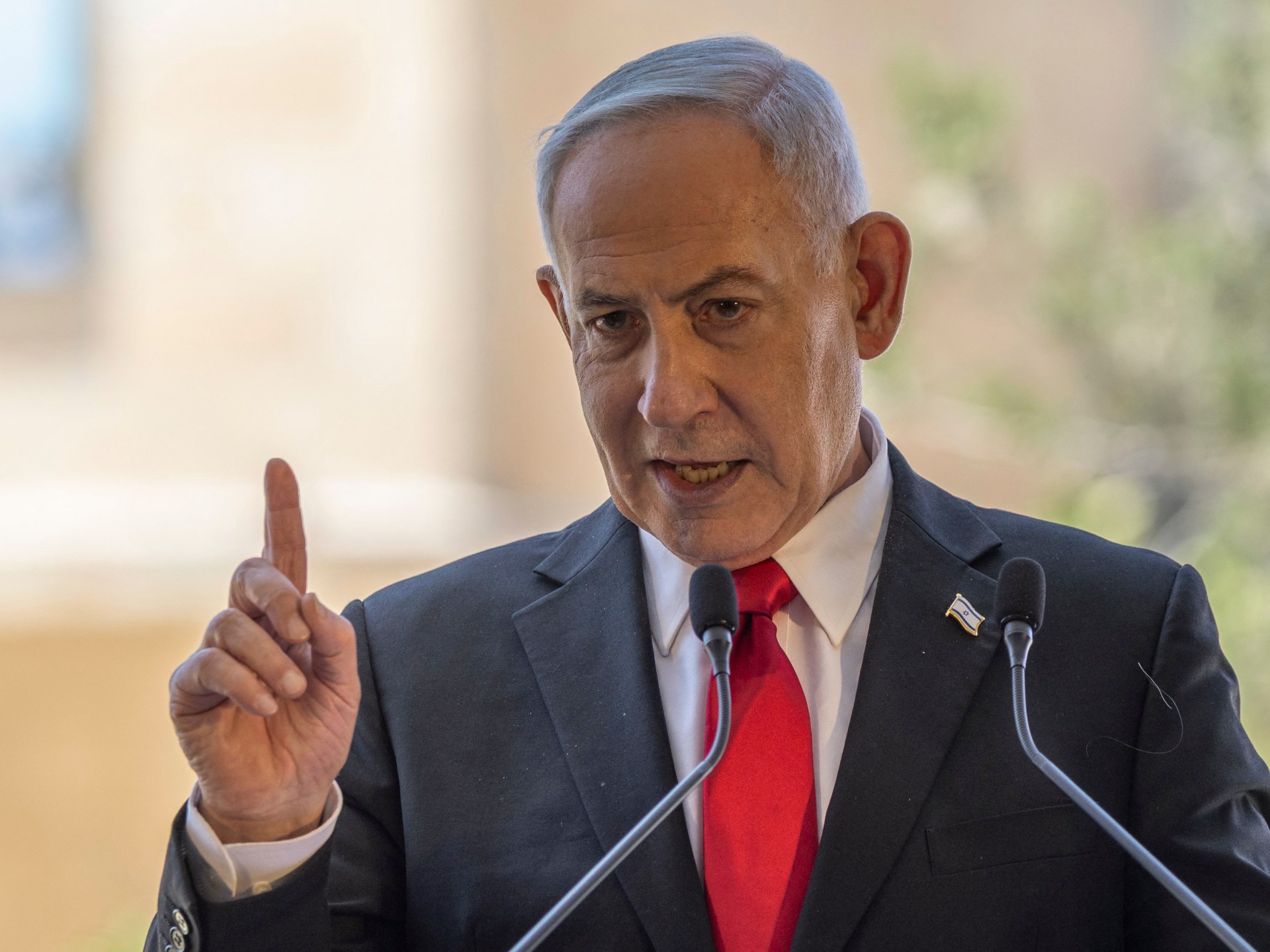

Israeli Prime Minister Benjamin Netanyahu’s rejection of a United States-led roadmap for Gaza has raised urgent questions about the fragile peace process and the prolonging of suffering for more than two million Palestinians in the territory.
The US-brokered 15-point plan mandates that Hamas would disarm in exchange for a phased Israeli military withdrawal and the transition of governance to a technocratic Palestinian committee backed by an international security force.
Since US President Donald Trump announced his peace plan for Gaza last year, Israel has continued near-daily deadly attacks in violation of a “ceasefire” deal. Rather than deploying its forces, it now maintains military control of more than 70 percent of the Strip. And on Sunday, just weeks before Israel’s crucial elections, Netanyahu effectively paralysed the diplomatic process by insisting that Israeli troops will not withdraw until Hamas is “genuinely disarmed”.
In Gaza, Netanyahu’s declaration sent shockwaves, extinguishing recent optimism and raising the prospect of intense attacks.
“There is a form of fear, unfortunately, because the matter is linked to Netanyahu possibly undertaking steps to return to assassination operations, bombing operations and targeting operations near the yellow areas,” said Gaza-based political analyst Eyad al-Qarra, referring to the unilaterally imposed “Yellow Line”, the effective Israeli buffer zone squeezing Palestinians into smaller areas.
The Gaza Government Media Office echoed the grim outlook, viewing the rejection as a deliberate tactic to continue the war.
Advertisement
“These positions represent a clear and explicit coup against the negotiation path and its outcomes, deliberately obstruct the path to calm, and greatly reinforce the state of humanitarian deterioration,” it said in a statement.
The office added that Netanyahu’s statement proves Israel “takes the negotiation path as a false political cover to buy time, pass its destructive projects, and continue the war of genocide against defenceless civilians.”
The rejection places the US-brokered ceasefire on the brink of total collapse.
Following Netanyahu’s statement, Hamas affirmed its commitment to the diplomatic process under the US-led Board of Peace and International Stabilization Force while demanding accountability.
“We call on the mediators, the guarantors, and the Board of Peace to assume their responsibilities, ensure the commitment of all parties to what was agreed upon, and prevent any breaches or violations that would disrupt the implementation path or undermine the ceasefire agreement,” it said in a statement.
Al-Qarra warned that if mediators fail to pressure Israel, Palestinians might face “the worst option, which is announcing practically the end of these negotiations after Netanyahu’s rejection and coup against them”.
‘Red line’
As the implications for Gaza’s future become apparent, the diplomatic fallout has triggered a sharp regional backlash.
Egypt’s Foreign Minister, Badr Abdelatty, warned that the threat of forced displacement of Gaza’s population remains actively on the table.
“The so-called ‘voluntary displacement’ cannot be considered voluntary if they create conditions that make life inside the Strip impossible,” Abdelatty said in statements carried by Egyptian media, stressing that pushing the population to leave under such conditions is a “red line” for Egypt, Arab and Islamic countries.
Abdelatty emphasised that Egypt “will not accept and will not allow” displacement to occur, while also criticising the failure to implement the first phase of the agreement, including achieving the minimum target of 600 aid trucks entering Gaza daily.
Pretext for chaos
Political analysts argue that Netanyahu’s demand for full disarmament prior to any withdrawal is not a genuine security requirement, but an intentional mechanism to block the agreement’s implementation.
Mahjoob Zweiri, an academic and expert in Middle East politics, noted that Netanyahu is fundamentally driven by a desire to prevent any return to a functional Palestinian society.
“He does not want Gaza to be as it was on the sixth of October 2023. Meaning: no rule for Hamas, no rule for the Palestinians, no weapons, no normal life. In other words, transforming Gaza into an area unfit for life,” said Zweiri.
Advertisement
He also pointed out that setting complete disarmament as an absolute prerequisite is an impossible condition by design.
“Israel knows deeply that the issue of ending weapons in an environment like the environment of Gaza or even Lebanon is almost an impossible matter,” he said, citing the lack of a weapons database and the absence of a trusted neutral party.
Zweiri also warned of potential US reaction, predicting “an expected diplomatic storm” and “a kind of diplomatic clash” between Netanyahu and Trump.
For Israeli affairs expert Nihad Abu Ghosh, Israel’s sudden pivot reveals its underlying strategic priorities regarding Gaza’s future.
Abu Ghosh argued that Israeli officials were fully aware of the plan’s details but gambled that it would be rejected by Hamas.
“The fundamental issue is that Israel does not want to give up the option of displacement,” he said. “And everything going on from partial objections on this issue or that is in truth an Israeli adherence to the displacement of the Gaza Strip and the displacement of the population.”
He added that Netanyahu wants to make his refusal “a restriction on any future Israeli government.”
Political survival
Analysts also said the timing of Netanyahu’s rejection is deeply tied to his domestic political survival ahead of the October elections. The leader of the Likud party faces multiple corruption charges dating back to 2019 – and could potentially end up in prison if found guilty.
“Netanyahu was waiting for this opportunity to say a big ‘no’ of this size to President Trump in order to control the debate, the propaganda and the election campaign with it,” said Israeli affairs expert Adel Sheded.
He argued that Netanyahu wants to prove to the Israeli public that he is the only one capable of saying no to the US administration.
Similarly, expert Suleiman Bisharat said the Israeli PM is leveraging Gaza to exert pressure on the US regarding broader regional topics.
“It is very clear that Benjamin Netanyahu wanted to flip the table in all files, starting from the file related to the Gaza Strip, on the basis that it is the file that establishes the rest of the files,” he said, noting that this challenge stems from his desire to appear as a hero to the right-wing Israeli public in a bid to secure his political future.
Related News

Trump announces ‘biggest oil deal in world history’ with Venezuela

US judge repeats block on Trump’s bid to limit voting by mail
US hits multiple targets in Iran as IRGC pledges retaliation: What we know