

India has arrested six Ukrainian nationals and an American citizen for allegedly entering India’s northeast region without permits and crossing to neighbouring Myanmar to train armed groups in drone warfare.
The foreign nationals were arrested by Indian police on March 13 at three different airports across the country. According to Indian media reports, the US national was detained by the Bureau of Immigration at Kolkata airport, three Ukrainians were detained in Lucknow and three more in Delhi. It is not clear if they were on their way to Myanmar or returning from the country.
- list 1 of 3‘Inch by inch’: Myanmar rebels close in on key military base in Chin State
- list 2 of 3Dozens killed in India’s northeast after rains trigger floods, landslides
- list 3 of 3‘Everyone feels unsafe’: Border panic as Indian forces kill Myanmar rebels
end of list
India’s main counterterrorism body, the National Investigation Agency (NIA), has charged them with violating the country’s anti-terror laws, and they will be held in custody until March 27.
Local police also arrested two more American tourists on Saturday for flying drones near Coast Guard headquarters in the southern city of Kochi – where India is harbouring sailors from an Iranian ship that it hosted in military exercises in February. Another Iranian ship that India had hosted was torpedoed by the US early in the war, embarrassing New Delhi and killing dozens of Iranian sailors.
Why have these Americans and Ukrainians been arrested? What does this mean for India’s relations with Myanmar, Ukraine and the US?
Here’s what we know:
Who has been arrested?
According to Indian media reports, the seven foreign nationals arrested by the NIA have been identified as Matthew Aaron VanDyke from the US, and Hurba Petro, Slyviak Taras, Ivan Sukmanovskyi, Stefankiv Marian, Honcharuk Maksim and Kaminskyi Viktor, who are all Ukrainian citizens.
Advertisement
According to VanDyke’s personal website, he participated in the Iraq war and Libya’s civil war. He is the founder of a Washington, DC-based consulting firm called Sons of Liberty International. The organisation’s website says it “provides free security consulting and training services to vulnerable populations to enable them to defend themselves against terrorist and insurgent groups”. The company also ran operations in Ukraine between 2022 and 2023, where it provided training and advice to Ukraine’s military in using non-lethal equipment.
Not much is known about the Ukrainian citizens who have been arrested.
The NIA did not specify when the foreign nationals entered India nor when they crossed into Myanmar.
The two American tourists arrested in Kochi have been identified as 32-year-old Katie Michelle Phelps and 35-year-old Christopher Ross Harvey, both from California.
Why has India arrested the suspects in the Myanmar case?
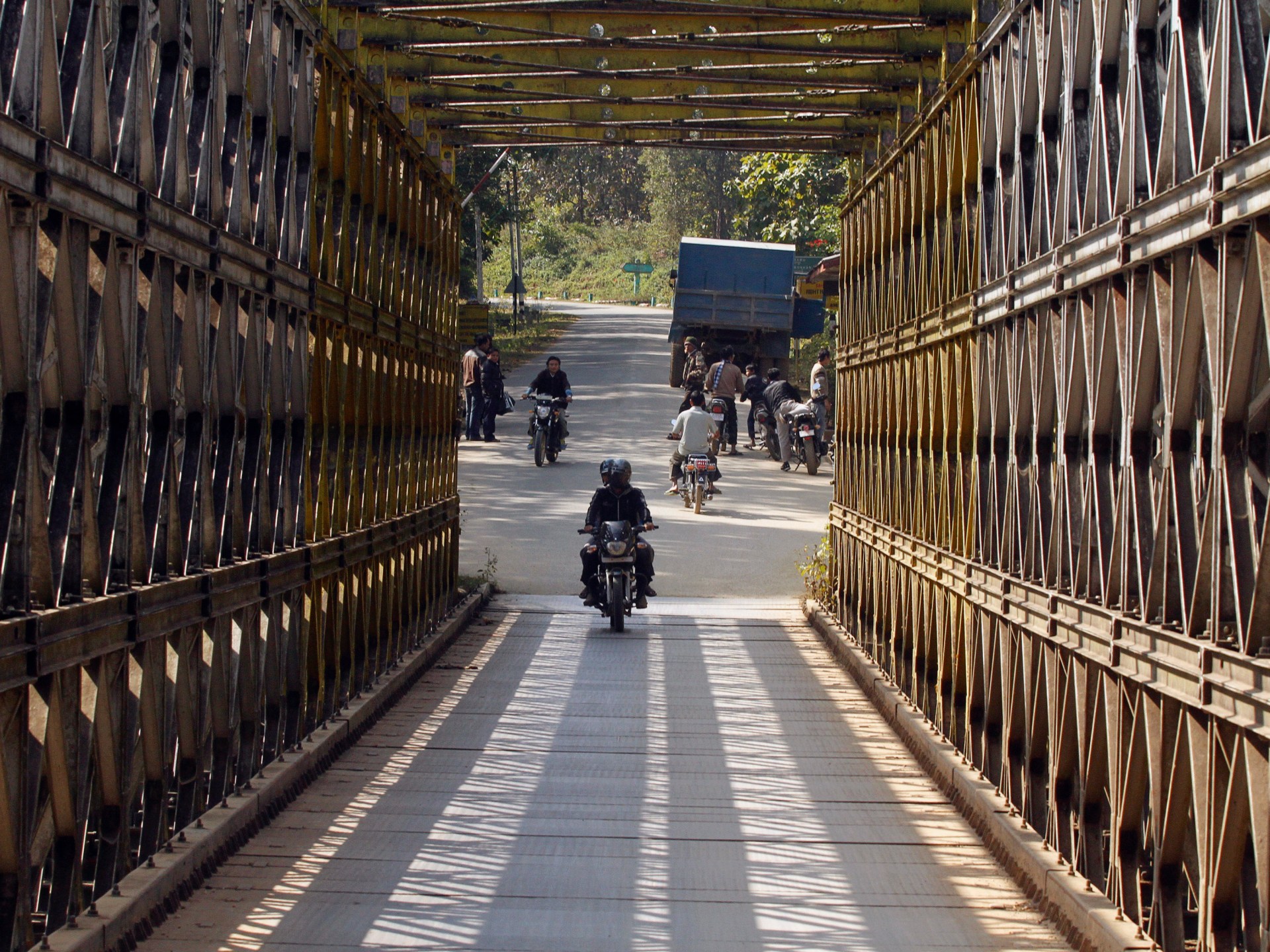
The seven men were initially detained by the NIA for entering India’s northeastern state of Mizoram without valid permits and then illegally crossing into Myanmar.
This is not the first time foreign nationals have been arrested by India for entering northeastern states bordering the subcontinent’s approximately 1,640km (1,020-mile) border with Myanmar. In April 2025, a Belgian photojournalist was arrested by police in Mizoram for allegedly entering the state without valid travel documents and then crossing into Myanmar.
On March 16, the NIA told a court in New Delhi that the seven foreign nationals had crossed to Myanmar to train armed groups fighting the military government in drone warfare.
According to The Indian Express daily newspaper, the NIA said the accused were involved in illegally “importing huge consignments of drones from Europe to Myanmar via India” for the use of “ethnic armed groups”. The agency added that these groups also allegedly supported “Indian insurgent groups” by supplying weapons and training them in “terrorist” activities.
India’s northeastern states like Mizoram and Manipur, which border Chin state in northern Myanmar, have a troubled history marred with ethnic tensions. Ethnic groups from the states, like Manipur’s Kuki National Army (KNA), also operate in Myanmar and have been actively fighting against the military government.
India, therefore, requires foreigners to obtain special permits before entering some northeastern states bordering Myanmar, particularly since the 2021 military coup there.
Angshuman Choudhury, a researcher and writer who specialises in political and security issues in the India-Myanmar borderland, told Al Jazeera that the Indian government views the India-Myanmar border as a major vulnerability, especially because it remains unfenced.
Advertisement
“Technically, anyone crossing the border without a valid visa or permit under the Free Movement Regime (FMR) is liable for prosecution. The surveillance tends to be higher when it concerns foreign journalists,” he said.
Foreigners who cross over into Myanmar from India to report on the conflict or support resistance forces there are not, in themselves, viewed as security concerns for India, he explained. “These forces have little to do with India and are fighting their own war against the Myanmar military government.
“But the Indian state still views their act of using Indian territory to cross into resistance-held territory as a violation of its own sovereignty and a security risk. This threat perception is aggravated by concerns that their support for Myanmar’s resistance forces may indirectly strengthen anti-India insurgents, although evidence for that remains sparse,” Choudhury added.
Why is Ukraine involved in this?
In recent years, Ukraine has deepened its ties with India but has also been accused by rights groups of supporting Myanmar’s military government. The six Ukrainians, by contrast, have been arrested for allegedly providing support to armed groups resisting the government.
In September 2021, months after the military coup, Justice For Myanmar, a group focusing on human rights violations in the country, accused Ukraine of supporting Myanmar’s military with arms exports and technology transfers.
But in a statement on March 19, Ukraine firmly rejected “any insinuations regarding the possible involvement of the Ukrainian State in supporting terrorist activities” and also asked India to release its nationals.
A statement from Ukraine’s Ministry of Foreign Affairs said: “Ukraine is a state that faces the consequences of Russian terror on a daily basis and, for this very reason, takes a principled and uncompromising stance in combating terrorism in all its forms.
“We also emphasise that Ukraine has no interest in any activity that could pose a threat to the security of India … Instead, it is Russia, as an aggressor state, that seeks under every circumstance to drive a wedge between friendly countries – Ukraine and India,” the Foreign Ministry added.
Media reports have suggested that Russia could have been involved in the arrests.
NIA officials told Germany’s international broadcaster DW News that it was possible that Russian authorities had shared intelligence about the foreign nationals’ movements.
Choudhury told Al Jazeera that this would be logical, given Russia’s growing ties with the military government in Myanmar.
“From Moscow’s vantage point, exposing the presence of Ukrainian drone experts in the India-Myanmar borderland also reaffirms the Russian view that Kyiv is contributing to the destabilisation of unstable regions across the world. This may turn global opinion against Ukraine and its Western allies like the US,” he said.
Russia’s Ministry of Foreign Affairs spokesperson Maria Zakharova accused Ukraine of trying “to conceal the incident and to keep its citizens’ questionable activities, which were clearly designed to destabilise the situation in the region, under wraps”.
Advertisement
In a statement on March 20, Zakharova said the incident clearly showed that “[Ukrainian President Volodymyr Zelenskyy’s neo-Nazi regime has a core exporter of instability worldwide.”
Meanwhile, the US has not yet commented on its citizen’s arrest.
A US Embassy spokesperson told the Reuters news agency that the country’s embassy in India was aware of the arrest but could not comment on the case “for privacy reasons”.
Why were the American tourists in Kochi arrested?
Kochi, in the southern Indian state of Kerala, is home to sensitive Indian Navy and Coast Guard facilities.
The headquarters near which the American tourists were allegedly flying drones falls within what authorities describe as a red zone: drone activity is strictly forbidden there.
But the arrests also come at a time when Kochi is hosting more than 180 crew members of the Iranian warship IRIS Lavan, which was given emergency docking permission in early March after the US-Israeli war on Iran began.
The IRIS Dena, another Iranian warship, was attacked by a US submarine in the Indian Ocean, just off Sri Lanka, at the start of the war while it was returning home from naval exercises hosted by India. IRIS Lavan was also a part of those exercises.
What do the arrests mean for Indian relations with the US, Ukraine and Myanmar?
Choudhury said the arrests could serve to strengthen trust between New Delhi and the Myanmar government in Naypyidaw, given the growing military challenge that the latter is facing from resistance forces along the border.
He said in the short term, the arrests could “adversely affect the India-Ukraine relationship”, however.
“Although I believe both sides will rely on backdoor channels to manage this issue – especially since Ukraine can’t afford to alienate India at this juncture,” he said.
Choudhury said the incident would not severely affect relations between India and the US, as Matthew VanDyke’s relationship with the current US administration is not clear.
“Washington, DC might not consider him an important enough figure to damage its bilateral relationship with New Delhi, which is already strained but appears to be steadily returning to normalcy,” he said.
Related News
Iran war live: Israel says it has killed commander of IRGC’s Basij forces
Oil prices surge after Israeli strike on Iran’s South Pars gasfield
Drone sparks fire at UAE oil site as Gulf takes more hits amid Iran war