

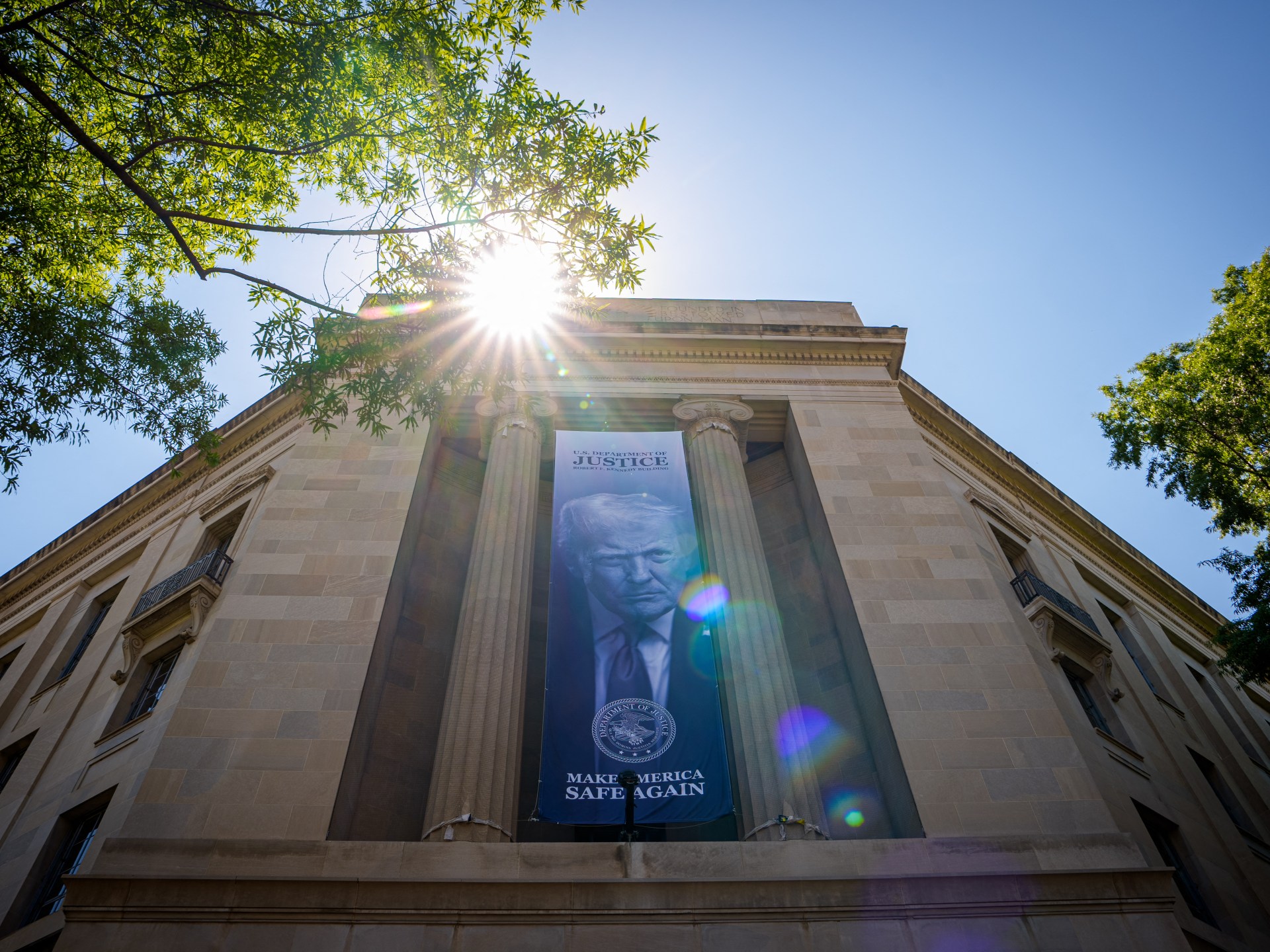

Two police officers in Washington, DC, have sued the administration of President Donald Trump over its decision to establish a $1.776bn fund to compensate victims of alleged government “weaponisation”.
In their lawsuit, filed on Wednesday, officers Harry Dunn and Daniel Hodges call the fund “the most brazen act of presidential corruption this century”.
- list 1 of 3US President Trump, family granted immunity from pending tax audits
- list 2 of 3Trump administration pledges $1.8bn in additional humanitarian aid to UN
- list 3 of 3Trump drops IRS lawsuit, sets up $1.7bn US anti-weaponisation fund
end of list
They are aiming to have the fund dissolved in order to prevent taxpayer money from being disbursed to participants in the attack against the United States Capitol on January 6, 2021.
On that day, thousands of Trump supporters descended on Congress in an apparent effort to prevent the certification of the 2020 presidential election, which Trump lost.
“If allowed to begin making payments, the Fund will directly finance the violent operations of rioters, paramilitaries, and their supporters who threatened Plaintiffs’ lives that day, and continue to do so,” the lawsuit argues.
Both Dunn and Hodges have said they were injured during the attack. Dunn, a member of the US Capitol Police, has since retired.
Hodges, who remains with the Metropolitan Police Department, recalled in the lawsuit being “nearly crushed by rioters” against a Capitol door. Another officer heard protesters threaten to “kill him with his own gun”. The officers feared they would not escape the attack alive.
Their lawsuit argues that Trump has signalled he would like to compensate the January 6 rioters, saying they were “treated unfairly” by the justice system.
The newly created fund, it argues, would allow him to do so with little oversight.
Advertisement
Already, on the first day of his second term, Trump issued a blanket pardon to nearly all the participants in the attack, and he commuted the sentences of 14 others.
According to their complaint, both Dunn and Hodges continue to be the subject of violent threats and harassment as a result of their defence of the Capitol. Compensating their attackers, the two men claim, will encourage further violence.
“The Fund’s mere existence sends a clear and chilling message: those who enact violence in President Trump’s name will not just avoid punishment, they will be rewarded with riches,” the lawsuit says.
“That message, by itself, substantially increases the already sizeable risk of vigilante violence Dunn and Hodges face on a near-daily basis. And it encourages those who are harassing Dunn and Hodges, and sending them death threats, to up the ante.”
A deal to end a controversial suit
The Trump administration has so far refused to rule out paying January 6 participants from the “anti-weaponisation” fund.
That pool of money was set up this week as part of a settlement between Trump and the Justice Department, which falls under his leadership.
In January, Trump had announced that he was suing the Internal Revenue Service (IRS), which also falls under his executive control, over the leak of his tax returns to media organisations like The New York Times and ProPublica.
Alleging harm to himself, his adult sons and his business interests, Trump sought $10bn in damages. Critics, however, quickly pointed out that the lawsuit constitutes a conflict of interest for the sitting president, who holds significant sway over both the IRS and the Justice Department.
Even the judge assigned to the case, Kathleen Williams, appeared sceptical that the two sides were “sufficiently adverse”, noting that the defendants were “subject to his direction”.
There were also serious questions about whether Trump had filed his lawsuit within the statute of limitations, and whether the leak — which was committed by a government contractor, Charles Littlejohn — was truly the responsibility of the IRS.
But Trump’s lawsuit never made it to trial. The case was closed after the settlement was announced on Monday.
As part of the settlement, the Trump administration directed the Justice Department to draw $1.776bn from the Judgement Fund, which is used to settle lawsuits against the government.
That sum was then put aside as an “anti-weaponisation” fund, a pot of money seemingly predicated on Trump’s assertion that he and his supporters are entitled to compensation for unfair treatment under previous administrations.
Advertisement
The settlement (PDF) stipulates that the US government has “no liability whatsoever for the protection or safeguarding of those funds” from fraud.
It also explains that the fund will be managed by five people, appointed by the attorney general and subject to the president’s removal.
On Tuesday, an addendum (PDF) was published to the settlement, forever discharging Trump and his family from legal claims related to his tax returns.
Contesting the settlement
The lawsuit brought by Dunn and Hodges is expected to be one of several legal challenges contesting the settlement’s terms.
Already, there has been widespread outcry, particularly among Democrats, over allegations of self-dealing.
In their complaint, Hodges and Dunn allege that the “anti-weaponisation” fund’s “extraordinary sum” has “no plausible basis in the strength” of Trump’s claims. They also argue the lawsuit against the IRS should never have been brought.
“That lawsuit was frivolous,” they say in their complaint. “Because Trump, as the sitting President, was both the plaintiff and in direct control of all defendants, Trump v IRS lacked adversity.”
“Trump all but conceded the lack of adversity,” the complaint added. “Earlier this year, he described the case as requiring him to ‘work out a settlement with myself’.”
Ultimately, Dunn and Hodges said they fear the anti-weaponisation fund will amount to “the public financing of paramilitary organizations in the United States”, if it is not promptly dissolved.
Their lawsuit has been filed in the US court for the District of Columbia.
Related News
Thailand’s Thaksin Shinawatra released from prison
Pakistan’s mediation faces limits as Iran-US tensions deepen
Chris Rabb win in Pennsylvania energises Democrat’s progressive flank