
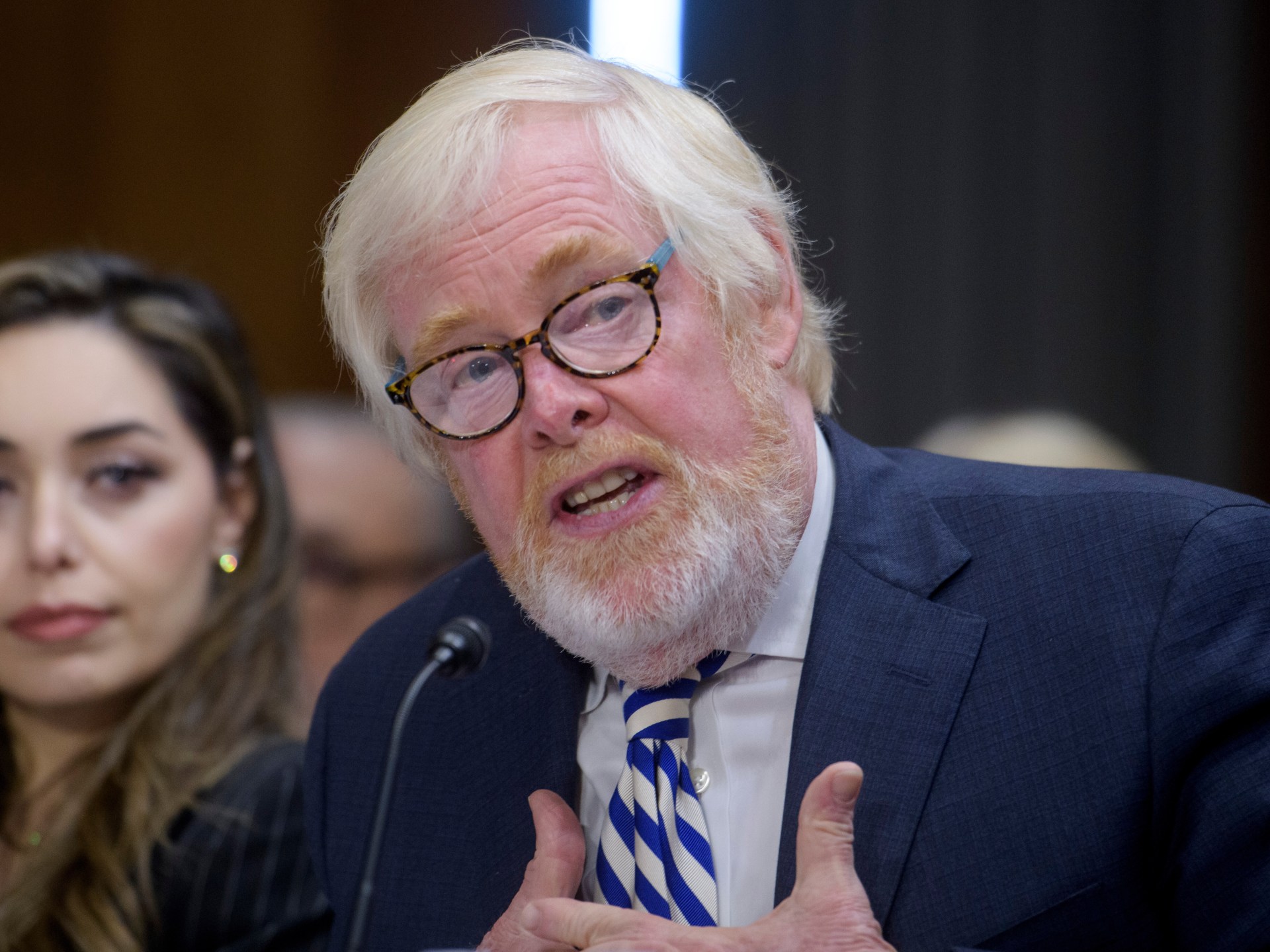

South Africa’s government has summoned the United States ambassador to the country to discuss his “undiplomatic remarks”, a sign of the deepening rift between Pretoria and Washington.
Foreign Minister Ronald Lamola announced that Ambassador Leo Brent Bozell III had been summoned Wednesday, following a series of comments from the envoy, who took his post last month.
- list 1 of 3White House accuses South Africa of harassing US gov’t staff in latest row
- list 2 of 3Trump is the ‘elephant in the room’ as the African Union holds new summit
- list 3 of 3South Africa: A year after USAID cuts
end of list
“We have called in the ambassador of the United States, Ambassador Bozell, to explain his undiplomatic remarks,” Lamola said.
The summons comes as the administration of US President Donald Trump continues to heap pressure on South African President Cyril Ramaphosa and his government, based on claims that white Afrikaners face persecution in the country.
Last year, the Trump administration imposed a blanket 30 percent tariffs on South Africa, though a court decision recently rendered that rate defunct.
The US also extended refugee status to white Afrikaners, based on claims they faced “illegal or unjust discrimination”, even as it halted resettlements of nearly every other refugee group.
South Africa’s government leaders, including top Afrikaner officials, have acknowledged that crime remains high in the country, but they have rejected that notion that white Afrikaners are being specifically targeted. They have noted that Black residents face a higher crime rate.
The tensions came to a head last year when Trump confronted Ramaphosa during an Oval Office meeting in May, presenting images and videos he claimed were evidence of efforts to violently persecute white Afrikaners.
Advertisement
Several subsequent analyses found the images were misrepresented, in some cases depicting violence in other countries.
Claims of ‘hate speech’
A conservative media advocate, Bozell has been a longtime ally of Trump. In late February, he took up his role as ambassador to South Africa.
But he recently came under fire for comments denouncing what he called “hate speech”, as well as remarks critical of the country’s post-apartheid policies.
Speaking to a meeting of business leaders on Tuesday, his first public appearance as ambassador, Bozell addressed an apartheid-era chant: “Kill the Boer, kill the farmer.”
The chant has been disowned by many leaders of the anti-apartheid movement and remains controversial in South Africa. However, the country’s courts have ruled that the chant does not constitute “hate speech” and should be viewed in the context of the struggle against white-minority rule that ended in 1994.
“I’m sorry, I don’t care what your courts say. It’s hate speech,” Bozell said on Tuesday.
Bozell appeared to backtrack on Wednesday, saying in a post on the social media platform X that his remarks reflected his “personal view”.
He added that “the US government respects the independence and findings of South Africa’s judiciary”.
Bozell also criticised policies meant to address apartheid-era employment disparities between white and Black South Africans. He compared the approach to apartheid-era policies that discriminated against Black citizens.
Foreign Minister Lamola, however, denied that analogy. “Broad-based Black economic empowerment is not reverse racism, as regrettably insinuated by the ambassador,” Lamola said.
“It is a fundamental instrument designed to address the structural imbalances of South Africa’s unique history. It is a constitutional imperative that the South African government can and will never abandon.”
Lamola added that Bozell “must not take us back to a polarised society along racial lines”.
Bozell’s appointment, in and of itself, has been viewed as ratcheting up tensions between the two countries.
Bozell founded the Media Research Center, which describes itself as a “media watchdog” that works to “expose and counter the leftist bias of the national news media”.
In 1990, when Nelson Mandela toured the US after being freed from prison amid his fight against apartheid, Bozell’s nonprofit criticised the media for having “never referred to Mandela as a saboteur or terrorist”.
Bozell was confronted with the statement during his Senate confirmation hearing in October. He replied that, at the time, Mandela had been “aligned with the Soviet Union”.
Advertisement
He added he now had the “most respect for” Mandela.
Bozell’s son, Leo Brent Bozell IV, was convicted and sentenced for his participation in the riot on January 6, 2021, at the US Capitol. He was subsequently among the 1,600 people pardoned by Trump last year.
Latest diplomatic spat
The summoning in South Africa was only the latest diplomatic spat for the Trump administration.
In February, France’s Ministry of Foreign Affairs summoned US Ambassador Charles Kushner, the father of Trump’s son-in-law Jared Kushner, after he said the killing of a far-right activist evidenced “violent radical extremism is on the rise”.
The elder Kushner was briefly barred from access to government officials after he failed to appear, although his access has since been restored.
That same month, another US ambassador, Bill White, was also summoned to speak with Belgium’s government after he accused officials of “anti-Semitism” for investigating whether ritual circumcisions were being performed in Antwerp without proper medical training.
Belgian’s foreign minister, Maxime Prevot, said White’s statements “violate basic diplomatic norms”.
Related News
Why are the US and Israel framing the ongoing conflict as a religious war?
Israel’s Smotrich threatens Beirut suburbs amid evacuation orders
Why have Europe, Australia sent military assets to the Middle East?