
Pakistan installs fishing nets at security outposts to block drone attacks
 05 October 2026
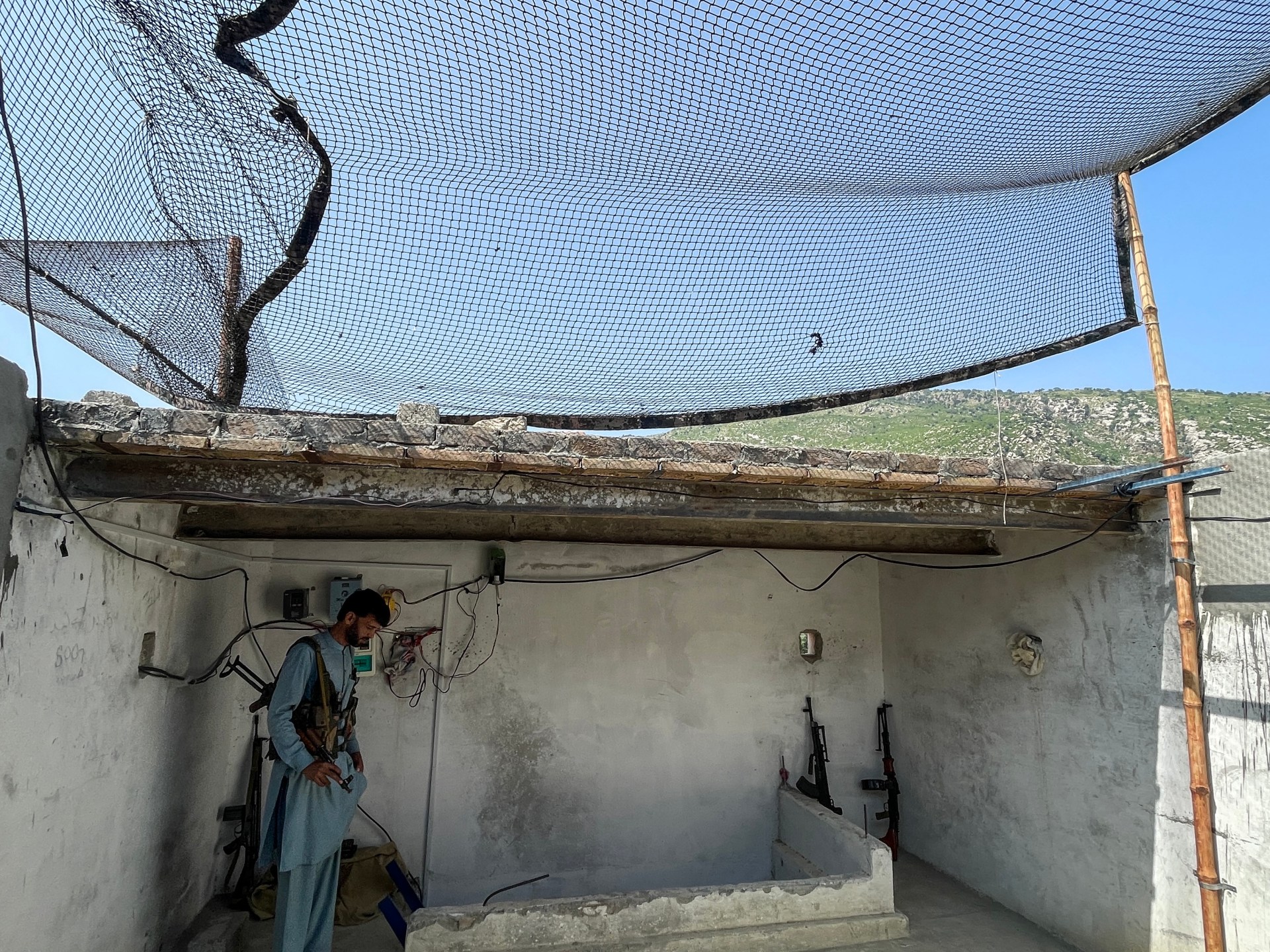

Hangu, Pakistan – Police officer Fayyaz Khan and his colleagues ducked for cover as drones carrying explosives rained them down on their checkpost in northwest Pakistan’s Khyber Pakhtunkhwa province this year.
The April 16 attack was claimed by Tehreek-e-Taliban Pakistan (TTP), commonly known as the Pakistan Taliban, and its fighters then opened fire from all sides of the Sarki Piyala police checkpost in Hangu district, about 30km (18 miles) from the border with Afghanistan and a hotbed of deadly attacks by armed groups, mainly the TTP.
- list 1 of 4Suicide bombing in Pakistan’s Dera Ismail Khan kills at least 12 people
- list 2 of 4Pakistan launches deadly air attacks on Afghanistan
- list 3 of 4Pro-Imran Khan mass rally launched after Pakistan government talks fail
- list 4 of 4Pakistan, India summon diplomats after two people killed in border incident
end of list
The confrontation lasted roughly seven hours, killed the driver of an armoured vehicle and injured a constable, Khan, a 40-year-old police inspector, recalled.
“There was a great deal of fear because we were in the middle of a battle. At that moment, we did not even know whether we would make it back home alive,” Khan told Al Jazeera.
To defend against such attacks, the police in Hangu came up with an unlikely, low-cost solution – fishing nets strung several metres overhead between the checkpost’s rooftops and perimeter walls, forming a kind of aerial ceiling.

Simple in construction and resembling what fishermen use for their work, the netting was first installed two months ago, according to the local police. Since then, Khan said, no drone attacks have taken place at Sarki Piyala.
“If a drone comes over the checkpoint, there is a possibility that it could get caught in the net and be defused or stopped,” he said as his colleagues, strapped into bullet-resistant vests and holding guns in their hands, kept watch beneath a canopy of black mesh patched together with rope and wire.
Advertisement
“Even if a drone does not get caught and explodes above the net, the damage is expected to be much less because most of the shrapnel and fragments would be dispersed in the air rather than falling directly onto the ground where the police personnel are positioned.”
A standard checkpost can be covered with such nets for about 400,000 Pakistani rupees ($1,435), Hangu district police officer Tariq Habib told Al Jazeera.
“The police have introduced the netting system at vulnerable police stations and checkposts to reduce the impact of drone and quadcopter attacks,” Habib said, adding that more nets were being installed at police stations across the district.
He said the police in Hangu have asked for additional funding from the provincial government to expand the programme and their request is under review.
A spokesman for the Khyber Pakhtunkhwa police said the nets have been installed at checkpoints and police posts in at least five other vulnerable districts: Kohat, Karak, Bannu, Lakki Marwat and Dera Ismail Khan. Even military outposts at some sites in the province have deployed the antidrone netting system.

The fishing nets have been put up in response to a shift in the tactics of armed groups, which are pairing gunfire and mortars with drones and quadcopters.
Pakistan has seen an increase in armed attacks in recent years, mainly targeting the police and the military, with many of them claimed by the TTP, which says it is fighting for a Taliban-style, religious-driven government in Pakistan.
Pakistani officials have repeatedly accused Kabul’s Taliban government of providing the TTP a safe haven on its soil and have demanded that it prevent cross-border attacks into Pakistan. Kabul has denied the accusations and called the attacks Islamabad’s domestic security problem.
In Hangu, the deadliest of such attacks happened on July 29 when attackers stormed a police outpost with quadcopters rigged with bombs before launching a ground ambush, killing at least 11 police officers and wounding 28. Fifteen attackers were also killed in the hours-long assault, claimed by the TTP.
On September 20, another exchange of fire in Hangu killed six soldiers and eight attackers, according to the Pakistani army.
That attack came two days after another armed group, called Ittehad-ul-Mujahideen Pakistan, killed 23 people, including 16 police officers, and bombed a mosque in coordinated attacks in Khyber Pakhtunkhwa’s Kohat district.
Police said they have recorded at least 16 attacks in Hangu this year, making it one of the most sensitive districts in the province.
Advertisement
But police officer Zeeshan Khan said no drone or quadcopter attacks have occurred at Sarki Piyala and the nearby Baliamena checkposts since the fishing nets went up.
He said the nets provide “an extra layer of security” to police personnel.
“If an attack does take place, the arrangements we have made can reduce the potential damage,” he said, estimating that the measures could reduce potential losses by 40 to 50 percent.
The frequent armed attacks have reshaped the daily lives of the people in Hangu who live near the police checkposts.
Mohammad Usama, a 28-year-old social activist in Baliamena, said the attacks often prompt families to pull children out of school.
“There is always a fear that a stray bullet or something else could hit our children, brothers, cousins,” Usama said.
“We just pray that Allah ends terrorism in our country so that we can live peacefully in our area, our children can continue their education and people can go to work without fear.”
Usama said since the fishing net was put up in his area, he has noticed a decline in ambushes.

But security experts said the strategy may offer a “false sense of security”.
“Deploying nets at particular locations is an immature, cheap ploy because police stations are not necessarily always the target,” Imtiaz Gul, executive director of the Islamabad-based Centre for Research and Security Studies, told Al Jazeera.
“The drones are intended to hit prominent locations and generate dramatic optics.”
He said the more pressing question was whether Pakistani security institutions have the capacity to intercept drones as soon as they take to the air.
“Drones are a source of scare and terror, and they can generate this intended spectacle whenever they are able to hit a strategic, important public location,” he said.
Fida Adeel, a Peshawar-based analyst specialising in counterterrorism and security, said the fishing nets are not a new concept. He traced them to camouflage nets used by the military to conceal their equipment. More recently, he said, they were adapted in Ukraine as a way to intercept Russian drones.
Adeel cautioned that the effectiveness of a fishing net against explosive-laden drones depends on its design and deployment. He also questioned whether the police estimates of “40 to 50 percent protection” could be verified without real-world trials.
“The extent of protection can only be determined through proper testing,” he said.
In response, Abdul Salam Khalid, a spokesman for the Khyber Pakhtunkhwa police, told Al Jazeera they conducted a formal trial of the netting system in Kohat. He said an explosive was dropped on one of the nets during the trial, but it did not explode.
Back in Hangu, police inspector Khan said he knows that having fishing nets over his head is no foolproof solution. For him and his colleagues, he said, the nets offer some reassurance, even if they cannot eliminate the risks they face while on duty.
Advertisement
“We cannot say that the netting system provides complete protection,” Khan said.
“We remain prepared for an attack. … If defending our country and our people requires us to make the ultimate sacrifice, we will not hesitate. and we will not step back from our duty.”
This article is published in collaboration with Egab.
Related News

Carney and Erdogan launch ‘strong and resilient’ Canada-Turkiye partnership
Ben-Gvir joins hundreds of Israelis to storm Al-Aqsa Mosque compound

US orders departure of personnel from Saudi Arabia, citing Houthi threat