
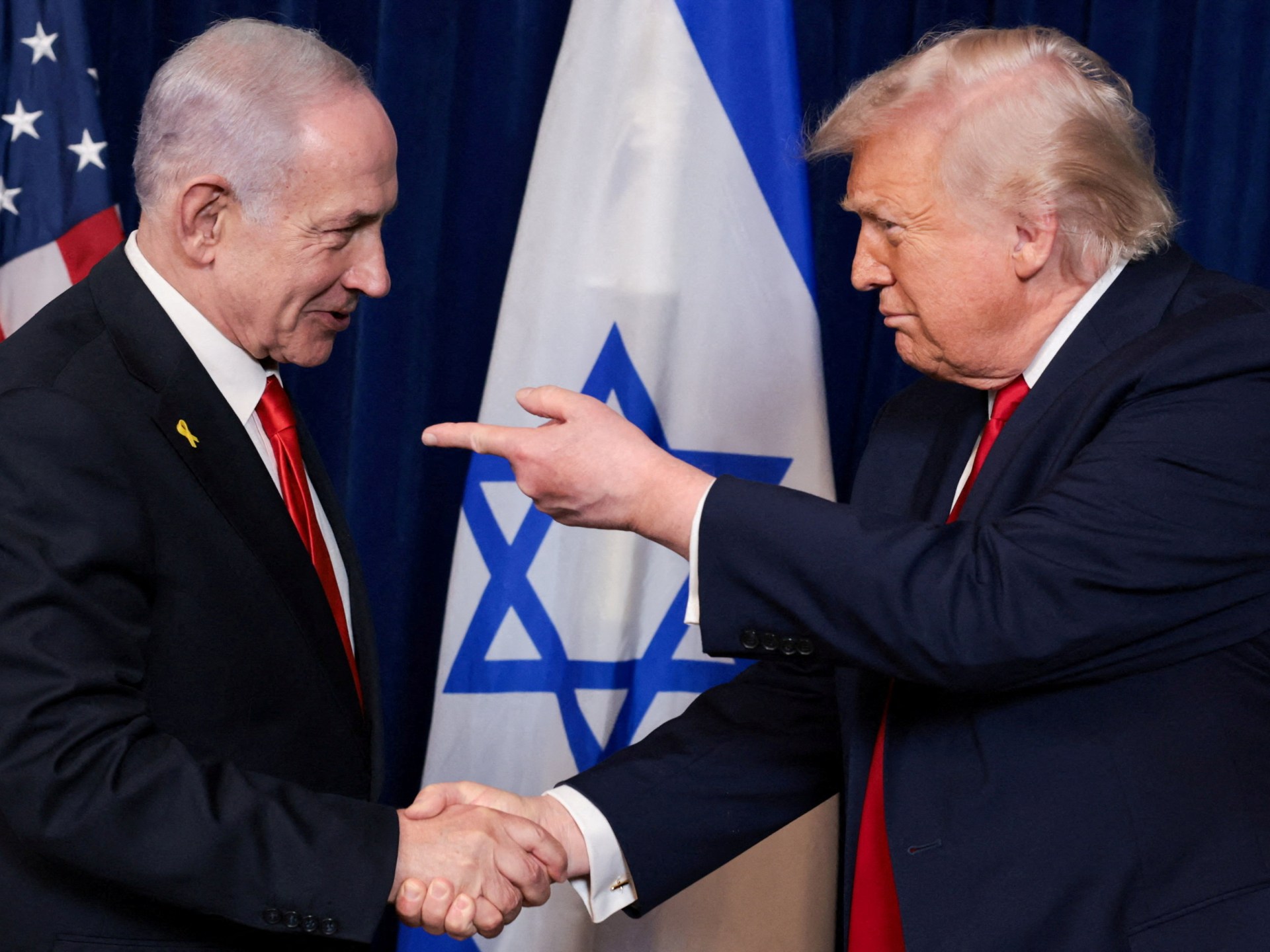

US President Donald Trump and his Republican party’s resounding midterm defeat has left many in Israel, particularly on the political right, grappling with the scale of the rebuke to those seen as their closest allies in Washington.
Prime Minister Benjamin Netanyahu has repeatedly sought to portray himself as almost uniquely qualified to maintain the unflinching support of Trump, who returned to the White House last year promising, among others, to not start “stupid foreign wars that never end”.
- list 1 of 4‘Seismic shift’: World reacts to US midterm election results
- list 2 of 4Can Democrats stop Iran war, reverse Trump’s tariffs after midterms win?
- list 3 of 4Iran’s Khamenei warns Trump loss at polls won’t end US hostility
- list 4 of 4How big is the Republican midterms loss, and is there a silver lining?
end of list
Yet in late February, Trump joined Netanyahu in ordering a joint military campaign against Iran, prompting immediate Iranian retaliation and raising the spectre of an all-out regional war. With the prospect of renewed hostilities looming, both leaders exchanged effusive endorsements in the build-up to Tuesday’s US congressional election and Israel’s parliamentary vote last week, calling upon the other’s electorate to head to the polls to support their ally.
The moves, however, seem to have either backfired or missed the mark dramatically.
Netanyahu’s right-wing coalition finished the October 27 electoral race with just 53 seats, far shy of the 61 needed to form a government. Trump’s party, meanwhile, lost control of both the House of Representatives and the Senate to Democratic challengers who made sweeping inroads into traditionally Republican territory, including the strongholds of Texas and Kansas.
“Obviously, what we have witnessed is a historic political tsunami that amounts to a total repudiation of Trumpism, so it’s certainly broader than one issue,” Shibley Telhami, of the University of Maryland and director of the Critical Issues Poll, said of the US midterm results. “But foreign policy was central, especially the Iran war and US backing of Israel, as Americans tie these to pocketbook issues,” he added.
The US is Israel’s staunchest diplomatic and military backer. Over the years, it has repeatedly used its United Nations Security Council veto to block dozens of resolutions critical of Israel, including several motions calling for an end to the genocidal war against the Palestinians in the Gaza Strip.
Advertisement
At the same time, it has been providing Israel with at least $3.8bn in military aid annually, allowing it to acquire the cutting-edge US weaponry that has granted it military superiority across the region – assistance, however, that is carrying an increasingly high political cost.
Polling overseen by Telhami a week ago found that a majority of people in the US believed that Israel had influenced the Trump administration’s decision to instigate the costly and protracted war with Iran. The survey indicated that Washington’s close relationship with Tel Aviv had become more of a liability than an asset for many in the electorate, Telhami noted, “with most saying specifically Israel would be a factor in their vote. An even larger majority said the Iran war, which they tie to Israel, would impact their vote”.
While Trump acknowledged the Democrats’ midterm win, and reluctantly conceded that the war on Iran was partly to blame due to its impact on energy prices, Netanyahu has spent the days since his own electoral defeat questioning the results.
Over the past week, the Likud party leader has falsely accused foreign powers of illegally boosting the vote for Israel’s Arab-led parties and cited his victory among Jewish voters as the basis for a national government. In his most recent echo of Trump’s reaction to his own loss in the 2020 US presidential election, Netanyahu even threatened not to recognise the certification of the results.
But as Israel enters a period of coalition wrangling, its political establishment also has to grapple with the routing of its White House ally and its potential culpability in it.
On Wednesday, key opposition figure Yair Lapid said almost all of Netanyahu’s actions since the vote, including his call for the internal security service Shin Bet to investigate the leaders of the Arab parties, in conjunction with the US election results, had rendered the prime minister politically noxious.

With voting still ongoing on Tuesday, Trump said in a TV interview he had made a deal with Netanyahu that the US would no longer be providing funding of “$4bn a year” to Israel after the end of 2026. While details remain scarce, the timing prompted speculation that Trump’s comments were part of a bid to stave off public anger over his administration’s support for Israel and a time of mounting domestic economic pressure.
Advertisement
“There’s a degree of denial inside Israel as to the depth of the change that is taking place in the US,” former Israeli government adviser Daniel Levy told Al Jazeera, caveating that while Israel itself may not have been on the midterm ballot, the sense of the “tail wagging the dog” in how Netanyahu’s relationship with Trump was perceived, certainly was.
“Most palpable was, of course, the effect of the Iran war,” said Levy. “Part of that is the Israeli role in dragging a gullible president into another calamitous Middle East military adventure.”
The war also brought a sense of clarity to the US public over their country’s relationship with Israel and the electoral cost of launching further wars in the Middle East, he added.
That the US’s full-throated support for Israel may be shifting in the face of growing international isolation might as well be on the minds of Israel’s opposition leaders as they weigh their coalition options. Netanyahu may be reviled by some within the US Democratic Party, but his relationship with Trump could still give him the political space to foment a new push for escalating the war against Iran, the political consequences of which could even see him once more able to set the agenda, Levy suggested.
“Netanyahu’s hand will now be weaker in trying to achieve that, but it should not be dismissed altogether – certainly not with a wounded Trump at the helm,” he said.
For Alon Pinkas, a former Israeli ambassador and consul general in New York, the relationship between the US and Israel had reached “a real inflection point, the consequences of which I don’t think much of Israel has either the imagination or education to truly understand”.
Much will depend on the Iran war and Trump’s reaction to the dramatic rejection of him and his policy agenda at the polls, Pinkas said, which could see him either escalate the conflict or seek an agreement that might appease Congress.
Either way, the future ties between the US and Israel had fundamentally changed, he argued.
“Even with all the speculation that the ending of the $3.8bn grant was some kind of quid pro quo to satisfy the US public, there was still no mention of the access to the weaponry that’s part of that grant,” said Pinkas.
“The money, Israel could probably live without; the weaponry, it depends upon – but there was no mention of that,” he added. “There was no mention of any future strategic agreement. It’s all just in the air.”
Related News
France protests live: Macron to address nation after protests
‘Who will represent us?’ Palestinians react to election delay
World’s oldest shipwreck found off coast of Turkiye