

Mohaddeseh Fallahat remembers combing her children’s hair on the morning of February 28, then tying their shoes and lifting their backpacks onto their shoulders before kissing them goodbye.
“That morning was like any other,” Fallahat told a session of the United Nations Human Rights Council in Geneva via videolink on Friday. “There was no sign that this would be the last time.
- list 1 of 3Minab: When the world’s most precise missile chose a classroom
- list 2 of 3Map shows how 22 days of attacks have evolved in US-Israel war on Iran
- list 3 of 3US responsible for deadly attack on Iranian school: Amnesty International
end of list
“As they walked out the door, they simply said, ‘Mum, come pick us up after school.’ That simple sentence now repeats in my mind 1,000 times, and each time my heart burns with pain,” she said.
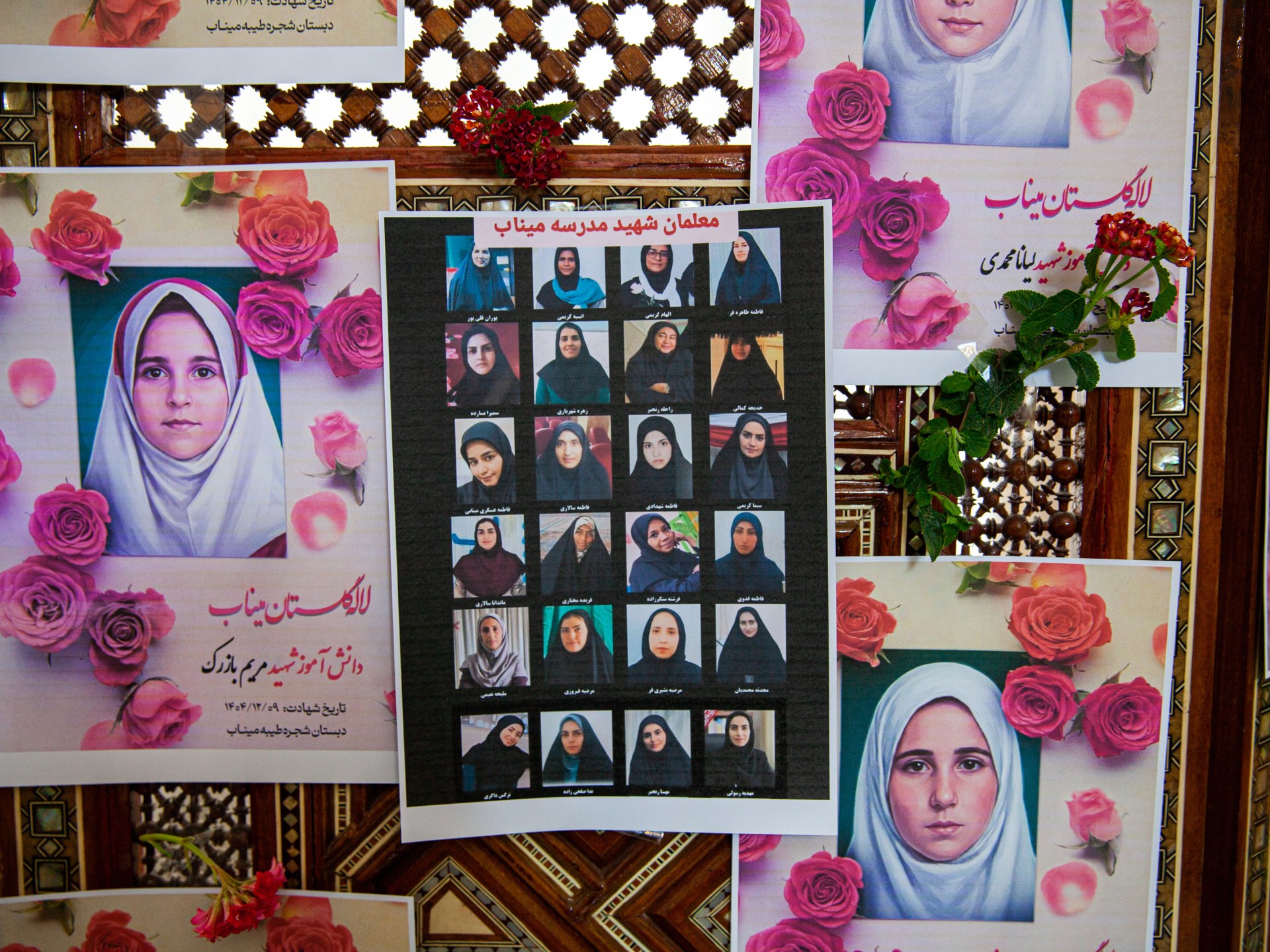
Her two children were among more than 170 people killed by United States Tomahawk missiles that hit the Shajareh Tayyebeh Girls’ School in Minab, southern Iran, during the opening hours of the US-Israeli assault. Most of the victims were schoolgirls.
Speaking to the UN’s top rights forum as it held an urgent debate on the crisis in the Middle East, Fallahat said: “No mother ever thinks she will send her child off to school with a smile, only to be met with silence. No mother is prepared to hear the words: ‘Your child is not coming back.’”
Iran’s Foreign Minister Abbas Araghchi told the council via videolink that the attack was no “miscalculation”.
“At a time when the American and Israeli aggressors, in their own assertion, possess the most advanced technologies and the highest precision military and data systems, no one can believe that the attack on the school was anything other than deliberate and intentional,” he said.
Advertisement
Araghchi said the victims were “slaughtered in cold blood”.
He claimed the US and Israel had “the audacity to commit the worst humanitarian crimes with impunity”, which is “the direct result of silence in the face of earlier manifestations of lawlessness and atrocities in occupied Palestine, Lebanon and elsewhere”.
The foreign minister called on UN member states to denounce the illegality of the “blatantly unjustified” war on Iran. “Indifference and silence in the face of injustices will bring no security and peace,” he added.
The UN special rapporteur on the right to education, Farida Shaheed, told the council that the school and other buildings in the compound were “each struck individually by precision munition, meaning that the US military clearly intended to strike the school”.
Ongoing investigations suggest the attack may have been the result of a mistake by the US military due to the use of outdated intelligence.
“If officially confirmed, this would mean that the principle of taking feasible precaution in attacks was most likely violated,” Shaheed said.
More than 600 schools and education facilities have been destroyed or severely damaged by US-Israeli attacks so far in Iran, while at least 230 children and teachers have been killed, according to her office.
“The killing of children can never, ever be justified,” she said.
UN Human Rights chief Volker Turk told the council that targeting schools constituted a grave violation of international law.
“Whatever differences countries have, we can all agree they will not be solved by killing schoolchildren,” he said.
Last year, the UN said Israeli attacks damaged 97 percent of Gaza’s education facilities.
Related News
Iran calls US proposal to end war ‘maximalist, unreasonable’
Trump administration to drop charges against US veteran who burned flag
EU urges members to start storing winter gas as Iran war causes price surge