

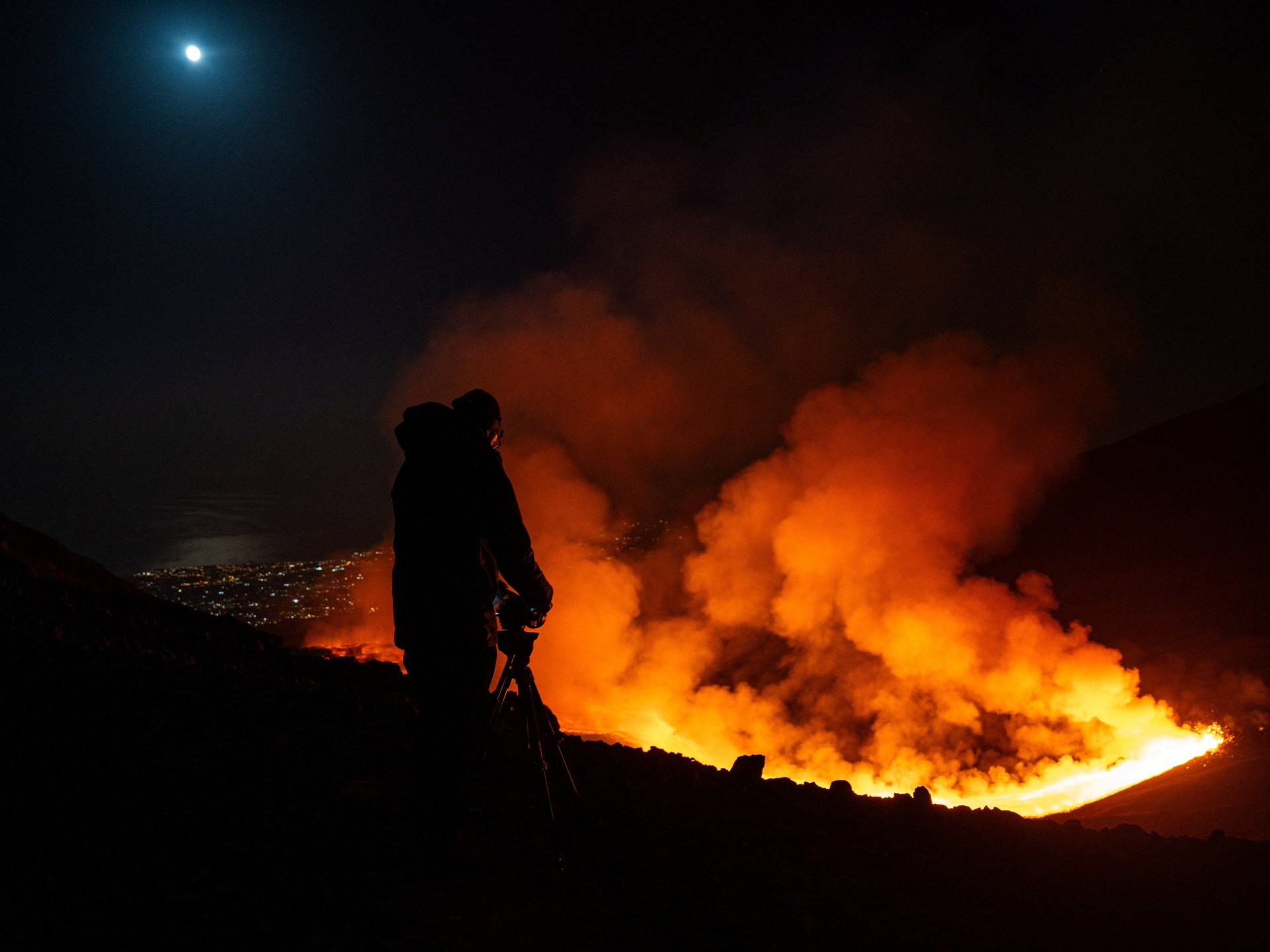

Mount Etna, one of the world’s most active volcanoes, has belched smoke and ashes in a new eruption, forcing the suspension of arrivals at a nearby airport in Sicily.
“Due to Etna’s eruptive activity and the associated release of volcanic ash into the atmosphere, the airspace corresponding to the cloud … has been closed,” Catania airport said in a statement on Saturday.
- list 1 of 3In Pictures: Etna’s spectacular new eruption
- list 2 of 3Etna eruption sends rocks and lava flying, injures 10
- list 3 of 3Concerns about eruptions at Italy’s Mt Etna
end of list
“All arriving flights at Catania Airport are suspended until 12:00 local time (10:00 GMT). Departures of aircraft currently at the airport are operating normally,” it added.
Catania international airport services the eastern part of Sicily, one of Italy’s most popular tourist destinations.
A plume of smoke could also be seen billowing from the summit on a webcam on the website of the National Institute for Geophysics and Volcanology, which monitors Etna.
At 3,324 metres (nearly 11,000 feet), Etna is the tallest active volcano in Europe and has erupted frequently in the past half-million years.
Tough restrictions and ash advisories have been in place since last July due to increasingly intense eruption activity and have led to demonstrations from guides who take tourists up the mountain to see the lava flow.
In January, after authorities in the city of Catania suspended or restricted excursions to see the volcano’s lava flows, guides demonstrated for the first time in front of Mount Etna’s lava flow gate, calling the new restrictions excessive and saying the lava flows are slow-moving enough to be viewed safely, as has been done in the past.
Advertisement
Italy’s National Institute of Geophysics and Volcanology confirmed in January that while Mount Etna’s eruptions are ongoing, the lava fronts are cooling and not advancing further.
Related News

US strikes Iran for second day: Is it a violation of war powers resolution?
Hamas condemns ‘new war crime’ as Israel kills 10 in crowded Gaza hubs
New Israeli roadblocks entrench siege of homes in West Bank’s Qusra