
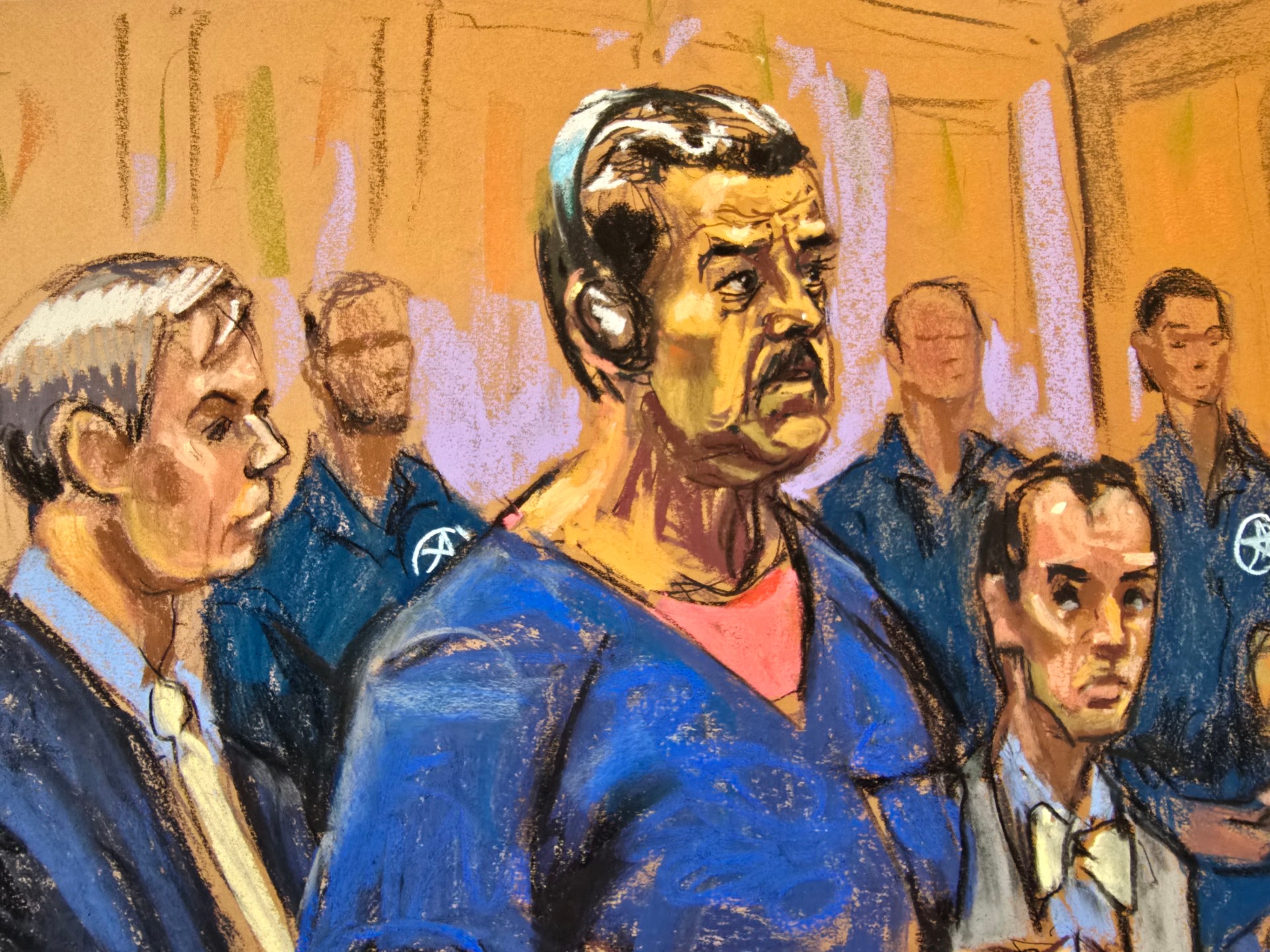

Two days after Venezuelan President Nicolas Maduro, 63, was abducted by special forces of the United States during an operation in the Latin American country, he appeared in a courthouse in New York.
On Monday, Maduro pleaded not guilty to federal charges, including narcoterrorism and conspiring to import cocaine. In a blue and orange prison uniform, he listened to the indictment filed by prosecutors against him and his codefendants, including his wife and son.
- list 1 of 4Colombia prepares for refugee influx after US strikes on Venezuela
- list 2 of 4Ukraine’s top allies meet in Paris to push for Kyiv’s security guarantees
- list 3 of 4‘Closing his eyes’: Why is Russia’s Putin quiet on US abduction of Maduro?
- list 4 of 4What to know about Trump’s plan on Venezuela
end of list
The Trump administration has framed Maduro’s abduction as a law enforcement operation, arguing that congressional approval was not needed.
But in court, Maduro insisted that he was a “prisoner of war” (POW).
What did Maduro say?
“I am innocent. I am not guilty. I am a decent man. I am still president of my country,” he said through an interpreter, before he was cut off by US District Judge Alvin Hellerstein in Manhattan federal court.
Maduro called himself a POW, a person captured and held by an enemy during an armed conflict.
Maduro’s wife, Cilia Flores, who appeared in court on Monday as a codefendant, also pleaded not guilty.
Other Venezuelan leaders have echoed Maduro’s position. On Saturday, his then-deputy, Delcy Rodriguez, appeared on state television alongside her brother, National Assembly chief Jorge Rodriguez, Interior Minister Diosdado Cabello and Defence Minister Vladimir Padrino Lopez, declaring that Maduro was still Venezuela’s sole legitimate president.
However, on Monday, the day when Rodriguez took over as Venezuela’s interim president, she posted a statement on social media offering to cooperate with Trump. In the statement, she invited Trump to “collaborate” and sought “respectful relations”.
Advertisement
“President Donald Trump, our peoples and our region deserve peace and dialogue, not war,” she wrote.
The Venezuelan ambassador to the United Nations, Samuel Moncada, said, “We cannot ignore a central element of this US aggression.”
“Venezuela is the victim of these attacks because of its natural resources,” Moncada said, according to the UN website.
What is the US position?
The US has described the January 3 special operation in Caracas during which Maduro was abducted as a law enforcement operation.
US Secretary of State Marco Rubio told Kristen Welker of NBC’s Meet the Press on Monday that the US and Venezuela were not at war.
“We are at war against drug trafficking organisations. That’s not a war against Venezuela,” he said.
The US ambassador to the UN, Michael Waltz, said the operation was necessary to combat narcotics trafficking and transnational organised crime threatening US and regional security.
“There is no war against Venezuela or its people. We are not occupying a country,” Waltz said, according to the UN website. “This was a law-enforcement operation in furtherance of lawful indictments that have existed for decades.”
However, Rubio’s words contradicted Trump’s statements.
During a news conference on Saturday, Trump said the US would “run” Venezuela until a “safe, proper and judicious transition” could be carried out.
On Sunday, Trump told reporters that the US is ready to carry out a second military strike on Venezuela if its government refuses to cooperate with his plan to “resolve” the situation there.
“Marco Rubio is not the President. Trump has declared unequivocally that the United States is engaged armed conflict with Venezuela to justify more than 100 murders of alleged drug traffickers in the Caribbean and eastern Pacific,” constitutional law expert Bruce Fein told Al Jazeera.
Starting in September, the US military launched a series of strikes in the Caribbean Sea and eastern Pacific on boats that it claimed were carrying narcotics. More than 100 people have been killed in at least 30 such boat bombings, but the Trump administration has yet to present any public evidence that there were drugs on board, that the vessels were travelling to the US or that the people on the boats belonged to banned organisations as the US has claimed.
“If the United States were not a war, Trump would confess he is engaged in mass murder of civilians.”
If Maduro is indeed a POW, then protections under international law apply to him.
Advertisement
The Third Geneva Convention of 1949 mandates humane treatment, respect and protection for POWs.
According to the convention, a POW can be tried and sentenced in another country, particularly the detaining power, but only for certain crimes such as war crimes.
Maduro, however, has been charged with narcotics-related offences, not with war crimes.
And in general, the Third Geneva Convention requires that POWs must be returned “without delay” to their nation as soon as the conflict ends.
“According to President Trump, Maduro is a prisoner of war because Trump declared Maduro had initiated war against the United States via drug trafficking leading to overdose deaths. That would mean the Geneva Conventions would apply but which Trump will certainly disregard,” Fein said.
What do other experts say?
Susanne Gratius, a professor of political science and international relations at the Autonomous University of Madrid, told Al Jazeera that the US attempts to portray Maduro’s abduction as a law-and-order exercise did not hold up in the face of facts.
“They sell the operation as a domestically motivated drugs issue, but it is clearly not. They violated national sovereignty. Even though Maduro is a dictator, there is no legal argument to hijack him and his wife through a US military operation,” Gratius said, referring to Maduro’s refusal to quit office despite widespread accusations that he lost controversial elections in 2024.
The US attack, she said, was a violation of Article 2 of the UN Charter, which decrees that all members are sovereign equals. “Regime change or access to oil do not justify unilateral military interventions.”
Ilias Bantekas, a professor of transnational law at Hamad Bin Khalifa University in Qatar, told Al Jazeera that the US involvement in Venezuela was “less about Maduro as it is about access to Venezuela’s oil deposits”.
Venezuela is home to the world’s largest proven oil reserves – at an estimated 303 billion barrels as of 2023 – it earns only a fraction of the revenue it once did from exporting crude.
According to data from the Observatory of Economic Complexity (OEC), Venezuela exported just $4.05bn worth of crude oil in 2023. This is far below the leading exporters, including Saudi Arabia ($181bn), the US ($125bn) and Russia ($122bn). This is largely because of US sanctions on Venezuelan oil.
“This [oil] is the number one target. Trump is not content with just allowing US oil firms to get concessions but to ‘run’ the country, which entails absolute and indefinite control over Venezuela’s resources,” Bantekas said.
Experts also point to the months-long military campaign that the Trump administration waged against Venezuela before Maduro’s abduction — including the bombing of boats — to underscore why it is hard to justify the US attack as a law-and-order operation.
“Trump’s seizure of Venezuelan oil and displacement of Venezuelan sovereignty are acts of war,” Fein said.
Related News
Venezuela after Maduro: Oil, power and the limits of intervention
What’s happening in Myanmar’s civil war as military holds elections?
Venezuela’s Machado says she hasn’t spoken to Trump since October