

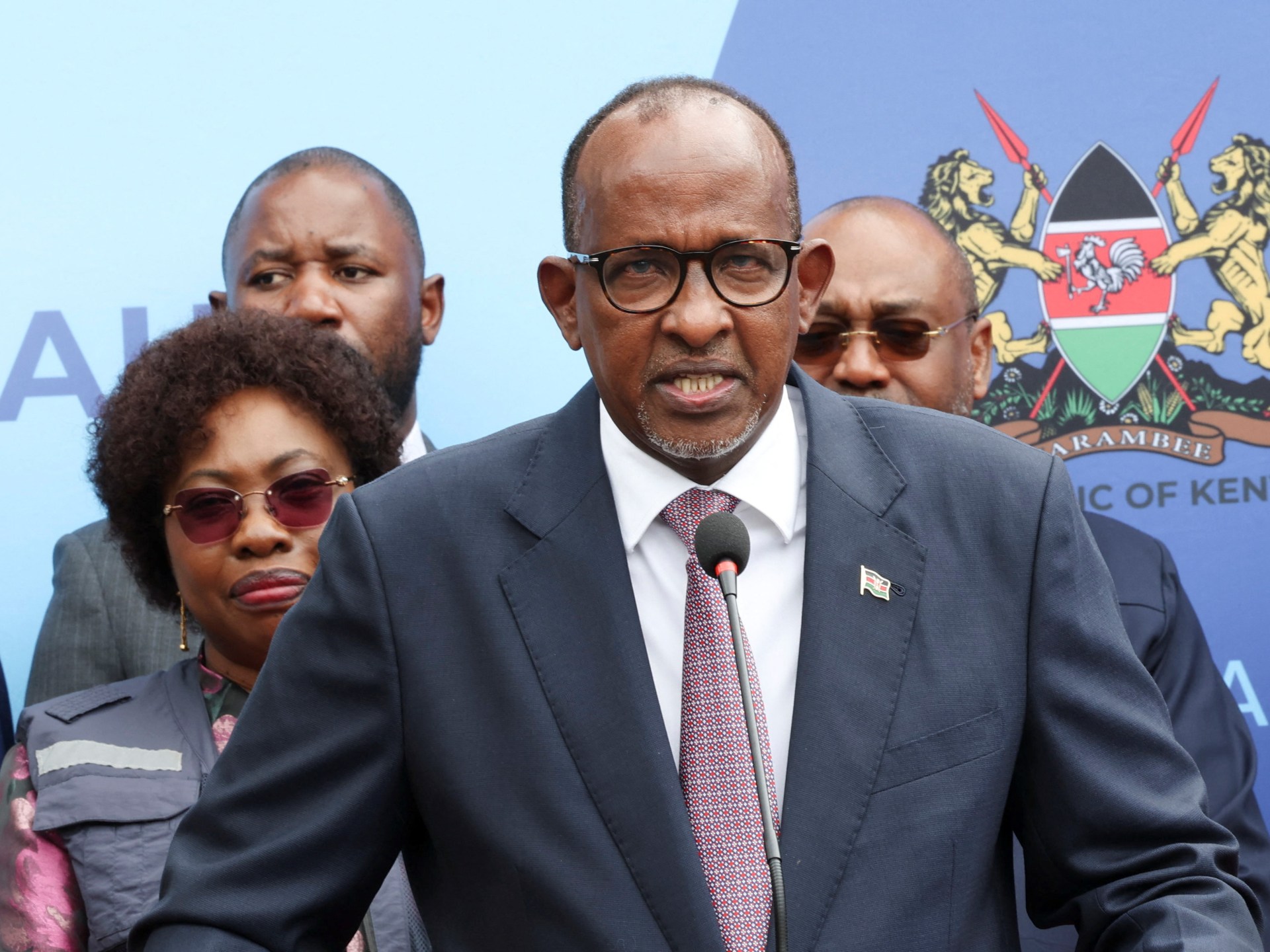

Kenya has released its last Ebola patient and begun a 42-day countdown to be declared free of the disease.
Health Minister Aden Duale made the announcement at a news conference in Nairobi on Wednesday, more than five weeks after the country recorded its first case on October 6.
- list 1 of 3Kenya’s Ebola cases test preparedness beyond Nairobi
- list 2 of 3Kenya announces second Ebola death, says ‘no evidence’ of community spread
- list 3 of 3Kenya confirms eighth Ebola case amid widening regional outbreak
end of list
Duale said Kenya would continue to exercise prevention measures until the December 23 date is reached.
The Ministry of Health previously expressed confidence that the outbreak was under control, noting that all nine confirmed cases were linked to the first patient’s contact list. This indicated that there had been no community transmission. The last case was recorded on October 19.
The first patient travelled from the Democratic Republic of the Congo (DRC) through Uganda, and transmitted the virus to four family members and four healthcare workers.
The first patient and his mother died of Ebola, while the other seven patients fully recovered. The government identified 135 contacts who interacted with the first patient.
Elsewhere in the region, the number of infections continues to climb. In the DRC, the epicentre of the outbreak, 11,042 people have been infected and 5,387 have died, the government said on Wednesday.
The outbreak also spread to Uganda and Nigeria through individuals who travelled from the DRC.
The current Ebola outbreak is caused by the Bundibugyo strain of the virus and has been described as one of the worst outbreaks on record.
Kenya faced travel restrictions following the Ebola outbreak, with Saudi Arabia announcing an indefinite suspension of visas on October 30. The decision affected hundreds of Kenyan workers travelling to the Gulf for employment, particularly as domestic and hotel workers.
Advertisement
The Ministry of Health urged Saudi Arabia to reconsider the travel restrictions, explaining that Kenya’s first Ebola case was imported and that all subsequent cases were traced to the initial patient’s contact list. The ministry said all contacts had been identified and traced in line with established outbreak-control guidelines.
Kenya tightened its border controls, designating a specific gate at the country’s main airport for passengers travelling from 10 countries that have reported Ebola cases or border those that have active cases. Passengers are being screened using thermal technology, and all new arrivals fill a health declaration form that provides their travel and health information.
Kenya will now require citizens arriving from the DRC to undergo a 21-day quarantine, Duale said.
Related News

Alberta rejects separation referendum: What’s next for Canadian province?

Will Trump strike nuclear sites again as Iran engages ‘cognitive warfare’?

Protests outside Poland’s constitutional court: What’s the crisis about?