
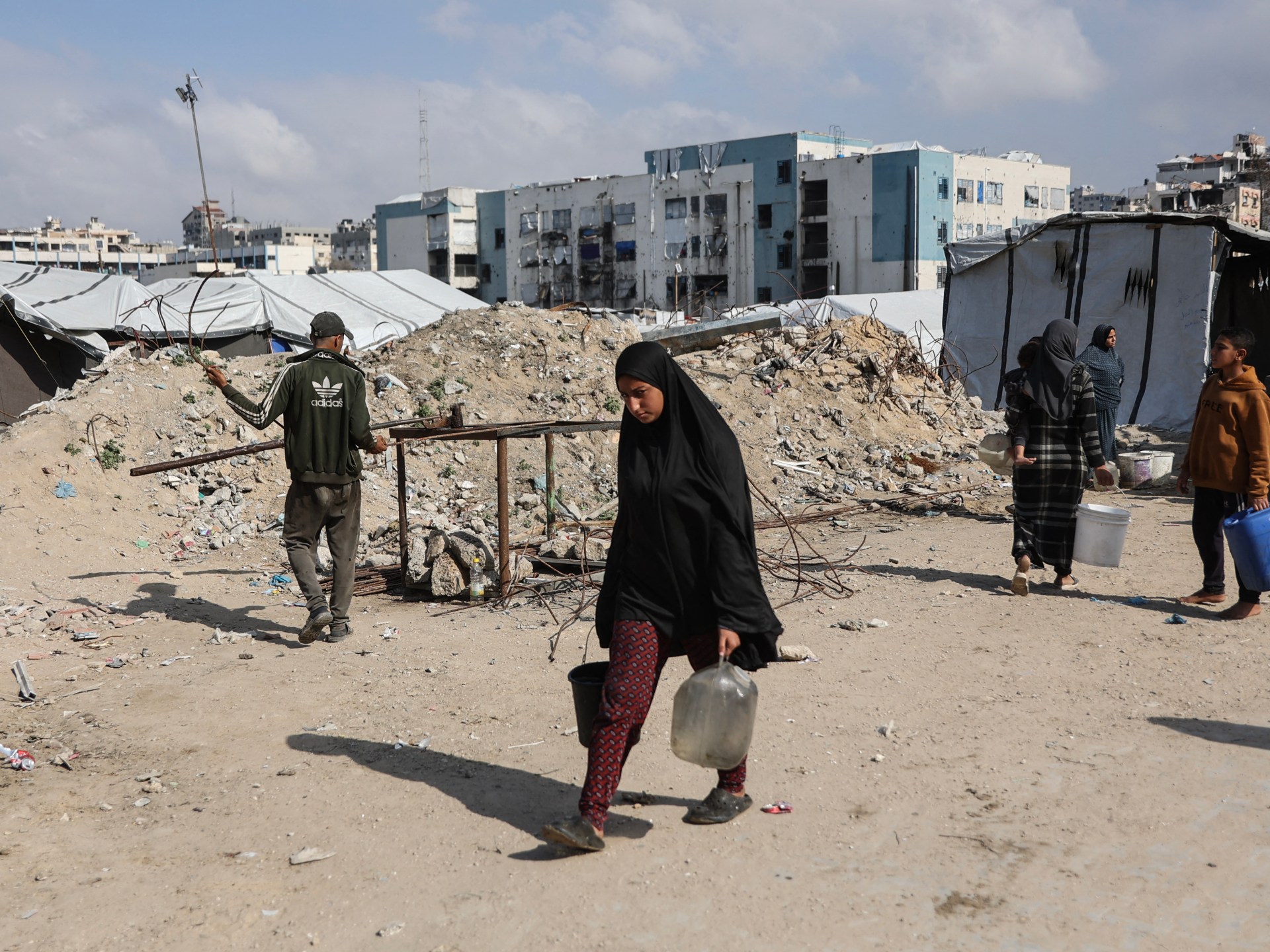

Israeli air strikes killed at least two Palestinians in Gaza on the third day of Ramadan in the latest breach of the truce deal signed with Hamas more than four months ago.
The attacks on Saturday occurred in northern Gaza’s Jabalia camp and the Qizan an-Najjar area in southern Gaza.
- list 1 of 4Farmers in Gaza risk Israeli bullets to bring their fields back to life
- list 2 of 4Indonesia, Morocco, Kosovo among 5 countries to send troops under Gaza plan
- list 3 of 4Trump’s Board of Peace faces its first test on Gaza
- list 4 of 4The Take: Who made the cut on Trump’s ‘Board of Peace’ and what they want
end of list
The total death toll from Israel’s attacks since the “ceasefire” came into effect has risen to 614, with 1,640 more Palestinians wounded, according to the Palestinian news agency Wafa.
Israel’s military appeared to acknowledge one of the attacks in a post on X, claiming its forces killed a fighter who crossed onto Israel’s side of the demarcation line in northern Gaza and approached its troops “in a manner that posed an immediate threat”.
The army said it would “continue to act to remove any immediate threat”.
‘Board of Peace’ deliberations
Saturday’s attacks come two days after US President Donald Trump’s Board of Peace held its first-ever meeting addressing reconstruction, security, and governance in the war-battered Strip.
Trump announced at the gathering that nine countries committed $7bn for Gaza reconstruction efforts, on top of a $10bn contribution from the United States. While significant, the total is far short of the estimated $70bn needed to rebuild the devastated Palestinian territory.
Trump also said five countries pledged to send troops to participate in an eventual 20,000-strong International Stabilization Force (ISF), which is to take over security from Hamas. But the task of disarming Hamas – called for in the next stage of the deal – is still unresolved, threatening to delay or derail the entire process.
Advertisement
Israeli Prime Minister Benjamin Netanyahu has insisted Hamas must disarm before any reconstruction begins. Last week, a top Netanyahu aide said Israel planned to give Hamas a 60-day deadline to comply before resuming its war, an ultimatum the group rejected.
Hamas has said it will not relinquish its weapons as long as Israel continues occupying the Strip and discussions on any political process in Gaza “must start with the total halt of aggression”.
The group has said it is open to a peacekeeping force, but with caveats.
“We want peacekeeping forces that monitor the ceasefire, ensure its implementation, and act as a buffer between the occupation army and our people in the Gaza Strip, without interfering in Gaza’s internal affairs,” said Hamas spokesperson Hazem Qassem on Friday.
‘Unclear in vision’
Along with Hamas’s disarmament, the next stage of Trump’s plan for Gaza calls for the gradual withdrawal of the Israeli military and the ISF’s deployment, with a transitional Palestinian technocratic committee overseeing day-to-day governance.
Many Palestinians told Al Jazeera they are deeply sceptical about the plan’s prospects for success, citing Israel’s continued deadly attacks and lingering aid shortages.
“Israel kills, bombs, violates the ceasefire agreement daily and expands the buffer zone without anyone stopping it,” said Awad al-Ghoul, 70, a Palestinian displaced from Tal as-Sultan in southern Rafah and who now lives in a tent in the town of az-Zawayda.
“So this project is a failure from the start and unclear in vision.”
Related News

Facebook, TikTok suspended in Gabon under regulator’s order

US seizes Venezuela-linked oil tanker in Indian Ocean
Iran arrests prominent reformists over deadly January unrest