
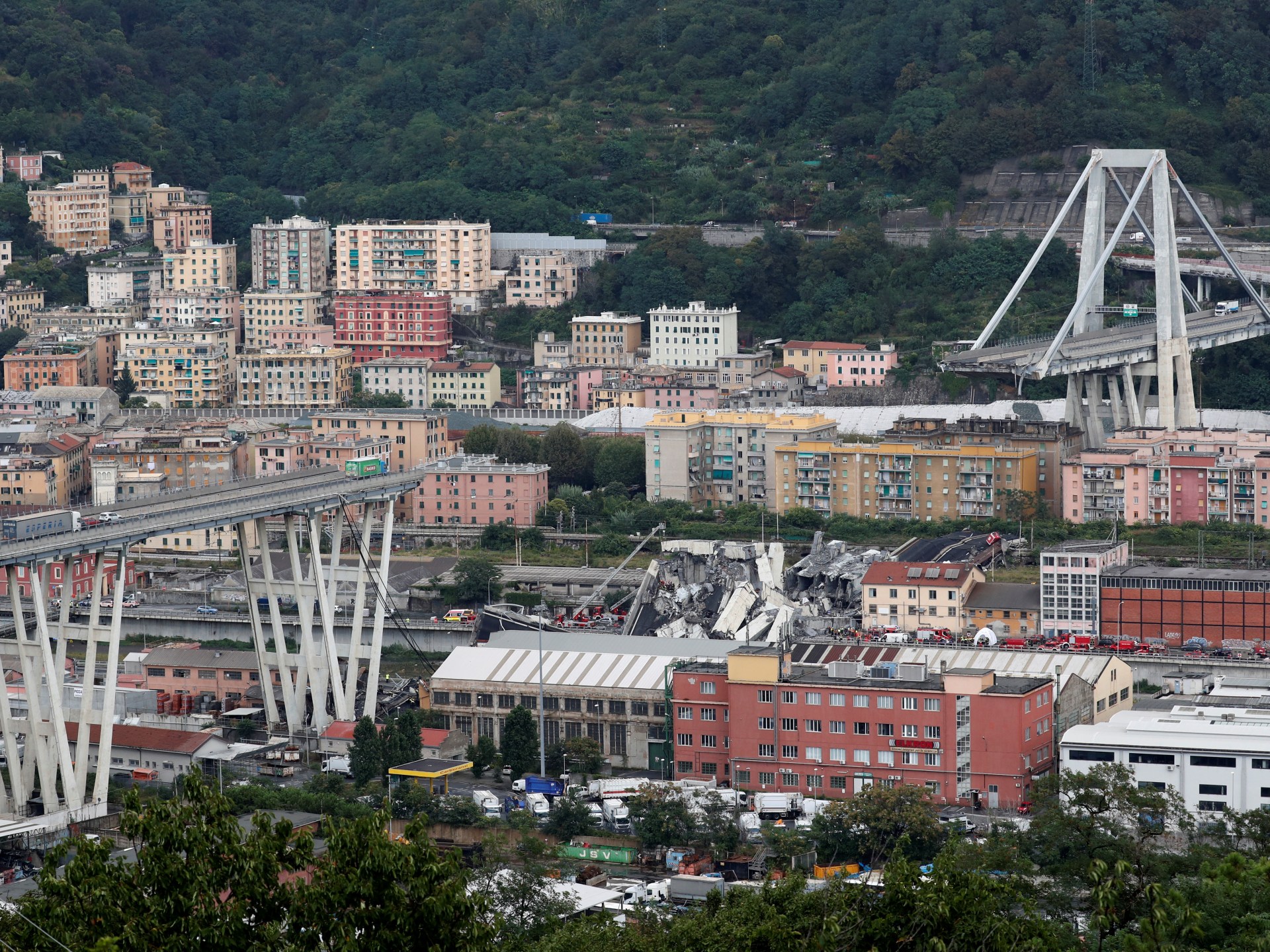

A court has sentenced the former CEO of Italy’s main highway operator to 12 years in prison over the collapse of the Morandi road bridge in the port city of Genoa.
Judges delivered their verdict on Thursday in Genoa in the first trial over the collapse of the bridge, which killed 43 people when it fell apart on August 14, 2018. It is considered one of the country’s worst infrastructure disasters.
- list 1 of 4Four Gaza aid flotilla activists released from Libya detention
- list 2 of 4Italy recovers 10 bodies as boat with nearly 60 on board capsizes off Malta
- list 3 of 4Thousands protest plan to build world’s longest bridge from Sicily to Italy
- list 4 of 4Italy greenlights plan to build world’s longest suspension bridge to Sicily
end of list
Atlantia CEO Giovanni Castellucci was found guilty of vehicular homicide and negligence related to the Morandi bridge’s collapse.
The bridge was operated by Atlantia’s motorway unit, Autostrade per l’Italia, which has come under severe scrutiny in this affair.
Castellucci is already in prison, serving a six-year sentence over another fatal incident in 2013 on a viaduct in southern Italy, and was not in court to hear the verdict.
Also convicted on Thursday were Autostrade’s former head of maintenance, Michele Donferri Mitelli, who was sentenced to 11 years in prison and the former CEO of the SPEA engineering company, Antonino Galata, who received five years and six months.
In all, 32 people were convicted and handed sentences ranging from one year and 11 months to 12 years. Others were either found not guilty, or lesser charges had expired under the statute of limitations.
Relatives of the victims, meanwhile, packed the court to hear the outcome of a case that has become a symbol of Italy’s decaying infrastructure and slow justice system. The verdict came after four years of trial hearings for 57 defendants, including company executives, engineers and transport ministry officials, on charges of manslaughter, endangering transport safety and falsifying official documents.
![Giovanni Paolo Accini, Lawyer of former CEO of Atlantia Giovanni Castellucci, speaks with media in the Courthouse after the verdict in the case of the Morandi Bridge collapse nearly eight years ago that killed 43 people in one of the country’s worst infrastructure disasters, in Genoa on July 16, 2026 [AFP]](https://www.aljazeera.com/wp-content/uploads/2026/07/afp_6a58ed6c60d1-1784212844.jpg?w=770&resize=770%2C480&quality=80)
The 1,182-metre (1,293-yard) bridge, which had been dubbed Italy’s “Brooklyn Bridge”, was designed by the architect Riccardo Morandi and inaugurated in 1967.
Advertisement
By the turn of the century, experts continued to warn that the structure was deteriorating, yet critical repairs were never carried out.
Prosecutor Walter Cotugno dubbed the bridge “a ticking time bomb” at the verdict.
The collapse of the then-51-year-old bridge triggered years of investigations into the maintenance of its decrepit infrastructure. A 50-metre (160-foot) high section of the bridge collapsed with as many as 35 vehicles on it, which fell onto warehouses and a riverbed below.
“I wish to apologise to the victims’ families, to the people of Genoa, and to all Italians for the suffering caused by the tragic Morandi disaster, fully aware that our gesture can never erase their pain,” Autostrade CEO Arrigo Giana wrote in an apology statement on Wednesday.
Prosecutors argue that years of inadequate maintenance, ignored warning signs and delayed safety work contributed to the collapse, alleging that vital work was postponed, while profits continued to be generated and distributed.
The defence’s main argument was that the bridge had a hidden construction defect, namely corrosion of its cables, that caused its collapse, not a lack of maintenance.
Related News
Key moments from former Qatar Emir Sheikh Hamad bin Khalifa Al Thani’s life
Iran, Gulf hit as Hormuz, Bab al-Mandeb close: What’s the latest?

Saudi Arabia helicopter crash kills all 14 on board