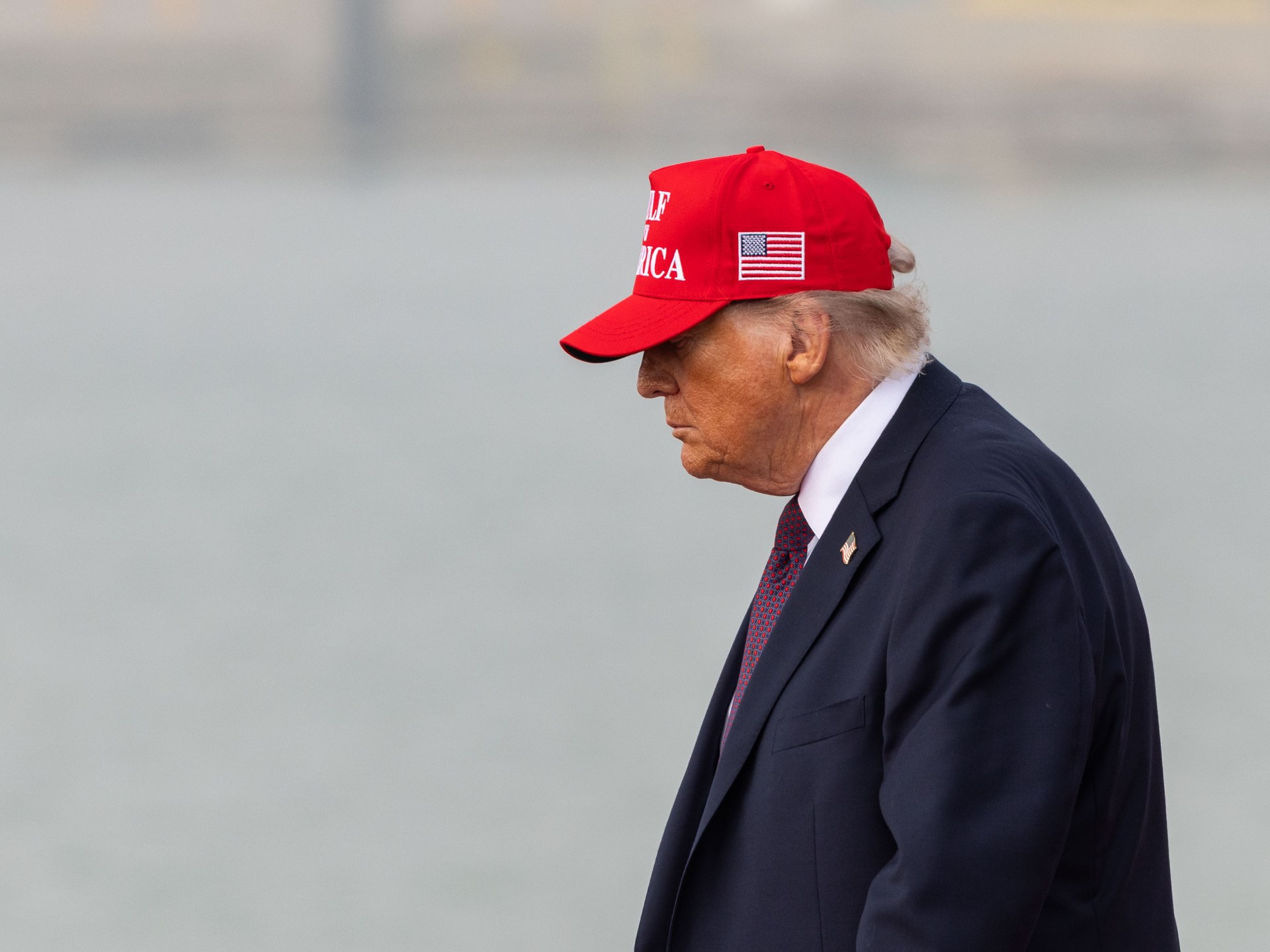

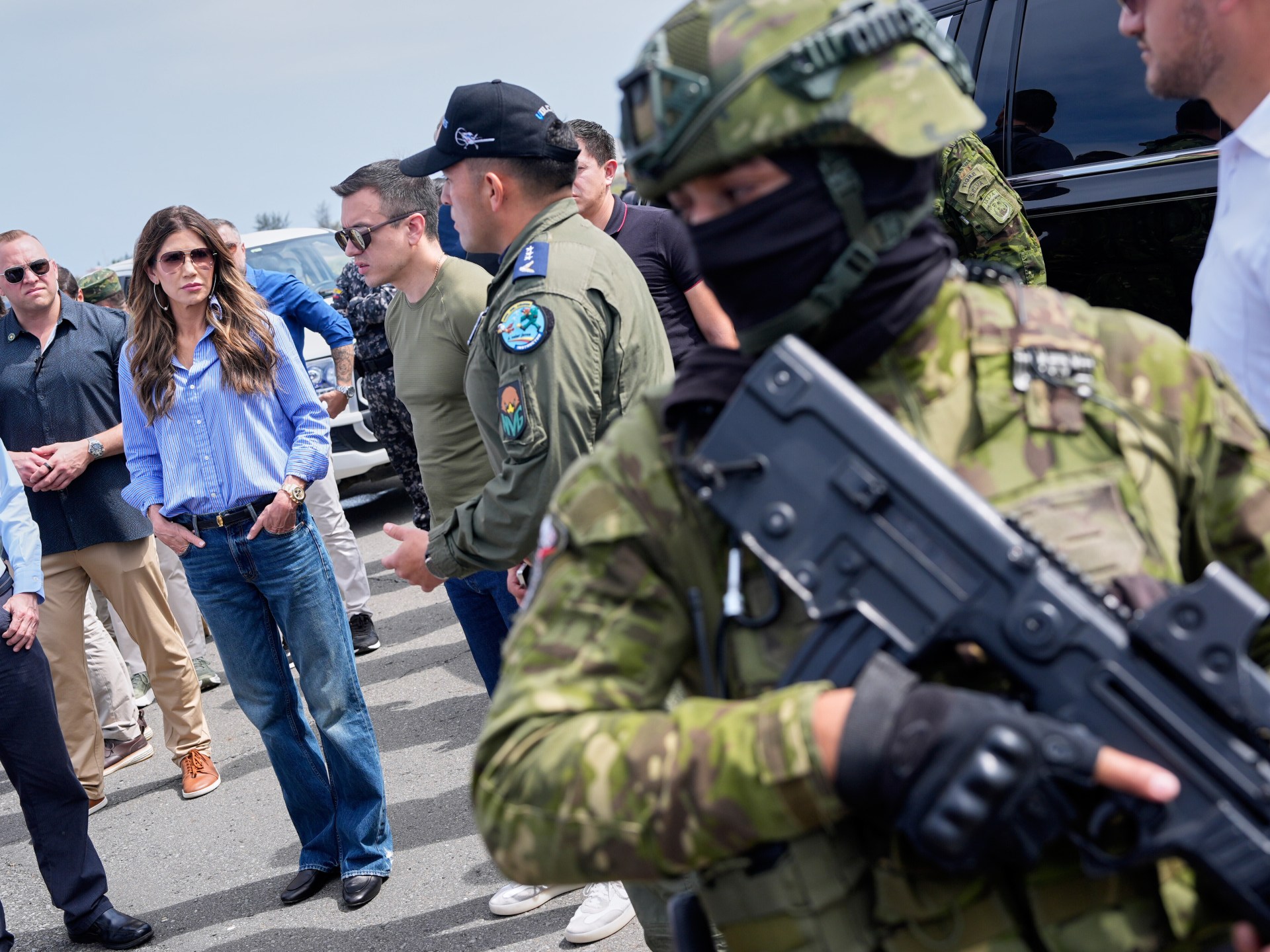

The government of Ecuador has announced that, starting this weekend, it is prepared to launch a sweeping military offensive against criminal networks in the country, with the support of the United States.
In an interview on Wednesday with Ecuador’s Radio Centro, Interior Minister John Reimberg framed the upcoming assault as a shift in tactic for the administration of President Daniel Noboa.
- list 1 of 3‘They’re cancer’: Trump threatens cartels, Cuba at Latin American summit
- list 2 of 3US military kills six in strike on alleged drug boat in the Eastern Pacific
- list 3 of 3Press freedom declines in Americas, with US seeing sharpest drop: Report
end of list
“Last year, we dedicated ourselves to catching all the heads of the [criminal] structures, which led them to fight among themselves for the same criminal economy,” Reimberg said.
“This year, we are going to attack the criminal economy.”
Illegal mining and drug trafficking operations would be among the targets of the latest sweep, the minister added. No further details were provided about the scope of the operations.
Ecuador imposes curfew
Reimberg’s statements follow the announcement of a curfew for four Ecuadorian provinces: El Oro and Guayas along the Pacific coast, plus the eastern central areas of Santo Domingo de los Tsachilas and Los Rios.
The curfew is expected to stretch for more than two weeks, from March 15 through March 30, requiring that residents stay indoors during designated hours.
Should travel be necessary during curfew hours, officials warned that residents must be prepared to show documentation to justify their trip.
In Wednesday’s remarks, Reimberg argued that such restrictions were necessary to avoid civilian casualties.
“We don’t want collateral damage from the attacks we’re going to carry out,” he told the radio show.
Advertisement
“We need the roads clear because there will be troop movements. We need to have the roads clear to be able to carry out the operations.”
Reimberg added that the operation is expected to be of “greater magnitude” than previous crime busts.
“What’s the difference? The force with which we’re going to act,” he said. “Basically and in summary, we are going to destroy.”
Tightening relations with Trump
The curfew was announced on March 2, as President Noboa addressed Ecuador’s national police force.
He told the law enforcement officers to be prepared for increased operations to combat criminal networks in the country: “The next phase of the fight against organised crime begins now.”
Within days of his speech, the US issued a statement confirming that it had launched joint military operations with Ecuador. So far, the US appears to be focused on offering support in the form of military logistics and intelligence.
But the coalition comes as US President Donald Trump pressures Latin American leaders to take more aggressive action against local criminal networks, several of which he labelled “foreign terrorist organisations”.
Trump and Noboa, in particular, have forged a tight bond, with Noboa appearing to echo the US leader’s hardline positions towards countries like Cuba and Colombia.
Noboa recently expelled Cuba’s diplomats from Ecuador, amid a US fuel blockade on the Caribbean island. And as Trump called for Colombia to crack down on its illicit narcotics trade, Noboa imposed tariffs on the country for the same reason.
Top US officials — including outgoing Homeland Security Secretary Kristi Noem and the head of the US military’s Southern Command, General Francis Donovan — have also visited Noboa in recent months to discuss regional security.
The Trump administration has said it would like the US to exert its “preeminence” throughout the Western Hemisphere.
It has also attacked Venezuela and dozens of vessels in the Caribbean Sea and eastern Pacific Ocean, on the grounds of combatting drug trafficking into the US. Those attacks, however, have been condemned by experts as illegal under international law.
A spike in crime
After coming to power in 2023 for an abbreviated term, Noboa was re-elected in 2025 on a platform based in large part on tackling the growth in Ecuador’s gang activity.
Once considered an area with relatively little violent crime, Ecuador experienced a surge following the COVID-19 pandemic.
Experts say the reasons are multipronged. Ecuador’s economy had been weakened by the pandemic, and youth unemployment was high.
Advertisement
Then, there’s the country’s geography. Ecuador sits between Colombia and Peru, the two largest cocaine producers in the world, and its position on the Pacific Coast made it an attractive port for illicit exports.
That, in turn, has resulted in criminal networks increasingly trying to assert control over Ecuadorian territory and trafficking routes.
Last year, in 2025, Ecuador once again saw a spike in its homicide rate, with an estimated 9,216 murders reported — an increase of more than 30 percent over the preceding year.
In an effort to bring down those numbers, Noboa has resorted to hardline tactics that critics compare to the “mano dura” or “iron-fisted” approach of countries like El Salvador.
Noboa himself has likened Ecuador’s conflict with drug gangs to a “war”. Last year, he unsuccessfully championed a voter referendum to allow foreign military bases on Ecuadorian soil, arguing that such measures are key to stopping drug trafficking.
Ecuador has banned foreign military bases since 2008, in part because of allegations of abuse. The referendum was ultimately defeated.
But the Trump administration had backed the ballot initiative and praised Noboa as a key ally in the US’s ongoing “war on drugs”.
Though no bases will be built, on Wednesday the Trump administration announced that it would be opening its first field office for the Federal Bureau of Investigation (FBI) in Ecuador.
A statement called it a “strategic and operational milestone for security” in the region.
Related News
‘Worst-case scenario’: Trump weighs replacing Khamenei as leader of Iran
Iran war: What is happening on day 11 of US-Israel attacks?

US-Iran talks live: Nuclear talks to kick off in Geneva amid tensions