
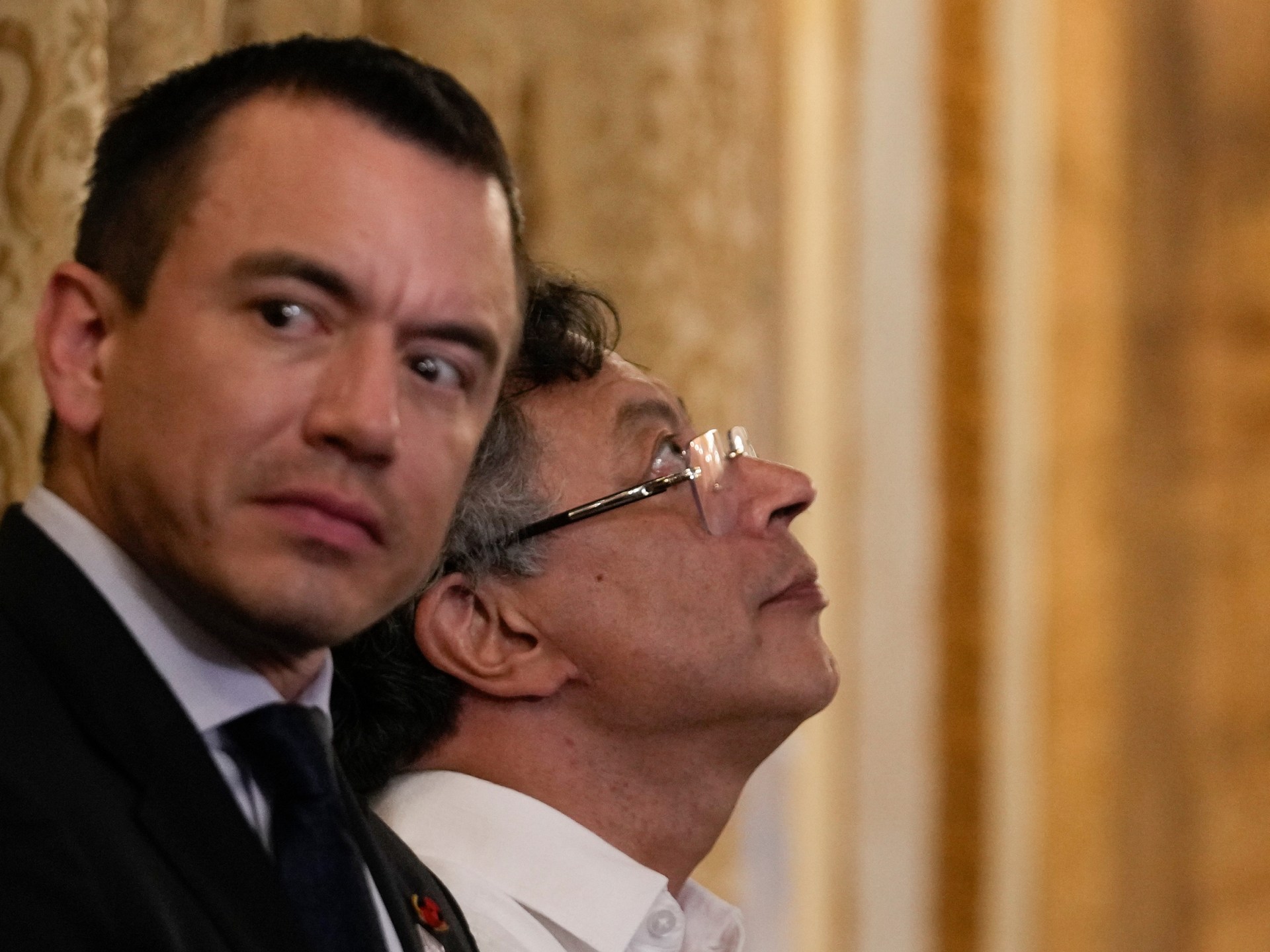

The government of Ecuadorian President Daniel Noboa has surged its tariffs on the neighbouring country of Colombia to 100 percent, effective May 1.
On Thursday, Ecuador’s Ministry of Production issued a statement blasting Colombia for failing to adequately address drug-trafficking and border security.
- list 1 of 3Colombia’s Petro accuses Ecuador of bombing near border
- list 2 of 3Ecuador claims 28% drop in homicides amid concerns over anti-crime campaign
- list 3 of 3Ecuador recalls its ambassador from Colombia over Jorge Glas comments
end of list
It was the latest salvo in an ongoing cross-border dispute between the right-wing Noboa and his left-wing counterpart in Colombia, Gustavo Petro, who have been feuding for months.
“After noting the lack of implementation of concrete and effective measures regarding border security on the part of Colombia, Ecuador is obliged to take sovereign actions,” the Ministry of Production wrote in its statement.
It justified the tariff hike as a necessary incentive to “confront the presence of drug trafficking on the border”.
“For Ecuador, security, as well as the fight against corruption and drug trafficking, are a non-negotiable priority,” the ministry said. “This measure reaffirms the country’s commitment to protecting its citizens and safeguarding the integrity of its territory.”
Already, Noboa had slapped Colombia with 50 percent tariffs on its exports to Ecuador as of March. That, in turn, was a spike from a 30 percent tariff rate announced in January and implemented in February.
Just over an hour after the new tariff rate was announced, Petro responded on social media that Ecuador’s actions were causing the collapse of the Andean Pact, a regional free-trade agreement whose origins stretch back to the 1960s.
Advertisement
“This is simply a monstrosity, but it signifies the end of the Andean Pact for Colombia. We have no business there anymore,” Petro wrote.
He called on Colombia to shift its focus away from its Andean trading partners and towards Mercosur, a trade alliance helmed by Brazil, Uruguay, Paraguay, Argentina and Bolivia.
“The Foreign Minister must initiate the process for us to become full members of Mercosur and steer us — with greater vigor — toward the Caribbean and Central America,” Petro added.
The escalating tensions between Ecuador and Colombia come within the final months of Petro’s presidency. Elected in 2022, Petro is Colombia’s first left-wing president and a former rebel involved in the country’s six-decade-long armed conflict.
But his government has faced stiff opposition from right-wing political movements both domestically and abroad.
Leaders like Noboa and United States President Donald Trump have repeatedly condemned him for not doing enough to tackle the illicit drug trade, despite historic drug seizures during Petro’s term in office.
Just last November, Petro’s government seized a shipment of cocaine worth roughly $388m, the largest drug bust in a decade.
But Petro has also championed a policy he calls “Total Peace”, which involves negotiations with rebel groups and criminal networks to put an end to the country’s internal conflict.
Trump and Petro have been at odds over multiple issues, including US immigration policies and its boat-bombing campaign in the Caribbean Sea and eastern Pacific Ocean.
In September, however, the Trump administration took the extraordinary step of decertifying Colombia as an ally in its “war on drugs”, saying that it had “failed demonstrably” in its efforts.
Then, in October, Trump sanctioned Petro and his family, blaming the Colombian president for having “allowed drug cartels to flourish”.
Noboa has echoed Trump’s stance on several foreign policy issues, including its pressure campaign on another left-wing government, Cuba.
He was among the right-wing leaders in Latin America to join Trump’s “Shield of the Americas” coalition, designed to confront criminal networks and cartels in the region.
In announcing the initial volley of tariffs in January, Noboa claimed his country had shown a “genuine commitment” to combatting drug trafficking, while Colombia had not.
“We have made genuine efforts to cooperate with Colombia, even while facing a trade deficit exceeding $1bn annually,” Noboa wrote.
Colombia remains the world’s largest producer of cocaine, a persistent trend that has existed since before Petro’s presidency.
Advertisement
But other factors have aggravated tensions between the two neighbours.
On Wednesday, for instance, Ecuador recalled its ambassador from Colombia over statements Petro made about its imprisonment of left-wing politician Jorge Glas, calling the former vice president a “political prisoner”.
Noboa had warned earlier in the week that he considered such rhetoric an “assault on [Ecuador’s] sovereignty”. He had previously faced criticism for authorising a raid on Mexico’s embassy to arrest Glas, which prompted Mexico to sever its relations with Ecuador.
Petro, meanwhile, has accused Noboa of bombing close to the Colombian border, as part of joint military operations with the US. Colombian officials have said they recovered 27 charred bodies from the border region.
Since Ecuador first imposed its tariffs, Colombia has suspended cross-border energy sales, which have been vital in helping Ecuador’s government navigate electricity shortages prompted by recent droughts. It has also issued retaliatory tariffs on certain Ecuadorian products.
Related News
Netanyahu orders military to expand invasion of southern Lebanon
Iran war day 41: What’s happening in Lebanon, Middle East and beyond?
Qatar says Iran’s attacks on neighbours crossed ‘many red lines’