
Burkina Faso’s rival armed groups turn on each other as state loses ground
 13 November 2026
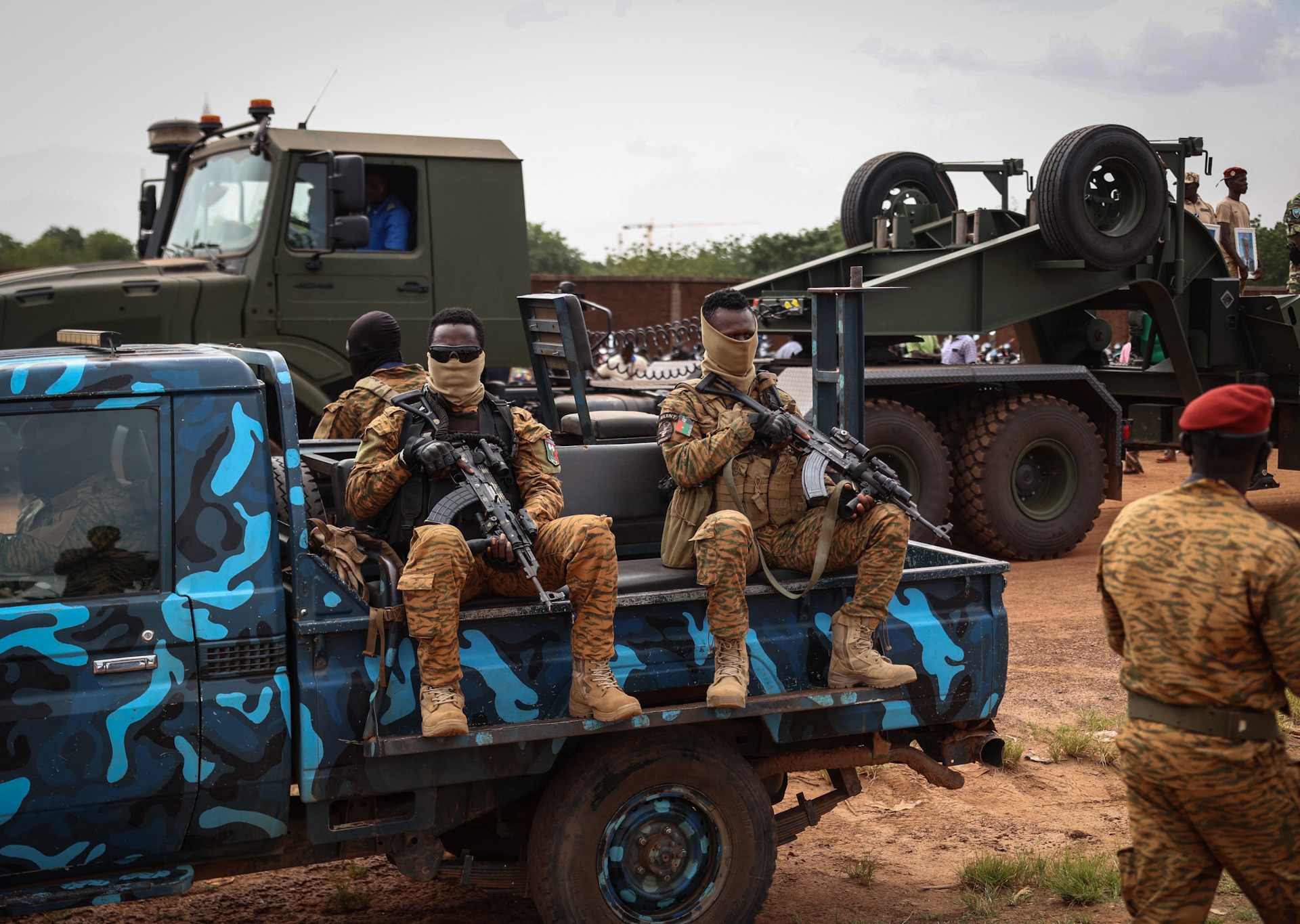

Ouagadougou, Burkina Faso – Armed fighters from two rival groups have fought a series of increasingly deadly battles along Burkina Faso’s northern border with Mali, as the government struggles to reassert control over large parts of the country.
The clashes between Jama’at Nusrat al-Islam wal Muslimin (JNIM), an al-Qaeda affiliate, and the ISIL affiliate in Sahel Province (ISSP) have intensified since early September, with both groups competing for territory and influence across the borderlands. Their latest confrontations have produced competing claims of heavy casualties, although the figures released by the ISIL (ISIS) group remain unverified.
One of the first major confrontations took place near Kacham, close to the Mali border, in early September. ISSP claimed to have killed more than 200 JNIM fighters, captured more than 30 others and seized weapons and motorcycles. The claim has not been independently verified. Heni Nsaibia, of the monitoring group Armed Conflict Location & Event Data (ACLED), said that, if confirmed, the reported death toll would make it the deadliest battle recorded between the two groups.
The fighting escalated again on October 9 around Ganadaouri, in Burkina Faso’s northern Oudalan province. ISIL’s weekly publication, Al-Naba, subsequently claimed that more than 400 JNIM fighters had been killed. JNIM has not publicly responded to the claim, and no independent assessment has established the number of casualties.
The scale of the claim came under further scrutiny when ISSP published photographs on November 1 presented as evidence of its victory, showing what it described as the aftermath of the battle.
Advertisement
Regional news outlet i-Sahel counted at least 120 bodies in the images but said it could not independently verify whether those pictured were victims of the reported fighting. The number visible in the photos is considerably below the 400 deaths claimed by ISIL.
A rivalry that is becoming increasingly costly
The confrontation is part of a rivalry that has persisted since 2019, when the two groups began fighting over territory, influence and access to local populations across the Sahel. Their competition has become increasingly costly, with ACLED recording around 320 armed confrontations between them and more than 2,200 fighter deaths since the conflict began.
The fighting comes as JNIM continues to make gains against government forces in Burkina Faso. The International Crisis Group says the group holds extensive areas of the country, particularly in the north, north-central region, west and east. Its influence has allowed it to challenge state authority across several regions while maintaining operations in neighbouring Mali and Niger.
ACLED’s March 2026 overview documented more than 30 JNIM attacks in Burkina Faso during a February offensive against the military and state-backed Volunteers for the Defense of the Homeland (VDP).
The attacks resulted in the deaths of more than 120 soldiers, forest guards and militia fighters, according to the conflict monitor. The campaign illustrated the pressure facing government forces, even as JNIM had to contend with attacks from its Islamic State rival.
The rivalry could offer Burkina Faso’s authorities some breathing room if JNIM is forced to divert fighters and resources to defend its positions against ISSP.
But there is little reason to assume that the infighting will translate into lasting gains for the government. JNIM remains active across several countries, while ISSP’s battlefield successes could strengthen its position in areas where the two groups compete.
The government faces a wider security crisis
For communities caught between the armed groups and government forces, the prospect of one organisation weakening another offers little certainty of relief. Burkina Faso’s security crisis has displaced millions of people and disrupted access to farmland, markets and basic services.
The scale of the humanitarian crisis remains severe. An estimated 4.5 million people in Burkina Faso need humanitarian assistance in 2026, according to United Nations humanitarian planning figures. The last consolidated official estimate of internal displacement, published in March 2023, put the number at approximately 2.1 million. That figure should not be mistaken for a newly verified 2026 count.
Advertisement
A citizen of Niger, who spoke to Al Jazeera on condition of anonymity because of security concerns, said the fighting between the two groups had raised hopes that communities in the borderlands might face less pressure.
“In Tillaberi, where I have family members, our people have endured too much fear. If JNIM and ISSP keep fighting each other, the danger to our communities may lessen, since their forces may weaken. People here deserve the chance to work their fields, travel safely, and raise their children without fearing attacks from either group.”
The rivalry is no longer confined to Burkina Faso and Mali. ACLED has documented its spread into Niger’s Tillaberi and Dosso regions and Nigeria’s Kebbi State, adding to concerns that the conflict is reaching further into West Africa.
The conflict monitor recorded more than 10,000 deaths from political violence across Burkina Faso, Mali and Niger between January 1 and November 28, 2025.
JNIM’s expansion raises concern across West Africa
Viraj Pattni, a senior associate at Castor Vali, a security risk management company, told Al Jazeera that JNIM’s expanding operations in the region could increase the threat to countries along the Gulf of Guinea.
“The threat of Islamist militancy spreading to coastal countries is very real,” Pattni explained. “Over the past 24 months, JNIM in particular has expanded the intensity of their operations in western and southern Mali. The group has established at least one training camp in the Sikasso Region of Mali, meaning they are well-positioned to continue building their fighting capacity along the border with Ivory Coast.”
“Although the group’s activity isn’t as pronounced in southern regions of Burkina Faso, the epicentre of Islamist militancy in the region, their stranglehold over the Est Region enabled the group to expand and intensify their operations in Togo and Benin in 2025,” he said.
“The group’s activity extended noticeably further into Benin in 2025, and they also claimed their first official attack in Nigeria’s Kwara State in October 2025,” Pattni added.
“Over the longer term, several underlying factors contribute to their likely continued expansion into littoral West Africa, such as porous borders, high levels of marginalisation in northern regions of littoral West African countries and communal tensions, particularly anti-Fulani sentiment.”
ISSP puts pressure on JNIM’s regional dominance
For Nsaibia, of conflict monitor ACLED, the growing confrontation between the two groups could force JNIM to reconsider how it allocates its resources across the region. He said the group had struggled to counter ISSP, which had repeatedly emerged victorious from some of their most significant battles in recent years.
“These increasingly deadly confrontations are forcing JNIM to divert fighters and resources from its primary objective of fighting government forces and allied militias in Mali and Burkina Faso,” Nsaibia said.
Related News
Iran says seven ships hit in Hormuz Strait, warns US of wider response

Spanish court suspends far-right group over alleged hate crimes

White House spokesperson Katie Zacharia’s law career faces scrutiny