

A punishing 2024 election cycle for US Democrats has accelerated a years-long debate over the party’s future and what voters want in a political age dominated by United States President Donald Trump.
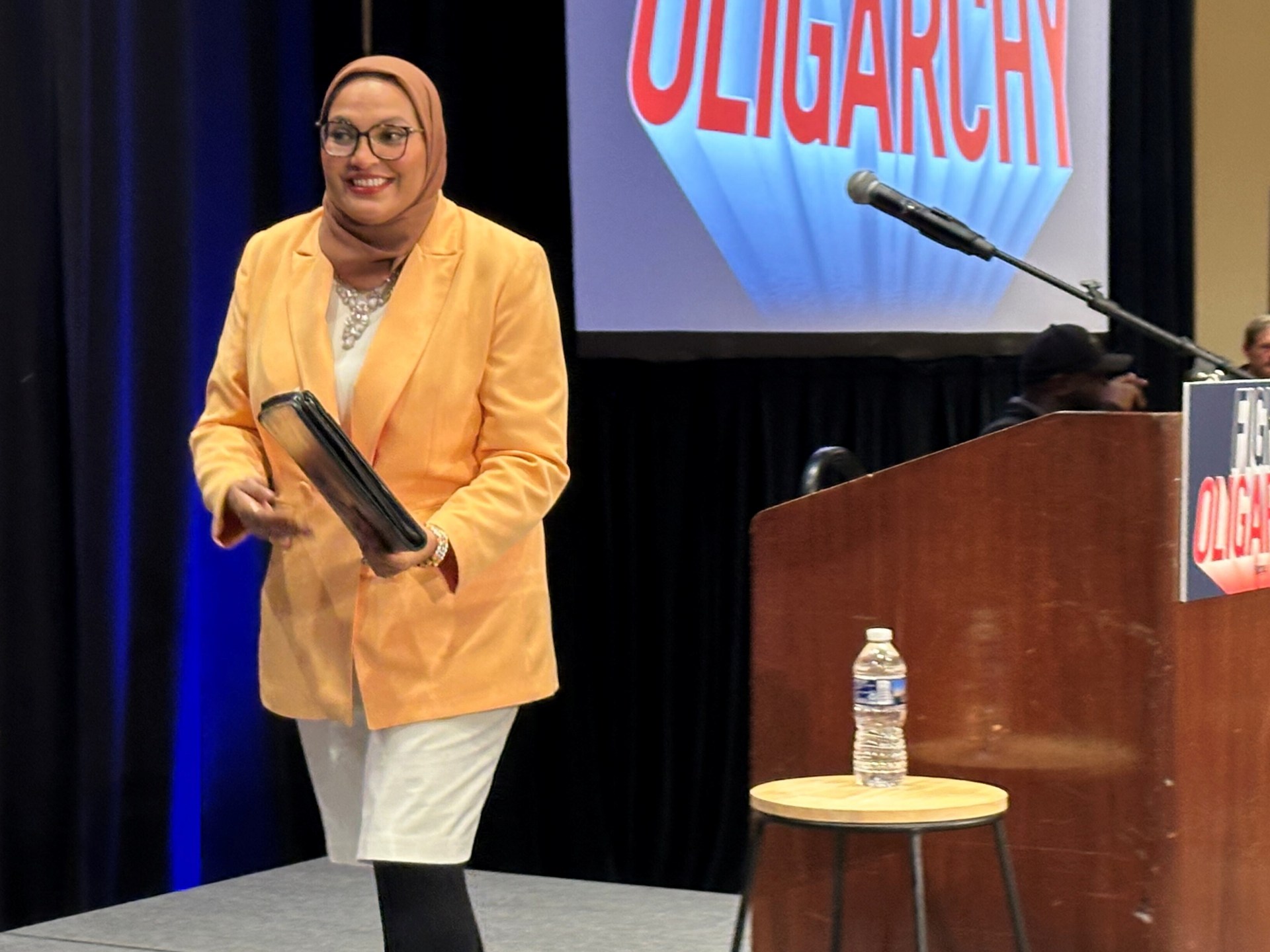
In two early primary races for US congressional seats, 32-year-old Nida Allam and 26-year-old Kat Abughazaleh hope to provide an answer, with both launching brazen progressive campaigns built on unapologetic stances calling for the abolishment of Immigration and Customs Enforcement (ICE), a hard reset of US policy amid Israel’s genocidal war in Gaza, the reversal of a rights backslide, and worker-first policies.
- list 1 of 3US Congressman Randy Fine suggests Muslims should ‘be destroyed’
- list 2 of 3Why is a moderate Democrat’s primary loss being called an AIPAC backfire?
- list 3 of 3Pro-Israel lobby group pressures ‘moderate’ US Democrat in new strategy
end of list
In the wake of the US-Israeli strikes on Iran, and Iran’s resulting strikes on countries across the region, the pair have also vowed to grow anti-war voices in Congress calling for checks on Trump’s power.
Their success will not only take the temperature of Democratic voters in the US, but could also send a message to party leadership still strategising how it will approach a deeply consequential midterm season. The November vote will decide which major US party – Democrat or Republican – controls the House of Representatives and Senate, and in turn, the shape of the latter half of Trump’s second term.
Up first will be Allam, whose March 3 primary for North Carolina’s fourth congressional district, a tech and research hub that includes the city of Durham, pits her against Representative Valerie Foushee.
In 2022, the incumbent Foushee defeated Allam, who cut her political teeth as a regional director for US Senator Bernie Sanders, in a crowded primary race buoyed by a deluge of outside spending, including millions in funding from a super PAC linked to the American Israel Public Affairs Committee (AIPAC).
Advertisement
“My leadership has always been rooted in being unapologetically proud of who I am,” said Allam, whose parents are from India and Pakistan and who, in 2020, became the first Muslim woman ever elected to public office – her post as county commissioner – in North Carolina.
“If we don’t step into these moments of discomfort and take these risks, then I don’t know what world I’m going to be leaving behind for my children,” Allam told Al Jazeera. “The time of just being able to silence our votes to push us into submission is gone. The working class is sick and tired of being told to wait our turn.”
Two weeks later, Abughazaleh, a journalist and researcher of the US far right, will face a crowded field of 15 Democrats vying to replace retiring US Representative Jan Schakowsky.

She is considered one of three top contenders in the March 17 race to represent the vastly ethnically and politically diverse district that snakes across the northern Chicago suburbs, taking on local mayor Daniel Biss and state senator Laura Fine.
“I think part of the reason that our campaign has been so successful, part of the reason that our launch went so viral … is because a lot of people saw someone just speaking honestly and openly about the Democratic Party needing to, as I said then, grow a [expletive] spine,” said Abughazaleh, who is Palestinian American, the granddaughter of survivors of the Nakba.
“People are sick of BS,” she told Al Jazeera. “They want someone who will say what they believe and not constantly focus group test their views or their statements. ”
A punishing 2024 cycle
The enthusiasm surrounding candidates like Allam and Abughazaleh, and a slate of other progressives facing early primaries, including fellow congressional candidates Junaid Ahmed in Illinois and Frederick Douglass Haynes III in Texas, follows a 2024 election cycle that set back the party’s leftward flank.
That segment grew dramatically in Congress in 2018, with the upset victories of New York’s Alexandria Ocasio-Cortez, Massachusetts’s Ayanna Pressley, and Michigan’s Rashida Tlaib, who became the first Palestinian American woman and the first Muslim woman elected to the chamber.
Subsequent elections saw the “squad” grow, with victories for Jamaal Bowman in New York, Ilhan Omar in Minnesota, Cori Bush in Missouri and Summer Lee in Pennsylvania.
In 2024, Bush and Bowman both lost their primary races, facing challengers buoyed by millions of dollars in advertisement buys, with AIPAC and its affiliated super PAC spending more than $100m across the primary season.
Advertisement
Amid the onslaught, organisations that back progressives took a largely defensive stance.
Usamah Andrabi, the communications director for Justice Democrats, said “2024 was a cycle where the super PACs really organised themselves in their opposition, particularly AIPAC and crypto, and threatened to take out our entire slate in Congress”.
“I think it became clear to us that the priority had to be protecting our incumbents against this $100m [AIPAC] threat,” he said.
“We left that cycle being very clear-eyed that no matter the outcome of the November results, we were going to go full steam ahead and punch back this cycle.”
Meanwhile, the 2024 “uncommitted movement”, in which voters cast “uncommitted ballots” in the presidential Democratic primary to protest Washington’s continued support for Israel amid the genocide in Gaza, further underscored the Democratic leadership’s failure to reflect a large portion of voters, he said.
Polls have repeatedly suggested that a majority of Democrats are opposed to Washington’s continued unconditional support for Israel.
“We learned what we’ve always known, which is that the Democratic Party leadership and the establishment group of donors, advisers and career politicians who have occupied this party for so long are deeply out of step with the grassroots and everyday people in this party,” Andrabi said.
“They should be looking to what people are marching in the streets for, what millions of people across the country are demanding.”
Personal origins
For Allam, the current political moment is a culmination of the overlapping realities that have shaped her life.
She shares the outrage over the Trump administration’s mass deportation policy that has soared in recent months, buoyed by several violent incidents involving immigration enforcement agents, including the killing of two US citizens.
But Allam also points to the genesis of ICE itself, created as part of the Department of Homeland Security (DHS) in the wake of the September 11, 2001 attacks that saw the federal government target Muslims and Arab Americans across the country.
In the wake of those attacks, she recalled her third-grade teacher asking her to explain why Muslims “hated Americans”. She further attributes her political awakening to the 2015 killing of her friends Deah Barakat, Yusor Abu-Salha, and Razan Abu-Salha, long charging that the attack was fuelled by hate, and not by a parking dispute, as police officially said.
“That was a huge awakening for me to see that the reason it’s so easy to dismiss hate and bigotry against Muslims, against immigrants, is because we don’t have a seat at the table,” she said, “and we’re always demonised and dehumanised by our leaders.”
A day before her primary election, Allam released an advertisement focusing on the deadly bombing of a girls’ school in Iran amid US-Israel attacks over the weekend, vowing to be your “proudly uncompromised pro-peace leader in Washington”.
Her opponent, incumbent Foushee, has also condemned the war as “an unconstitutional escalation that risks dragging the United States into another catastrophic and endless war in the Middle East”, but the war has upped scrutiny of her past support from defence contractors and pro-Israel groups.
Abughazaleh, meanwhile, recalled visiting the Democratic National Convention in Chicago in August 2024, where she spent the night with delegates of the uncommitted movement amid shared outrage over party officials’ refusal to allow a Palestinian to address the convention, even denying Ruwa Romman, a highly respected Palestinian-American Georgia state lawmaker, the opportunity.
Advertisement
“It wasn’t supposed to be an overnight sit-in. We were just supposed to be there until they decided that this was discrimination, but they didn’t, and so we slept on the concrete,” said Abughazaleh.
“I grew up as an Arab kid in post 9/11 Texas, and I heard slurs thrown by people that were DNC attendees that I have never heard in my life,” she added.
Fourteen months later, Abughazaleh experienced the Trump administration’s Department of Justice firsthand when she was indicted for taking part in a demonstration outside of an ICE detention centre in Broadview, Illinois.
Federal prosecutors said Abughazaleh “physically hindered and impeded” an immigration enforcement agent, who was subsequently “forced to drive at an extremely slow rate of speed to avoid injuring any of the conspirators”.
“It’s still surreal to see your name underneath the ‘United States government versus …'” reflected Abughazaleh, who has condemned the move as a blatant attack on constitutional rights.
“But this was not a surprise … We knew that the administration would violate laws and abuse their power in this way,” she said.
The final stretch?
Both candidates have faced large ad buys as their election days approach.
While Allam’s opponent, Foushee, has sworn off taking money from AIPAC this time around, at least one super PAC in the race appears to have ties to pro-Israel interests. A large portion of Foushee’s support has come from AI super PACs, with Allam’s opposition to an AI data centre in the district a key issue of the race.
Allam has also seen an influx of money from outside progressive groups. All told, the at least $4.2m in outside money that has poured into the race makes it the most expensive in state history, according to the non-profit news site NC Newsline.
A super PAC reportedly linked to AIPAC donors, dubbed Elect Chicago Women, has waded into Abughazaleh’s race. An analysis by the public radio station WBEZ Chicago found “AIPAC donors and affiliates” have spent $13.7m on four Chicago-area races, including Abughazaleh’s.
Still, both candidates see signs of hope in recent elections, particularly New York City Mayor Zohran Mamdani’s definitive victory last year and the upset primary victory of Analilia Mejia in New Jersey in early February.
“It’s one of these things where the establishment still tries to pretend that it is impossible for candidates like Mamdani, candidates like Nida Allam … candidates like myself, to be able to win, and that’s just not true,” said Abughazaleh.
Like Mamdani, she has run an unorthodox campaign that leans into a ubiquitous online presence to reach younger voters, while simultaneously operating a “mutual aid centre” from her campaign office to better connect with the community.
“I think that seeing Mamdani’s victory in New York made a lot of people … feel like their vote could mean something,” Abughazaleh said. “Which many people haven’t felt in a long, long time.”
Allam, meanwhile, said Mamdani’s success underscored the importance of thinking beyond a Republican-Democratic binary, particularly when it comes to supporting local communities over using tax dollars to “send bombs, to destroy hospitals, to destroy schools overseas”.
“These are working-class issues,” she said, “and I think that is what these moments are showing us. Our own Democratic establishment needs to see that we are failing the very base that we say that we stand up for.”
Related News
Missiles fly as 3rd round of Russia-Ukraine peace talks kick off in Geneva
Man killed after entering perimeter of Trump’s Mar-a-Lago resort
Brazil’s Lula says Maduro should face trial in Venezuela, not US