

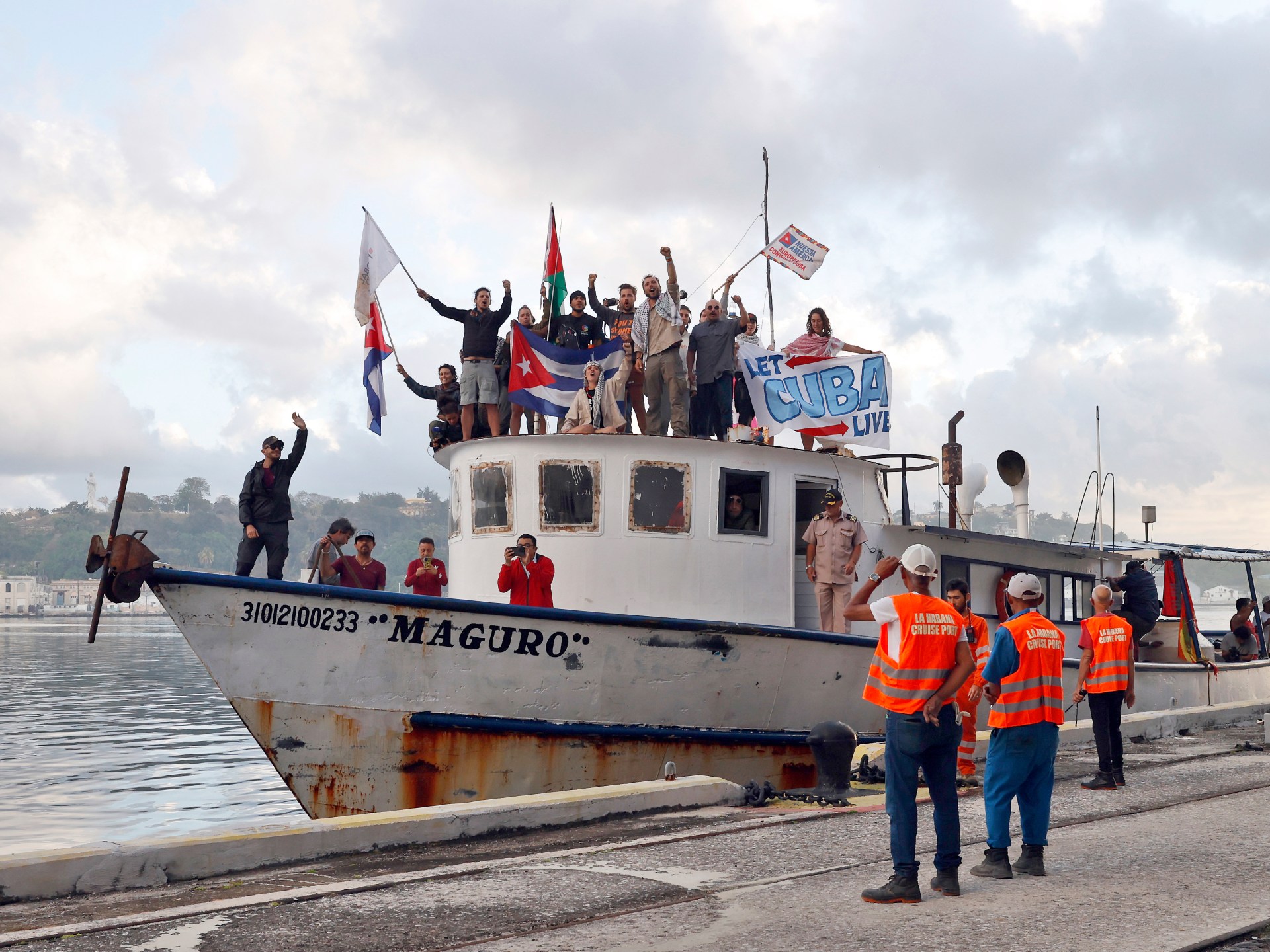

The first boat in a humanitarian aid flotilla has arrived in Cuba to support the island amid a worsening US energy blockade that is deepening its economic and energy crises.
A boat carrying about 30 people, including food, medicine, solar panels, and bicycles, arrived in Havana, the capital city, on Tuesday, part of the “Nuestra America” or “Our America” convoy that set out from Mexico last week.
- list 1 of 3Emerging from latest blackout, Cuba says ready for any potential US attack
- list 2 of 3Cuba ‘categorically’ rejects prospect of removing Diaz-Canel in US talks
- list 3 of 3‘Can’t live like this’: Cuba hit by second nationwide blackout in a week
end of list
“This type of economic warfare shouldn’t exist, this attitude of a pirate state that doesn’t respect international law,” activist Thiago Avila said of the US blockade, which Cuban authorities say has resulted in a nearly total ban on petroleum imports over the last three months.
“These ships are a drop in an ocean of need,” Avila said. “At the same time, it’s a gesture of solidarity.”
The convoy comes as US President Donald Trump and his allies continue to express their desire for regime change in Cuba, using greater energy restrictions to further degrade the Cuban economy. Trump has stated that he could “take” Cuba and select a government more amenable to US demands.
The vessel on Tuesday — called the “Granma 2.0” in reference to the boat that ferried Cuban revolutionaries led by Fidel Castro to the island as part of an effort to overthrow the regime of US-backed strongman Fulgencio Batista — departed from Puerto Progreso, in Merida, Mexico, last week. Two other vessels are also en route.
More than 650 participants from 33 countries arrived on the island last weekend as part of the flotilla and were greeted by President Miguel Díaz-Canel.
The US has had an economic embargo in place against Cuba for decades, but the energy restrictions have cut off a vital economic lifeline and contributed to a series of widespread blackouts.
Advertisement
Cuba’s Deputy Minister of Energy and Mines Argelio Abad Vigo stated last week that the island, which produces only about 40 percent of the fuel it needs, has gone for three months without access to vital supplies of diesel, fuel oil, petrol, jet fuel, and liquefied petroleum gas.
A February YouGov poll found that 46 percent of people in the US disapprove of the energy blockade, while 28 percent support it. A small plurality of 29 percent also said that the US approach towards Cuba was too harsh, while 26 percent said it was about right. Only 11 percent said the approach was too lenient.
Related News
Will the Houthis join Iran in war against Israel and the US?
Children among victims in Pakistan’s shelling in Afghanistan: Taliban
Press freedom declines in Americas, with US seeing sharpest drop: Report
