



Published On 26 Nov 202626 Nov 2026
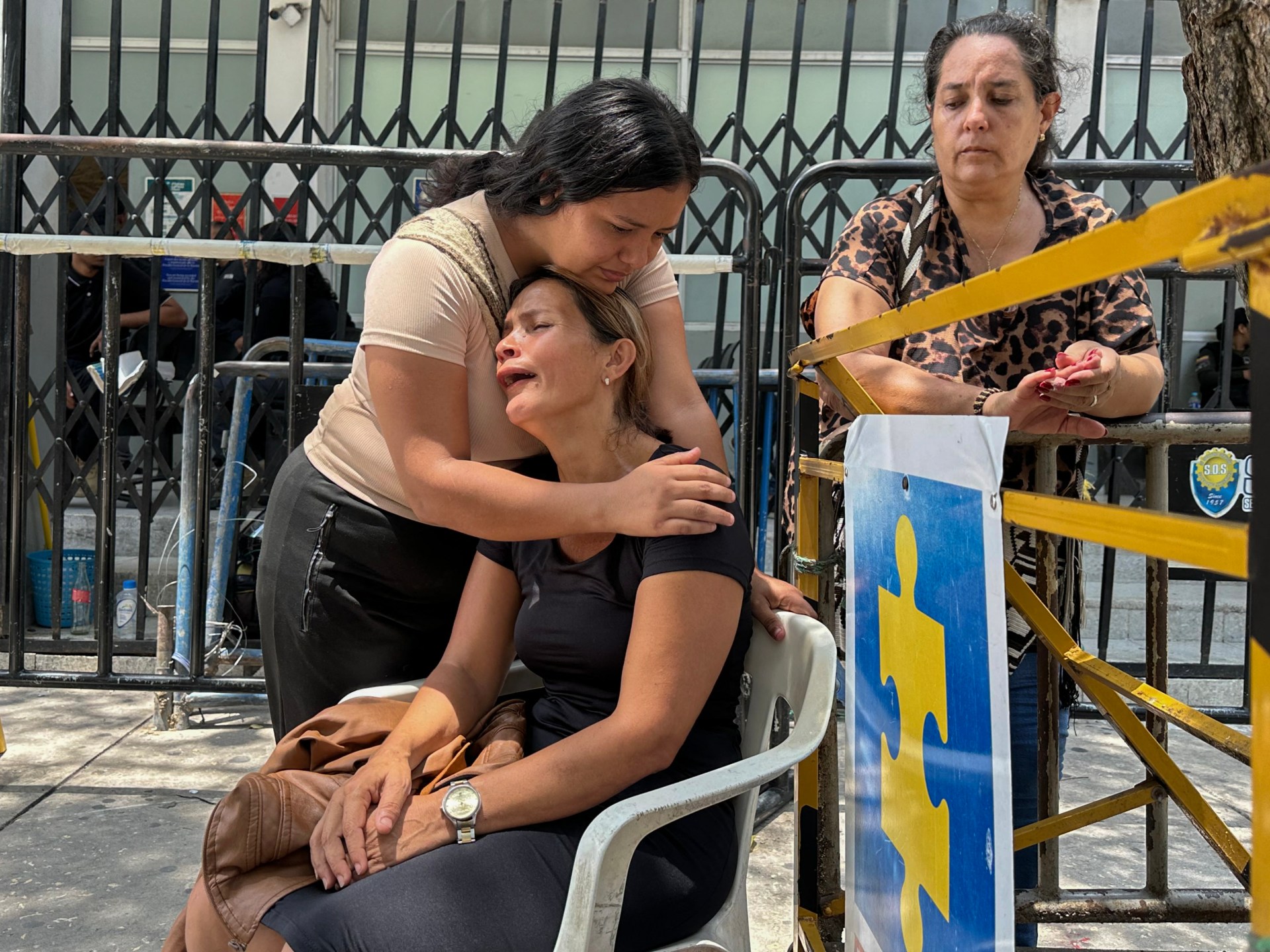
Bogota, Colombia – On the afternoon of September 13, Marelvis Rodriguez said goodbye to her 18-year-old son for the last time.
Ricardo Martinez left home that day for a cattle ranch, tucked away in the Sierra Nevada mountains of northern Colombia, where he said he had been hired as a day labourer to help vaccinate a herd.
A week later, on the morning of September 21, police stormed the ranch, targeting a top commander of the Conquering Self-Defence Forces of the Sierra Nevada (ACSN), a paramilitary force that traffics cocaine to Central America, the United States and Europe.
President Abelardo de la Espriella appeared that night before the media, praising the operation that had ended in the deaths of seven alleged paramilitary fighters and three arrests.
"This is undoubtedly a major blow to this narcoterrorist organisation," he said.
Seven white body bags, laid out near a table full of semi-automatic rifles and ammunition, were presented as evidence of the operation's success. Inside one of the body bags was Martinez.
The raid was one of the most high-profile operations of de la Espriella's security crackdown since he took office in August. He has pledged to wage all-out war against Colombia's armed groups, abandoning the country's peace talks and prioritising military offensives instead.
His iron-fisted strategy, he says, will help to secure peace after more than six decades of internal armed conflict in Colombia.
But the operation, which killed Jose Perez, the ACSN's second-in-command, has prompted allegations that a civilian, Martinez, was killed and falsely presented as a paramilitary fighter.
"My son was not part of any armed group," said Rodriguez. "All I want is for justice to be served and my son's name to be cleared because he had nothing to do with the [ACSN]."
The case has ignited fears of a return to one of the darkest chapters in Colombia's internal conflict: a wave of extrajudicial killings known as the "false positives" scandal.
Between 1990 and 2016, state agents killed more than 7,800 civilians and presented them as enemy fighters, according to Colombia's Special Jurisdiction for Peace, a state tribunal.
"We fear that we could see a resurgence of false positives," said Lerber Dimas, the director of the Human Rights Defenders Platform of Sierra Nevada, an organisation that investigates human rights abuses.
Even politicians have warned of the possibility. Representative Daniel Monroy led a protest in Colombia's Congress to highlight Martinez's death, calling it the "first extrajudicial execution of the Abelardo de la Espriella administration".
"Why are they killing young people and presenting them as combat casualties?" the left-wing congressman asked.
Separately, Monroy posted on social media: "I never thought Abelardo would resort to the 'false positives' so soon."


A tight mother-son bond
Living in the Sierra Nevada mountains was meant to be a safe haven for Rodriguez and her teenage son.
In 2020, Rodriguez lost her jobs as a sales associate at a travel agency and as a mariachi singer during the COVID-19 pandemic.
She decided she needed a fresh start. She sold her home and moved to the rural outskirts of Santa Marta, a popular seaside destination rimmed by the Sierra Nevada. There, in the foothills of the mountain range, she bought a 2.5-hectare (6.2-acre) plot of land.
The very next year, a war broke out between the ACSN and the Gulf Clan, the country's largest drug cartel, as they vied for control of international drug routes.
Her neighbourhood, however, was largely spared the violence. Rodriguez said she occasionally saw armed men passing by her home, but the conflict rarely intruded into her day-to-day life as a farmhand and day labourer.
As a single mother, her primary concern was making ends meet. Martinez, her youngest son, dropped out of school and joined his mother in working to support their two-person household.
They picked up odd jobs, from construction work to coffee harvesting to milking cows.
"Everywhere I went, he went," Rodriguez said. "He worked with me on nearby farms. When we didn't have work, we'd go looking for work. We were always working together."
In recent months, he had begun talking to his mother about the future. He planned to learn English so he could become a tour guide and eventually open a hostel to tap into the region's tourism industry.
For the most part, their lives had been peaceful, Rodriguez said.

That sense of normalcy was shattered on the afternoon of September 21, when news spread on social media that a police operation had taken place near the ranch where her son worked.
Rodriguez dropped everything and rushed to find him.
She found that the authorities had blocked off the road, and as she waited to be let through, she learned that police had targeted the ranch itself. At the suggestion of locals, she went to the forensic institute in a nearby city the next day.
There, officials confirmed that her son had been killed.
The Defence Ministry has not publicly explained what happened during the police operation.
It declined to comment to Al Jazeera, saying that cabinet ministers were not allowed to speak to the media without the president's approval.
The presidency also did not respond to a request for comment.


Unresolved questions
Dimas said he pieced together an account of that day based on interviews with local residents.
According to his sources, armed ACSN members arrived at the ranch in the early morning, seemingly intoxicated and tired after a late-night celebration.
They had stopped to rest before continuing their journey up the mountains.
It was then that the police raided the ranch. According to a witness, police singled out Martinez, who was unarmed and dressed as a civilian, and fatally shot him in the chest.
In the days following the operation, rumours circulated online that Martinez was the son of Freddy Castillo, the ACSN's top commander.
Local residents and even the ACSN itself attributed Martinez's death to police believing the false rumour.
An image altered by artificial intelligence also falsely depicted Martinez as carrying a gun. It spread on social media after the police operation, as evidence of his ties to the group.
But on September 24, the Defence Ministry addressed the claims in a social media post, clarifying that Martinez was not Castillo's son. The ministry added that it was up to the Attorney General's Office to determine what people were doing at the ranch at the time of the raid.
Martinez's family has been left struggling to find answers on its own. Rodriguez said that the state forensic institute refused to release an autopsy report for her son.
She added that his body was returned four days after his death, so badly decomposed that one of her family members advised her not to view it.
When Rodriguez filed a complaint at the Attorney General's Office over her son's death, she learned that three suspects had been detained at the ranch.
The revelation left her with questions about why deadly force was used in her son's case.
"Why would they take a young man dressed in civilian clothes and kill him? Why didn't they arrest him? If they had taken him into custody and carried out the proper investigations, he would have been released because he had nothing to do with any of it," she said.
The Attorney General's Office told Al Jazeera that the case had been referred to the military justice system, which investigates alleged crimes committed by security forces, "because it was a planned and scheduled police operation" that had received prior judicial authorisation.


Protecting civilians
Martinez's death raised concerns that the government's aggressive security strategy could put civilians at risk. Since then, two new allegations of extrajudicial killings have emerged.
Still, de la Espriella has maintained an approval rating of more than 48 percent as of November, according to the research firm AtlasIntel. That puts him ahead of other public figures in the survey, including his predecessor, Gustavo Petro.
His hardline approach to security has been informed, in part, by pressure from the US. The administration of US President Donald Trump has pushed Latin American leaders to dismantle groups it considers "narcoterrorists".
But achieving that security goal will likely prove difficult, according to Laura Bonilla, deputy director of the Peace and Reconciliation Foundation, a Colombian think tank.
As armed groups have expanded in recent years, they have increasingly embedded themselves in civilian populations and are operating in smaller units that are harder to detect, she said.
"Most armed groups today are not easily identifiable. They don't go around wearing uniforms and boots," she said. "They no longer have camps of 200 people."
The conflict today, she added, "requires a different approach, relying much more on police and judicial capabilities and, above all, intelligence rather than large-scale military operations".
Many experts, however, believe that the pressure to deliver quick results can undermine a more methodical approach.
"When you're under pressure to produce results, you don't have the time to properly plan an operation, assess all the intelligence, and consider the collateral effects," Dimas said.
His organisation believes that security forces should take extra precautions to prevent civilian deaths.
"We're telling the government that, if an operation poses a risk to civilians, it's better not to carry it out," Dimas said. "Instead, they should wait for another opportunity."
Rodriguez went further. She called on de la Espriella to stop military bombardments because of the risks they pose to civilians in rural areas and to improve intelligence gathering before operations.
"They should investigate thoroughly so that innocent people aren't hurt. There are farmers that live there too, young people with dreams, and mothers who love their children and want the best for them," she said.
At a cemetery in Santa Marta, Rodriguez recently brought an offering of red flowers to her son's final resting place. It has become her new Sunday ritual since his death.
"It's not fair," she said, before his tomb. "I want to know why – why they killed him when the authorities are supposed to protect citizens like him."
Related News
Hormuz oil traffic is down 40 percent: Are Iran’s tanker attacks working?
UN top court convicts Myanmar of ‘genocidal intent’ against Rohingya
One dead after two helicopters collide near Mount Everest in Nepal