
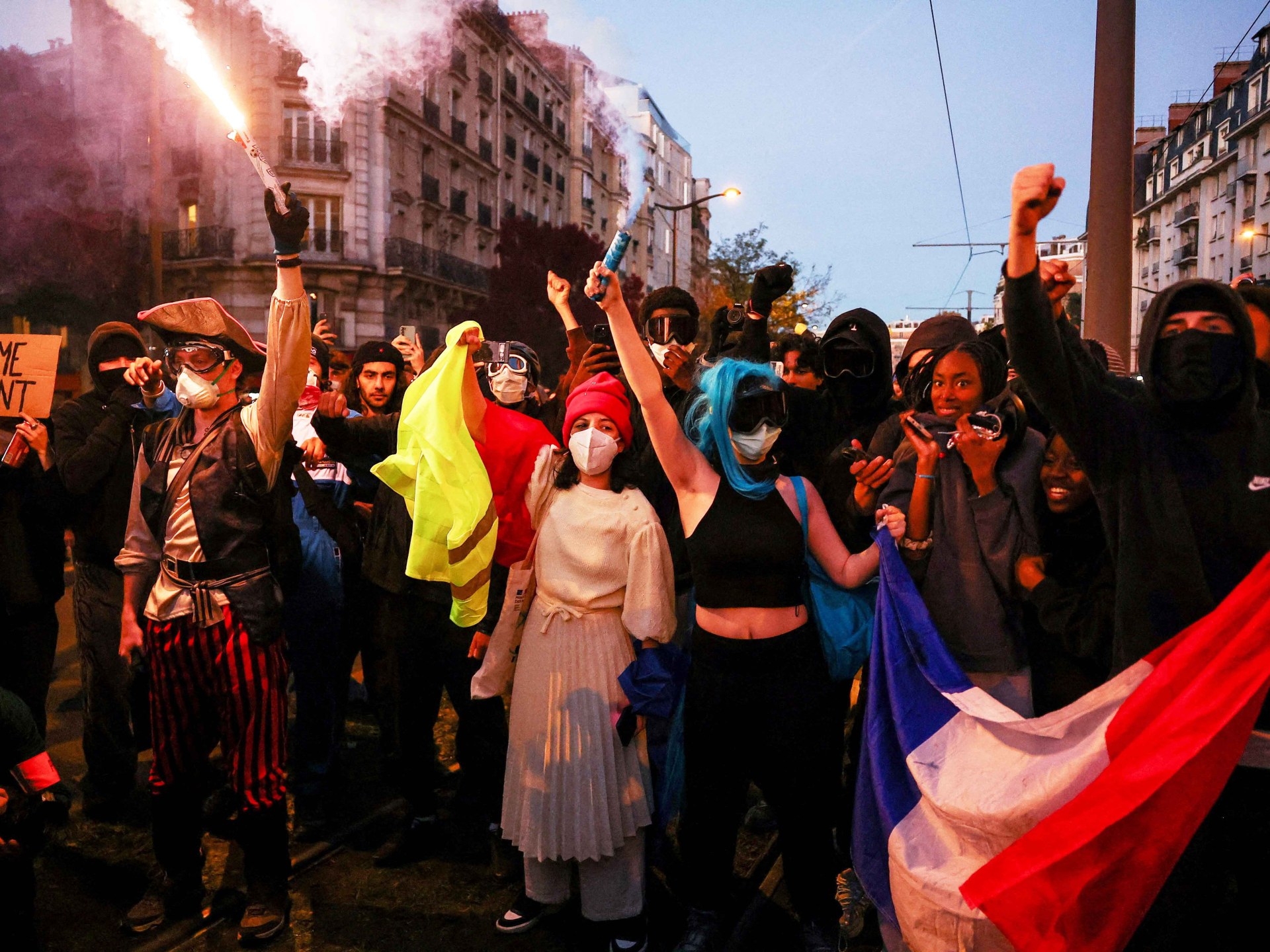

Protests across Europe show no sign of abating.
They subside on certain days, only to flare up a few days later. Largely led by young people, demonstrations have swept across at least eight European countries, driven by grievances ranging from school conditions and the cost of diesel to a deeper sense of insecurity about the future – and the feeling that opportunities are increasingly out of reach.
- list 1 of 3UK to double wait for permanent residency, with exemptions for care workers
- list 2 of 3California’s Bay Area debates data centres ahead of US midterm elections
- list 3 of 3‘Going hungry’: Garment workers in Bangladesh say wages barely cover needs
end of list
“They are plural and uncoordinated, with no single leader or programme,” said Alberto Alemanno, professor of European Union law and policy at HEC Paris Business School. “So it’s less a rejection of one policy and more a signal that people no longer trust the system to deliver. That’s why they are so critical.”
For governments, addressing discontent is proving difficult. Experts say there is no easy fix, and that many have so far struggled to offer answers beyond a show of force. The protests are likely to continue, they warn.
“Where there has been a reaction, the focus is on public order and security,” Alemanno said. “Part of the reason is that, like any popular protest, these movements include or attract small violent minorities. They dominate the headlines and risk undermining legitimate claims.”
Rallies continue because they are increasingly about more than individual grievances, said Donatella della Porta, a political science professor at the Scuola Normale Superiore in Florence. While governments have tried to address some of the protesters’ material demands, they have failed to grasp the broader political concerns driving the demonstrations.
Advertisement
“At this point, protests are no longer just about investing more in the school system. There are also fundamental issues, including military spending, governments’ alliance with [United States President Donald] Trump, the rising cost of gasoline and the war in Iran,” she said. “The issue of Palestine is also very central to these protests.”
This week, protesters have continued to blockade several high schools and universities in France, where students have been pushing for better conditions, more teachers and the replacement of Parcoursup, an admission system that some say is discriminatory.
In Germany, metal and electrical workers have gone on strike while students have demonstrated over fears of the return of conscription. In Belgium, firefighters marched through Brussels, demanding more staff and better equipment. And on Friday in Italy, the USB union brought tens of thousands of people together, calling for a reduction in military spending.

France’s Education Minister Edouard Geffray said on Monday that some measures to meet students’ demands have been adopted, including capping class sizes to 28 for the first year of high school, creating 10,000 places in higher technician programmes, and transforming Parcoursup.
Other measures require in-depth work between now and the end of December, he said on X. But the announcements have failed to quell the protests. On Tuesday, dozens of schools remained blockaded and several universities were disrupted, according to French media.
A nationwide strike over wages, the cost of living and public services is also expected on November 5.
In Spain, massive protests swept through the country for weeks over a housing crisis, triggered by the eviction and subsequent death of an 87-year-old pensioner from her lifelong home. On Tuesday, police dismantled a sprawling tent camp in Madrid’s Puerta del Sol square.
Officials said the eviction took place overnight “without incident or episodes of violence”, reporting that 334 people were removed and two arrested.
In a post on Telegram, protest organisers lamented “a violent police operation” that they said left several people injured.
The government has approved new housing measures, including limits on rent increases and temporary protections against eviction for some vulnerable tenants.
But these promises have done little to dissuade protesters, who are planning a general strike over housing rights and the cost of living on November 11.

In Italy, after violence broke out during protests two weeks ago, the government of far-right leader Giorgia Meloni tightened security measures. “Violent participation” in a demonstration – by joining a group of five or more people and throwing stones, firecrackers or sticks – was made a criminal offence that could result in up to five years in prison and a fine of up to 20,000 euros ($22,500). Italy also made parents liable for damage caused by their children and adopted a policy of preventive detention of children.
Advertisement
The growing emphasis on public order has raised concerns among human rights organisations, which warn that European governments risk treating social discontent as a security threat rather than addressing the grievances behind it.
In a statement in October, UN High Commissioner for Human Rights Volker Turk raised serious concerns about the state responses to protests across Europe and the unnecessary and excessive use of force against protesters, including children.
Following the use of tear gas and stun grenades, among others, by French police against young protesters, Human Rights Watch said the government should “listen to the demands of young people on the streets”.
Della Porta said governments risk further alienating protesters by responding to demonstrations primarily through policing and repression.
“They can start by doing concrete things, such as recognising the right to protest and not sending police in a counterinsurgency-style approach to repress students,” she said.
Several European governments face significant fiscal constraints, while simultaneously increasing defence spending and investing in security. They now find themselves having to respond to demands for better public services, affordable housing and higher living standards while their budgets are increasingly stretched.
The fiscal constraints are particularly visible in some of Europe’s largest economies. Italy’s public debt is projected to reach 138.5 percent of gross domestic product (GDP) in 2026, limiting its room for additional spending. France faces an even more immediate budgetary squeeze, with its deficit forecast at 5.4 percent of GDP, well above the EU’s 3 percent limit. Spain, meanwhile, has struggled to secure parliamentary approval for a new budget, forcing the government to roll over its 2023 spending plans.
These pressures come as governments are trying to increase defence spending, while citizens are demanding more investment in housing, education and public services.
There is no easy option, Alemanno said, and “money is only part of the answer.”
“People will tolerate hard trade-offs if they are explained and if citizens have a say in them. Ignoring them is what fuels anger.”
Related News
Ethiopian forces expand control in Tigray as militia claims Eritrean losses
District of Columbia and Virginia sue to block Trump’s triumphal arch plans
Keisha Lance Bottoms makes US history as first Black woman elected governor