
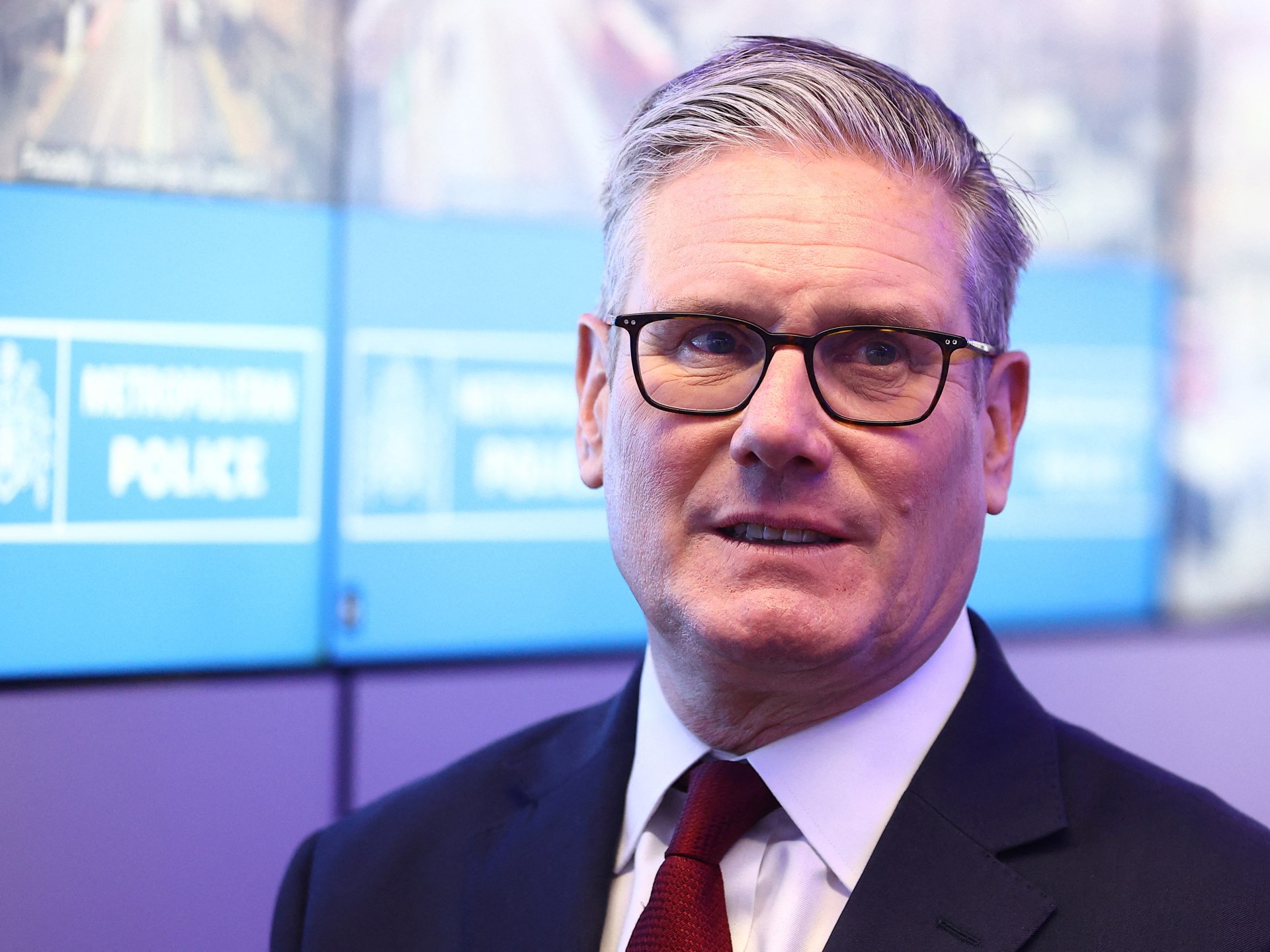

Amid all the backstabbing and plotting in Britain’s beleaguered Labour Party, one crucial fact can easily become lost in the twists and turns of the saga – embattled Prime Minister Keir Starmer has not even faced a formal challenge to his leadership yet.
Instead, he is facing a slow-motion coup that could drag on for weeks, with no guarantee that the many Labour MPs who want him to be replaced as PM will succeed. In the meantime, Britain will be adrift in leadership limbo.
- list 1 of 3Britain’s Health Secretary Streeting resigns as pressure on Starmer grows
- list 2 of 3Burnham set to run for UK parliament increasing pressure on PM Starmer
- list 3 of 3UK ex-health minister says will run to replace Prime Minister Keir Starmer
end of list
Conservative Party leader Kemi Badenoch taunted Starmer last week, declaring: “The PM has shown he is in office but not in power.”
This was a deliberate echo of what former chancellor Norman Lamont told Conservative Prime Minister John Major in 1993 in one of many bouts of infighting in the Tory party over the decades.
The Conservatives have traditionally been far more efficient at challenging their prime ministers than Labour. Margaret Thatcher, who won three successive elections and dominated British politics in the 1980s, was forced out in 1990, and was photographed weeping as she was driven away from Downing Street.
Her successor, John Major, launched a challenge against himself in 1995, resigning as party leader although not as prime minister, and challenging his critics to “put up or shut up”. He resoundingly won the ensuing leadership ballot.
Theresa May faced a confidence vote in 2018, triggered by her opponents in the party. Although she won it, the number of MPs who voted against her profoundly undermined her authority and she resigned six months later with a tearful statement.
Advertisement
Her successor Boris Johnson faced a Tory confidence ballot in 2022. Like May he won it, but the large number of no-confidence votes hastened the end of his premiership.
No sitting Labour prime minister has ever faced a formal leadership challenge.
![Britain’s former Health Secretary Wes Streeting delivers a keynote address at the Progress annual conference 2026, in London, Britain, May 16, 2026. [Jaimi Joy/Reuters]](https://www.aljazeera.com/wp-content/uploads/2026/05/2026-05-16T142012Z_431773176_RC2EALASI6W7_RTRMADP_3_BRITAIN-POLITICS-1778948732.jpg?w=770&resize=770%2C513&quality=80)
The differences in institutional culture and rules for a leadership challenge between the Conservatives and Labour provide part of the explanation.
For the Conservatives, 15 percent of MPs can trigger a confidence ballot by submitting letters anonymously – so coups can proceed quickly.
Labour requires 20 percent of MPs to endorse a challenger to the PM, which then triggers a leadership election decided by the party membership across the country.
This means that Labour leaders can sometimes survive, despite not having the support of most of their MPs, while conversely, Conservative leaders can sometimes be toppled despite still being popular with party members and voters.
This was most starkly illustrated in 2016 when Labour leader Jeremy Corbyn survived a massive rebellion by his own MPs. Mass resignations by prominent shadow cabinet ministers and junior frontbenchers crippled his shadow leadership team, and he was trounced in an ensuing confidence vote by 172 votes to 40.
But Corbyn refused to step down, and emphatically won a vote by Labour party members, with 62 percent support compared to 38 percent for challenger Owen Smith. Extraordinarily, Corbyn emerged with his position stronger than ever. Smith suffered because his challenge was seen as disloyal and an attempt to thwart Corbyn’s mandate in the party.
This is a recurrent theme in British political coups. The charismatic politician Michael Heseltine, after becoming Margaret Thatcher’s most high-profile Conservative opponent in 1986, said that his perceived disloyalty would probably prevent him from ever becoming prime minister: “I knew that he who wields the knife never wears the crown”.
This has become received wisdom for many MPs. A recurring theme in party leadership struggles is that nobody wants to make the first move to challenge the incumbent. Everybody tends to hold off, waiting for someone else to do the backstabbing.
In The End of the Party, his book on the ousting of Tony Blair and the subsequent general election defeat of Gordon Brown, the Observer newspaper’s chief political commentator Andrew Rawnsley wrote: “Brown was … torn between his craving to bring down Blair and his fear of the consequences of being seen with the dagger in his hand.”
Advertisement
After Blair eventually agreed to step down, and Brown became an increasingly unpopular prime minister, there were three concerted attempts to oust him. All failed, even though the rebels had the support of the majority of the cabinet and most Labour MPs. Leading ministers and potential challengers repeatedly got cold feet, fearful of the consequences of undermining the prime minister.
“A central characteristic of New Labour had been its appetite for power, the burning conviction that there is nothing to be said for the impotence of Opposition. Historians will ask why the party chose to go into an election with an atrociously unpopular leader with severe deficiencies as a communicator whom every senior colleague thought was taking them to an awful defeat,” Rawnsley wrote.
“One explanation was the sheer incompetence of the regicides. All three attempted coups against Brown – in autumn 2008, spring 2009 and January 2010 – were botched. Key ministers did not organise with decisive ruthlessness from a mixture of cowardice, fear of a bloody split and a pessimistic assumption that defeat was unavoidable.”
Starmer is seen as a much less menacing figure than Brown, but political commentators say similar fears are in play in the current turbulence within Labour.
Labour’s appalling election results on May 7, which saw the party losing 1,498 local council seats in England, mainly to Reform and the Greens, and losing control of the Welsh Senedd, galvanised opposition to Starmer among many MPs and cabinet ministers who believe he has no chance of beating Reform at the next general election.
British newspapers have reported that at least three cabinet ministers – including Home Secretary Shabana Mahmood and Foreign Secretary Yvette Cooper – have privately pressed him to set out a timetable for his departure.
Health Secretary Wes Streeting, who has made no secret of his political ambitions, quit the cabinet on May 14, telling Starmer in his resignation letter: “It is now clear that you will not lead the Labour Party into the next general election, and that Labour MPs and Labour unions want the debate about what comes next to be a battle of ideas, not of personalities or petty factionalism.”
Streeting has confirmed he would enter a potential Labour leadership contest, saying on Saturday that the party needs a proper contest with the best candidates. But he has not launched a formal leadership challenge.
![Britain's Prime Minister Keir Starmer meets school children at a breakfast club with Greater Manchester Mayor Andy Burnham, during a visit to a primary school in Ashton-under-Lyne, Greater Manchester, Britain, April 13, 2026. [Paul Ellis/Reuters]](https://www.aljazeera.com/wp-content/uploads/2026/05/2026-04-13T115819Z_1722709855_RC28OKAD6OJE_RTRMADP_3_BRITAIN-POLITICS-STARMER-1778581225.jpg?w=770&resize=770%2C513&quality=80)
The ‘King of the North’
Another reason for the curious slow-motion shadow war is that the man regarded as Starmer’s most likely successor is not even in the House of Commons yet.
Greater Manchester Mayor Andy Burnham – nicknamed the “King of the North” by British media in an allusion to Game of Thrones – has built a formidable powerbase in northwest England, after leaving the House of Commons in 2017 to take up his new position.
Advertisement
A YouGov poll earlier this month found he remains the most popular figure among Labour voters and the wider public, with a net favourability rating of +4 compared with -46 for Starmer and -28 for Streeting.
Burnham has faced formidable obstacles in his quest for the Labour leadership. His bid to resign as mayor and stand in the Gorton and Denton by-election in February was thwarted by Labour’s National Executive Committee, apparently at the behest of Starmer. Labour ended up in third place, behind the Greens who won the seat, and Reform.
Following the local election results this month, Starmer was urged by colleagues to allow Burnham back into parliament, if he could find a seat. Days of uncertainty followed as one after another, Manchester MPs ruled out stepping down to enable a by-election to be triggered that Burnham could then contest.
But on May 14, Makerfield MP Josh Simons announced he was willing to resign to give Burnham his chance. The following day, Labour’s NEC gave permission for Burnham to stand for the seat, in another sign that Starmer’s authority over the party is waning, according to British media.
The by-election – described by Sunday Times commentator Jason Cowley as “the most consequential since the Second World War because of what’s at stake” – is by no means a foregone conclusion. It is expected to be held on June 18.
Makerfield has been one of Labour’s safest seats since the constituency was created in 1983. In the 2014 general election, Simons won it with a reduced majority of 5,399. Labour’s share of the vote was 45 percent, compared with 32 percent for second-placed Reform.
Although the results of the recent local elections are not fully comparable due to slightly different constituency boundaries, Reform won 50 percent of the vote share, with Labour at 27 percent, the Greens at 10 percent, Conservatives at seven percent and four percent for the Liberal Democrats.
Reform leader Nigel Farage has said his party will “throw absolutely everything at the by-election” and the Greens have so-far rebuffed calls for them not to compete.
So it’s certainly possible Reform could win, which would boost the party’s momentum ahead of the next general election, due by August 2029, and prevent Burnham from challenging Starmer.
If the most popular potential candidate, Burnham, was unable to challenge Starmer, the Labour leadership struggle would be thrown into turmoil. Streeting has said he will contest any leadership election, and former deputy prime minister Angela Rayner has indicated she will stand if Burnham can’t. Starmer has given no indication he would not stand in a leadership contest, and so could still hang on as PM.
However, Burnham is much more popular than his party – particularly in northwest England – and his team believe they can beat Reform for this reason, British media say. A recent poll by Britain Predicts suggests Burnham would beat Reform.
If Burnham does get back into parliament, it is a virtual certainty that he will become Britain’s new prime minister. Several British newspapers have reported that, despite his public statements pledging to fight on, Starmer has privately told allies that he is listening to the voices in the party and considering setting out a timetable for leaving office.
“If Andy wins Makerfield he will be carried aloft into the Westminster tearooms on the shoulders of Labour MPs,” a Labour cabinet minister was quoted as saying.
“There is simply not a world in which he doesn’t win the leadership so it must be a coronation – because the last thing we need is a damaging leadership battle.”
Advertisement
But there is a long way to go, and in the meantime the leadership limbo will persist.
Robert Peston, political editor of ITV News, wrote on his Substack that Starmer’s authority has ebbed away: “The timing and manner of his exit are now at the mercy of events, which makes him a lame duck prime minister whose utterances about policy will barely be heard above the racket of speculation about how and when he will go.”
Related News

Manipur’s ‘unknown’ killers: Three years of India’s bloody ethnic conflict
Palestinians expose torture and sexual violence in Israeli detention

Acute hunger grips nearly 20 million people in war-battered Sudan, says IPC