Guyana: The Theatre Of Populism: How Performance Is Reshaping Guyana’s Politics
 22 March 2026

News Americas, TORONTO, Canada, Mon. March 23, 2026: A bizarre theatre unfolded at Guyana’s Attorney General’s office last Thursday, when the Leader of the Official Opposition arrived with wheelbarrows of small notes and coins to satisfy court-ordered costs of G$4.5 million. The payment stemmed from a failed legal attempt to block extradition to the United States, where he faces charges tied to an alleged US$50 million gold smuggling and money laundering scheme.
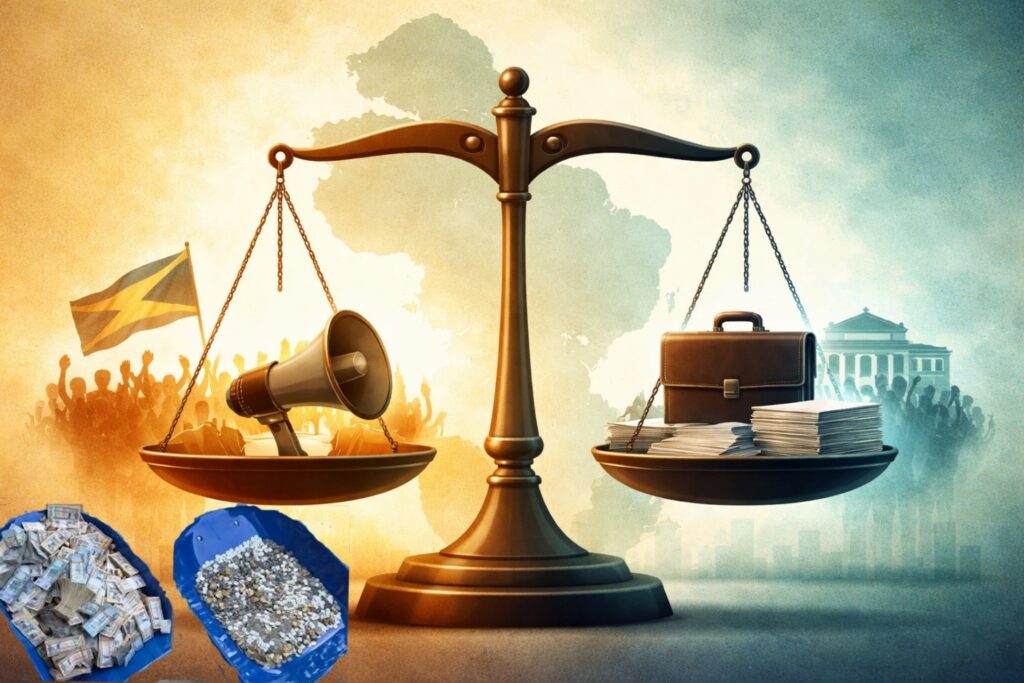
The spectacle was deliberate. It was political theatre designed not merely to pay a debt, but to project defiance, grievance, and identification with “the people.”
But it raises a more fundamental question: is this the movement that has displaced APNU as Guyana’s official opposition? How does such a transformation occur?
To understand this moment, one must first understand the myth, and the method, of the populist “champion of the people.”
The self-styled “champion of the people” presents himself as instinctive and unfiltered – a voice rising organically from the frustrations of ordinary citizens. Supporters reinforce this image: he “speaks his mind,” “says what others are afraid to say,” and “cannot be coached.”
This is a myth. What appears spontaneous is often carefully constructed. The language of grievance, the division of society into “pure people” and “corrupt elites,” and the ritual denunciation of institutions are not improvisations. They are elements of a well-worn political script; refined across countries and decades because they reliably produce results.
The resemblance among such figures is no coincidence. The pattern repeats with striking consistency: simplify complex realities into moral binaries, personalize power, and discredit institutions that might challenge the narrative.
Donald Trump exemplifies this model – reducing complexity into stark moral conflict while positioning himself as both victim and champion.
In Guyana’s current political moment, the leader of the We Invest in Nationhood, (WIN) movement has cultivated precisely this posture – presenting himself as a corrective to injustice, a voice for the overlooked, and a disruptor of the established order.
Yet this raises an inconvenient question: how does one become a “champion of the people” from a position of considerable privilege?
It is not a contradiction. It is a pattern.
Many of the most effective populists emerge not from deprivation, but from advantage. Their distance from everyday struggle becomes an asset. It allows them to construct grievance selectively, dramatize injustice without constraint, and perform identification with “the people” while remaining insulated from their realities.
Again, the example of Donald Trump is instructive – a billionaire who successfully cast himself as the tribune of the forgotten.
What matters is not biography, but the construction.
Human beings are predisposed to respond to narratives of threat, belonging, and betrayal – a dynamic long established in Social Psychology.
Effective populists do not invent these instincts; they exploit them.
The method is consistent:
- simplify complexity into moral conflict
- elevate the individual above institutions
- transform criticism into persecution
- dominate the narrative space, particularly through social media
What feels authentic is often rehearsed. What feels instinctive is often engineered.
If the “champion” is constructed, then the public must be brought to change how it evaluates him – not as a champion, but as a manager.
A champion thrives on emotion, symbolism, and defiance. A manager must deliver outcomes: competence, stability, institutional respect, and measurable progress.
This distinction explains a broader political reality. Consider Donald Trump and J. D. Vance. Vance can replicate arguments and mirror grievances, but he cannot replace Trump as the focal point of that movement.
Why? Because he presents as a manager attempting to perform a champion.
Trump, by contrast, is perceived, however controversially, as the authentic article. His appeal lies not in administrative precision but in emotional command. The contrast exposes a hard truth: populism is not merely a set of ideas. It is a performance not all can sustain.
The implications for Guyana are no longer abstract.
The rise of the We Invest in Nationhood, (WIN), movement has upended the country’s political architecture. In a stunning electoral breakthrough, a newly formed party captured 16 parliamentary seats, displacing APNU/PNC as the official opposition and fracturing what once appeared to be an entrenched political order.
This was not an incremental change.
It was a political earthquake – one that cannibalized the traditional opposition base and revealed a deep appetite for disruption over continuity.
That disruption now faces its most serious test.
Mohamed’s political rise has unfolded alongside an ongoing extradition battle tied to U.S. indictments alleging large-scale gold smuggling and related financial crimes. The case is not incidental to his political identity – it is central to it.
To supporters, it reinforces a narrative of persecution.
To critics, it raises fundamental questions about credibility and governance.
If extradition proceeds, WIN faces an existential challenge. Movements built around a singular figure rarely outlive his absence. Without Mohamed at the center, the party risks fragmentation, internal rivalry, or gradual absorption into the system it sought to disrupt.
If extradition does not proceed, the challenge shifts to his opponents.
For APNU/PNC, the lesson is stark: its base has been breached. Mimicking populist rhetoric will likely accelerate decline rather than reverse it. Renewal must come through credibility, organization, and a demonstrable capacity to govern.
For the governing PPP/C, the risk lies in miscalculation. If legal pressure is perceived as political containment, the “champion” narrative may deepen rather than diminish. A figure cast as embattled can become more potent, not less.
The more effective response is not theatrical opposition, but competent governance – delivering results, strengthening institutions, and addressing the grievances on which populism feeds.
Guyana is no longer confronting a personality alone. It is confronting a method.
A method that can rapidly redraw political loyalties. A method that thrives on distrust, feeds on division, and presents performance as authenticity.
And methods, unlike men, do not disappear when one individual exits the stage.
They wait – until the conditions allow them to return.
EDITOR’S NOTE: Ron Cheong is a frequent political commentator and columnist whose recent work focuses on international relations, economic resilience, and Caribbean-American affairs. He is a community activist and dedicated volunteer with extensive international banking experience. Now residing in Toronto, Canada, he is a fellow of the Institute of Canadian Bankers and holds a Bachelor of Science degree from the University of Toronto.

Related News

U.S. Gun Pipeline To Caribbean Exposed As Teacher Sentenced For Trafficking Weapons To Tri...
When The Quiet Decide: Reading The Votes, Voices, And The Spaces Between In St. Philip’s...

Leadership: The Lighthouse Principle – Leading People When The Map Keeps Changing