Analysis – Trump’s foreign policy message in a nutshell: ‘We can reach you’
 03 March 2026
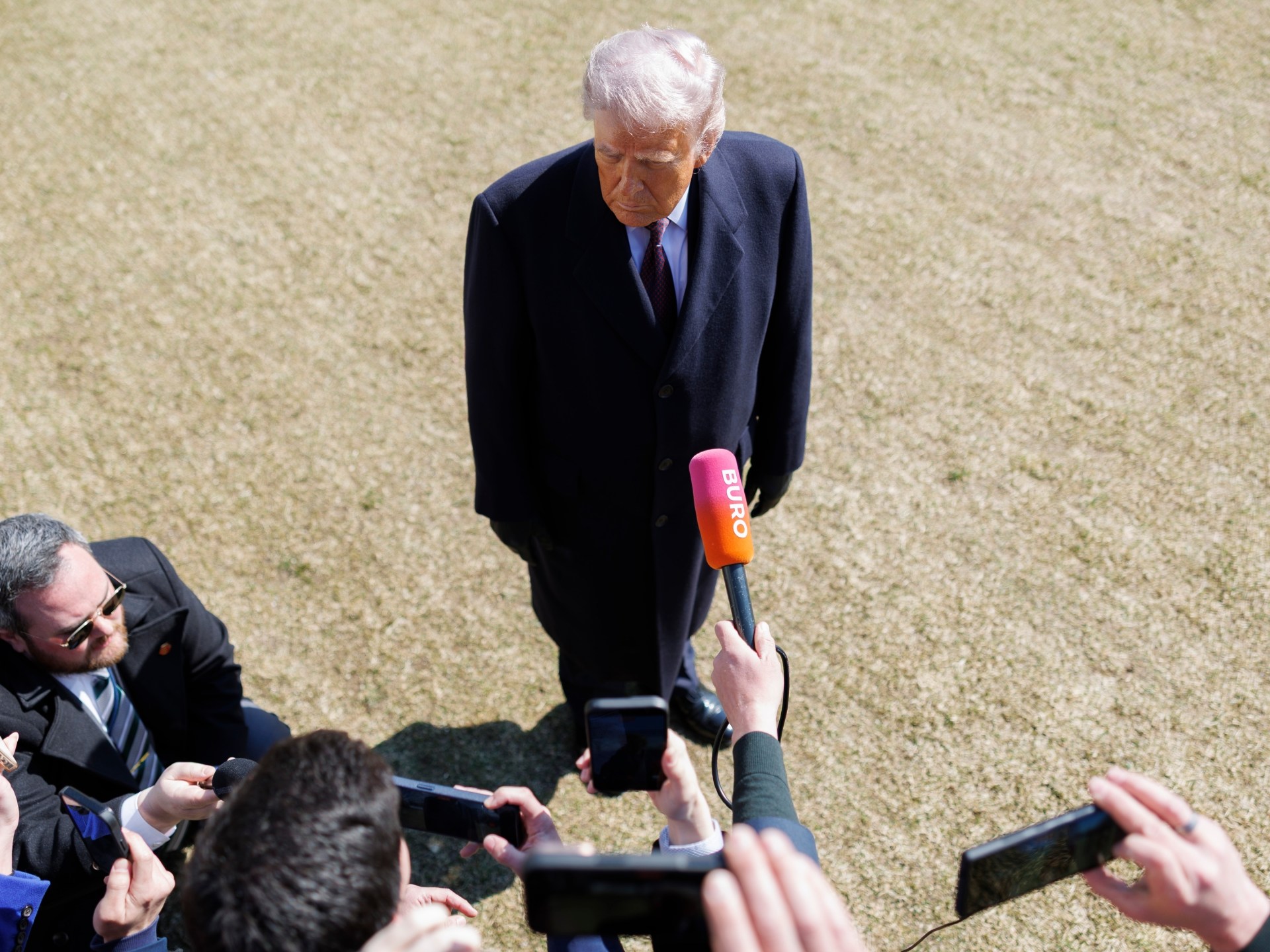

United States President Donald Trump’s second term in office has been defined by the abduction of Venezuela’s left-wing President Nicolas Maduro, joint US-Israeli strikes on Iran that killed the country’s Supreme Leader Ayatollah Ali Khamenei, among hundreds, and new threats against other leaders from Latin America to even Europe.
This policy is testing alliances, legal norms, and the idea that shock action abroad yields predictable outcomes at home. At its core is a message Trump repeats in different ways: “We can reach you – and we might not protect you if you do not do what we want.”
- list 1 of 4Trump admin offers scant evidence on Iranian threat in ‘America First’ war
- list 2 of 4Could the US run low on weapons for its assault on Iran?
- list 3 of 4Is the US arming Mexican cartels?
- list 4 of 4How Russia could benefit from the US-Israeli war on Iran
end of list
Trump talks directly to foreign leaders, promising swift punishment or personal favour, and casts himself as the only US president “with the gloves off”.
While his supporters see strength and candour, critics underline threats and deals aimed at domestic politics as much as foreign capitals.
A doctrine built around enemies
Trump’s decision to attack Iran has been described as the “biggest foreign policy gamble of his presidency”, with analysts saying he has pivoted from “swift, limited operations like last month’s lightning raid in Venezuela” to what could be a more protracted conflict that is already morphing into a wider regional war.
His doctrine is anchored in identifying adversaries – Iran, China, Russia and North Korea – alongside a cluster of actors such as Venezuela, Cuba, certain Latin American leaders, as well as drug cartels, Hezbollah and Hamas.
Analysts at the Atlantic Council say Trump’s National Security Strategy “elevates great power competition with China and Russia while casting Iran and North Korea as rogue regimes”, creating an organising map of enemies reflected in his rhetoric and operations.
Advertisement
The Foreign Policy Research Institute describes Trump’s strategy as “a deeply transactional document”, arguing that security guarantees and pressure on adversaries are framed around what others “pay” or concede to the US.
The Pentagon has named its Iran campaign Operation Epic Fury, with Trump insisting the US “did not start this war”, but intends to finish it – a claim rejected by Iran’s foreign minister in an interview with Al Jazeera.
Trump said US forces would “lay waste” to much of Iran’s military, deny Tehran a nuclear weapon, and “give Iranians a chance to topple their rulers”. Some media reports said he has privately claimed Iran would “soon have a missile that can hit the US”, even though intelligence assessments do not support that.
Analysts say Trump is hoping the US-Israeli strikes would incite a popular uprising to oust Iran’s rulers, even though outside airpower has never directly achieved government change without ground forces. The Atlantic Council warns the Iran attack risks drawing Washington into a wider regional war “without a clear endgame”.
A briefing from the Royal United Services Institute says if Iran’s retaliation causes significant US casualties, Washington will be under intense pressure to expand Operation Epic Fury into a larger military campaign.

Meanwhile, hawks in Washington see an opportunity. A report by the Foundation for Defense of Democracies says the attacks on Iran provide “a historic opportunity to help the Islamic Republic fall”.
Trump has told the US media the military operation could take “four weeks or less”, even as his defence secretary acknowledged it could be shorter or longer, depending on how Iran and its allies respond.
Within days of the Iran strikes on Saturday, the war has spread across the region, with Israel on Tuesday saying it has launched ground operations in Lebanon. Meanwhile, Iran’s retaliatory attacks have targeted US assets and even civilian infrastructure in the United Arab Emirates, Saudi Arabia, Qatar, Bahrain and other Gulf nations.
This is exactly the escalation experts had warned about: strikes framed as targeted decapitation of Iran’s leadership now pulling in a weakened Hezbollah and even Lebanese civilians, reinforcing the perception that the US is willing to put an entire region at risk to prove that it can reach one man or topple one regime.
Like he did in Venezuela by capturing Maduro in an in‑and‑out raid in Caracas after a CIA tip – an episode analysts say emboldens similar thinking elsewhere.
Advertisement
‘Troubling precedent’
The Caracas raid came on the back of a “maximum pressure” campaign, which saw sanctions, criminal cases and asset seizures in a high‑visibility operation. Maduro’s abduction gave the US considerable control over Venezuela’s vast oil reserves.
The Center for Strategic and International Studies calls the Maduro operation “a military victory with no viable endgame”, arguing that while the exfiltration of the president was tactically successful, the structural drivers of Venezuela’s crisis remained in place.
A Brookings analysis warned that the raid “sets a troubling precedent for US‑led regime change by special forces”, suggesting that other Latin American leaders may see it as a potential US “template” rather than a one‑off.
Like Colombia, whose President Gustavo Petro was referred to by Trump as “sick”, suggesting a Venezuela-like intervention there “sounds good to me”, and warning Petro to “watch his a**”.
Petro in January said the US was behaving like an empire that treats Latin American governments as subjects, warning that Washington risks shifting from “dominating the world” to being “isolated from the world”.
The killing or abduction of leaders or prominent figures from other nations violates international law. Experts say Trump’s expanding “targeted killing” doctrine erodes the taboo on assassinating political leaders, making reciprocity more plausible.
Protection as transaction
With allies, Trump’s posture is less kinetic but equally blunt.
Trump once boasted about telling a NATO partner, “You didn’t pay? You’re delinquent … No, I would not protect you. In fact, I would encourage [Russia] to do whatever the hell they want.”
The comments triggered alarm in European capitals and prompted what analysts described as efforts to “Trump‑proof” NATO by locking in higher defence spending and deeper political commitments.
The European Council on Foreign Relations alleges Trump has “exported MAGA to Europe”, turning NATO into “a protection racket in all but name” where security guarantees appear conditional on allies’ political and financial alignment.
A declassified White House memo from 2019 remains the clearest example of how Trump’s transactional logic extends to partners. The memo shows Trump responding to Ukrainian President Volodymyr Zelenskyy’s request for more weapons.
“I would like you to do us a favour though,” Trump purportedly said before asking Zelenskyy to investigate former US President Joe Biden and his son – a conversation that led to Trump’s first impeachment.
Who could be next?
Put together, the Maduro raid, the Iran attack, threats to Petro and pressure on NATO suggest who could be next: Latin American leaders labelled soft on drug cartels; the Iran‑aligned groups in Iraq, Syria and Lebanon; or smaller European nations branded “delinquent” by Trump.
US media reports say Trump’s advisers have urged him to focus on the domestic economy, warning that a prolonged confrontation with Iran could alienate parts of his “America First” base that are sceptical of open‑ended wars.
Advertisement
Meanwhile, Trump’s backers cite the rising NATO outlays, the Maduro raid and Iran strikes as proof that Trump “does what he says”. Some argue that degrading Iran’s nuclear programme, even without regime change, would still count as a victory for Trump.
Critics, however, worry that the Iran campaign could escalate into the biggest US military campaign since the Afghanistan and Iraq wars, with some of Trump’s stated claims on Iran not backed by intelligence.
Whether the US power produces durable outcomes without blowback – in Iran, Lebanon, Latin America and inside the US – is a key test for Trump in the days ahead.
Related News

White House post after US hockey win over Canada stirs controversy
Germany’s Merz arrives in China for two-day visit with focus on trade
Three aid workers killed, 4 wounded in RSF drone attack in Sudan’s Kordofan