
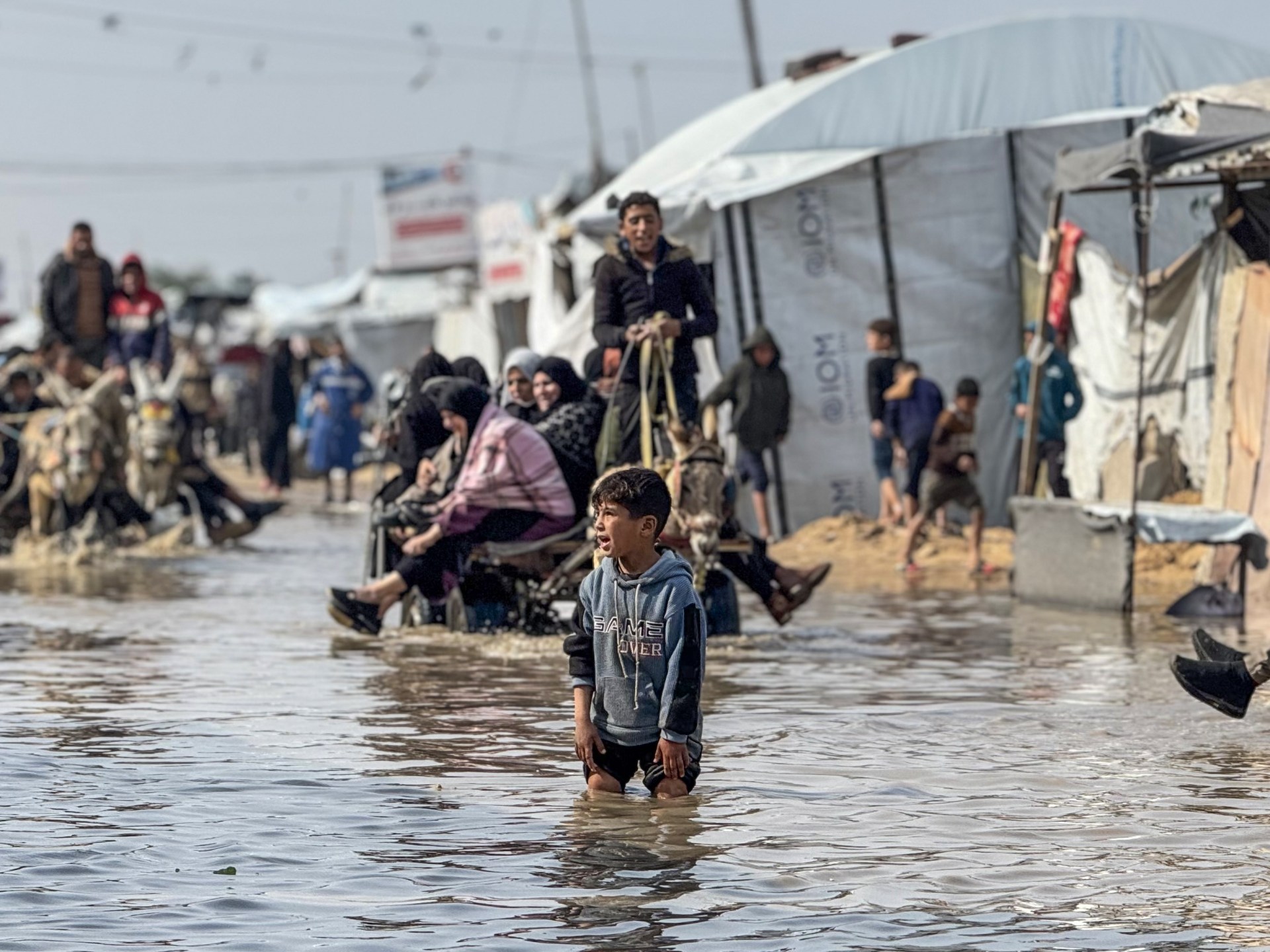

Palestinians across Gaza have woken up to heavy rains that flooded their makeshift tents as they brave the winter with little to no protection.
The enclave was hit by a winter storm late Monday through Tuesday – the first since the start of the holy month of Ramadan – with Gaza’s civil defence units reporting multiple distress calls overnight.
- list 1 of 4Gaza child dies waiting for Israeli permission to leave for treatment
- list 2 of 4BBC criticised for nixing ‘Free Palestine’ tribute from BAFTA coverage
- list 3 of 4Israeli settlers deface, set fire to West Bank mosque during Ramadan
- list 4 of 4What is Christian Zionism, the pro-Israel ideology invoked by US ambassador
end of list
Rescue teams provided emergency assistance to several families whose tents were flooded in the al-Mawasi camp west of Khan Younis in southern Gaza.
Areas west of Gaza City, particularly the Remal neighbourhood and the port area, were also hit hard.
Videos circulating on social media showed flooded tents in Remal, as residents struggled to find solutions to prevent further damage.
Meanwhile, Israeli forces continued to kill Palestinians in Gaza in violation of a “ceasefire” reached with Hamas in October.

As the enclave battled the aftermath of the rains, the Israeli military killed two people, including a boy, in northern Gaza’s Beit Lahiya area. The details of those killings are awaited.
“It’s not only the fact that aid is not entering, but also [that] Israel continues violating the ‘ceasefire’, continues to kill Palestinians,” said Al Jazeera’s Hind Khoudary, reporting from Gaza City.
More than 600 Palestinians have been killed in Israeli attacks since the United States-brokered “ceasefire” came into effect, according to the Ministry of Health in Gaza.
Israel launched its genocidal offensive in Gaza in October 2023, killing more than 72,000 Palestinians and wounding 171,000 others as it turned the enclave to rubble.
Tens of thousands of Palestinian families are living in makeshift tents, unable to withstand heavy rains and exposed to waterborne illnesses and the risk of hypothermia.
Advertisement
United Nations rights chief Volker Turk said the situation remains “catastrophic”.
Since December, a series of winter storms have flooded or blown away tens of thousands of tents and caused already damaged buildings, previously hit by Israeli attacks, to collapse, killing and injuring dozens of Palestinians.
Some have died from extreme cold in their flimsy tents as Israel continues to block the entry of aid shipments and shelter materials, including tents and mobile homes.
Despite the harsh weather, Israel is maintaining its restrictions on the entry of critically needed humanitarian aid.
Al Jazeera’s Khoudary said thousands of Palestinians denied permission to travel abroad for urgent medical treatment were “homeless, because they do not have any houses to return to, as the Israeli forces destroyed most of their houses”.
Related News
US Energy Secretary Chris Wright touts oil production on Venezuela visit
Iran, US spar as diaspora organises rallies abroad calling for action
When is Ramadan 2026, and how is the moon sighted?