
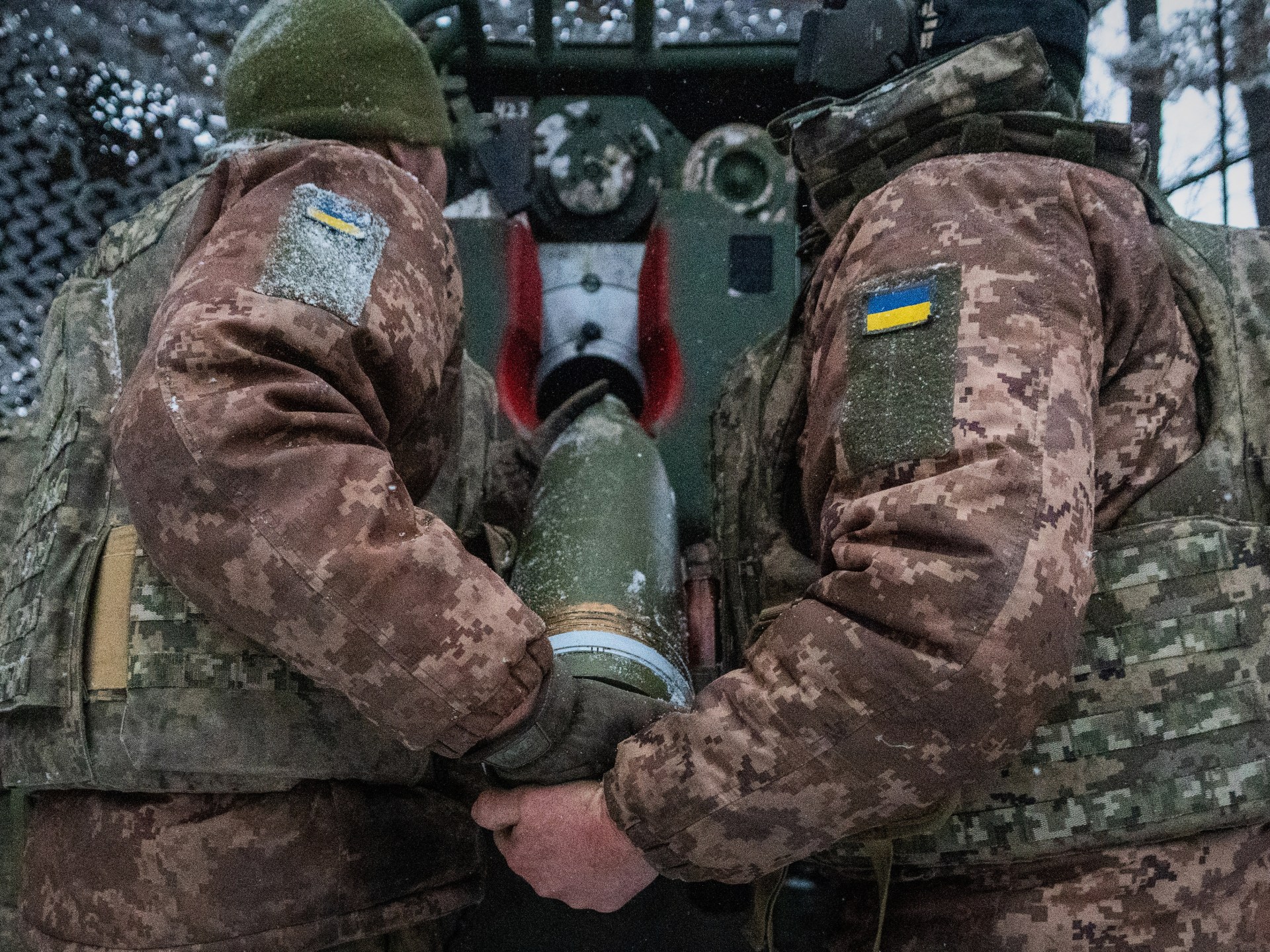

It’s Europe’s biggest war since World War II. It’s also Russia’s deadliest war since that conflict. And it has reshaped the global economy — with Moscow facing the most sanctions that any country has ever encountered.
As Russia’s war on Ukraine completes four years on February 24, Al Jazeera takes stock of what has been lost — the people, territory and the money spent.
People
Casualty numbers — fatalities and those injured and possibly incapacitated — vary widely, with Russia and Ukraine both presenting figures that amplify the losses of their enemies and downplay their own losses.
Still, their contrasting numbers offer a sense of the scale of death and devastation.
Russia’s war in Ukraine is estimated to have caused roughly two million military casualties in all.
Ukraine’s General Staff estimated that some 418,000 Russian troops were killed or wounded last year, bringing total Russian casualties for the war to just over 1.25 million.
The Center for Strategic and International Studies (CSIS) last month agreed, estimating that Russia had suffered 1.2 million casualties, including at least 325,000 deaths, from the beginning of the full-scale invasion on February 24, 2022 until December 2025. Ukraine estimated an additional 31,680 Russian casualties in January 2026.
“These numbers are extraordinary. No major power has suffered anywhere near these numbers of casualties or fatalities in any war since World War II,” said the CSIS in its report.
Ukrainian President Volodymyr Zelenskyy earlier this month said 55,000 Ukrainian soldiers had been killed in the entire war.
Advertisement
The CSIS estimated Ukraine had suffered up to 600,000 casualties, with as many as 140,000 deaths.
Al Jazeera cannot confirm casualty estimates from either side.
Ukraine believes Russian mortality rates on the front lines are rising to levels that cannot be sustained by the current method of voluntary recruitment.
“In December, 35,000 occupiers were eliminated – and this has been confirmed with video footage,” Zelenskyy said in early January, comparing this to 30,000 deaths in November, and 26,000 in October.
The CSIS agrees that Russian casualties have been rising throughout the war.
“Why are Russian casualties and fatalities so high?” the CSIS asked. “There are several possible explanations, such as Russia’s failure to effectively conduct combined arms and joint warfare, poor tactics and training, corruption, low morale, and Ukraine’s effective defence-in-depth strategy in a war that favors the defense.”
Ukraine has additionally suffered significant civilian deaths.
The United Nations Human Rights Monitoring Mission in Ukraine (HRMMU) believes 15,168 Ukrainian civilians have been killed and 41,534 wounded during four years of full-scale war.
It also believes the war is becoming more dangerous for civilians, with 2025 the deadliest year so far.
The open-source project Conflict Intelligence Team (CIT) said that at least 2,919 Ukrainian civilians had been killed and 17,775 injured in 2025, mostly from Russian drone strikes in Ukraine but also from activities in Russian-occupied areas. The figures represented an increase from 2024.
In addition to military and civilian casualties, Ukraine has lost about a quarter of its pre-war population of 42 million.
Some five million people were living under Russian occupation, estimated the government in 2023.
Another 5.9 million Ukrainians have left the country, 5.4 million of them for Europe, estimates the UN High Commissioner for Refugees.
Finally, Ukraine says thousands of children were abducted from occupied territories to be raised in Russia and re-educated as Russians. The Yale School of Medicine estimates there are more than 19,000 abductees. Despite persistent pleas, Ukraine says, only 1,238 have been returned.
Territory
At its zenith in March 2022, Russia’s invasion held 26 percent of Ukraine, according to geolocated footage catalogued by the Institute for the Study of War, a Washington-based think tank. That included Crimea, which Russia had seized in January 2014, and large parts of the eastern regions of Luhansk and Donetsk, where pro-Russian separatist forces had fought Kyiv’s forces since February 2014.
Advertisement
The following month, Ukraine pushed Russia back from a string of northern cities – Kyiv, Kharkiv, Sumy and Chernihiv – leaving Russia in possession of 20 percent of the country.
In August and September of 2022, Ukraine’s then-ground forces commander Oleksandr Syrskii masterminded a campaign to push Russia east of the Oskil River in the northern Kharkiv region, and Russia itself withdrew east of the Dnipro River in the southern region of Kherson, leaving it with 17.8 percent of the country.
In the last three years, the war has been mostly frozen: Russia has struggled to make any meaningful territorial gains. During this time, Russian troops have inched forward while they suffered staggering losses to raise the territory under occupation to 19.3 percent of Ukraine by December 2025 – approximately 116,000sq km (44,800 sq miles).
Money
Russia’s military spending surged from just under $66bn in 2021 to $102bn in 2022, the first year of its full-scale invasion, and then up to $109bn in 2023, according to the Stockholm International Peace Research Institute (SIPRI). Then, in 2024, defence spending surged to $149bn, said SIPRI.
Estimates vary for Russia’s defence spending in 2025. According to Janis Kluge, a researcher with the German Institute for International and Security Affairs, it went up again, to $142bn for just the first nine months of the year — which, extrapolated for the whole year, would have surpassed 2024’s $149bn spending.
But according to Craig Kennedy, an economist at Harvard University’s Davis Center for Russian and Eurasian Studies, actual Russian defence spending was on track to fall by 15 percent overall last year because of last-quarter budget cuts following an out-of-control deficit, and because of a drop in bank lending to the defence industrial base.
“Funding for the war in 2025, including state-directed lending to arms manufacturers, is on track to contract by 15 percent this year,” he told Al Jazeera last October.
According to documents seen by Reuters news agency, Moscow is on track to cut defence spending by at least 7 percent in 2026 as well.
Ukraine’s defence spending has also shot up, from $6.9bn in 2021 to $41bn in the first year of the full-scale invasion, and $65bn for each of 2023 and 2024, according to SIPRI. Its 2025 defence budget was raised last October to a record $71bn.
These increases have been funded by Ukraine’s allies, mainly the European Union and the United States, which have together contributed more than $300bn to Ukraine in military and budgetary support since 2022.
After Donald Trump was sworn in as US president in January 2025, the US withdrew 99 percent of its support, shifting the financial burden onto Europe.
Yet according to the Kiel Institute’s Ukraine Support Tracker, support to Ukraine remained stable after the US withdrawal because Europe increased its contribution by about two-thirds. Last year, Europe contributed about $70bn in military and financial aid to Ukraine, while the US contribution fell to $0.4bn.
Advertisement
Russia has an additional financial cost. Half of its central bank’s gold and foreign exchange reserves – some $300bn – are held in Western financial institutions, including $230bn in Belgium. These have been immobilised, meaning that Russia cannot access the funds or earn proceeds from them. In May 2024, the EU decided to award those proceeds to Ukraine, allocating 90 percent to military needs and 10 percent for reconstruction.
The EU has immobilised an additional $33bn in Russian private wealth belonging to sanctioned individuals.
Related News
Washington appoints new US envoy on Tibetan human rights

PM Sanae Takaichi’s party set for majority in Japan parliamentary elections
US readying another aircraft carrier for Middle East deployment: Trump