
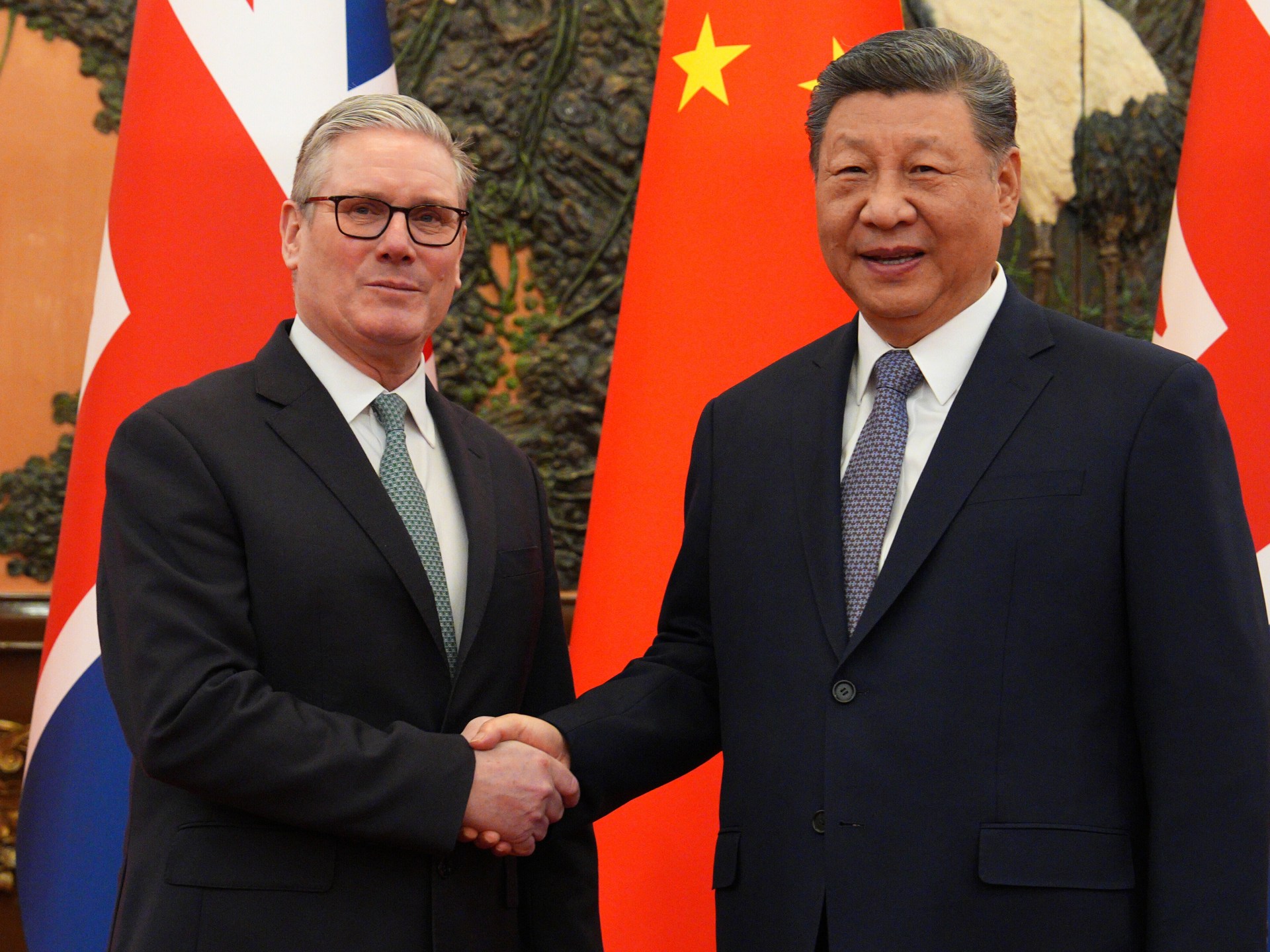

United Kingdom Prime Minister Keir Starmer is on a three-day state visit to China as he seeks to deepen economic and security ties with the world’s second-largest economy after years of acrimonious relations.
This is the first trip by a UK prime minister to China since Theresa May met Chinese President Xi Jinping in 2018.
- list 1 of 4Is the global economic order unravelling?
- list 2 of 4China executes 11 linked to Myanmar scam operations: State media
- list 3 of 4Syria grants immediate citizenship to Kurds in wake of gains against SDF
- list 4 of 4Car ramming at largest synagogue in Brooklyn
end of list
Here’s what you need to know about the trip aimed at mending ties at a time of global uncertainties:
What’s on Starmer’s agenda for China?
The UK PM met Xi and Chinese Premier Li Qiang in Beijing on Thursday. He will next head to Shanghai to meet British and Chinese business leaders, according to his official itinerary.
After their meeting on Thursday, Starmer and Xi called for a “comprehensive strategic partnership” between the two nations.
“China-UK relations experienced setbacks in previous years, which were not in the interests of either country,” Xi said. “In the current complex and ever-changing international situation … China and the UK need to strengthen dialogue and cooperation to maintain world peace and stability.”
In his opening remarks, Starmer told Xi the two nations should “work together on issues like climate change, global stability during challenging times”.
The prime minister is accompanied by a delegation of nearly 60 representatives of businesses and cultural organisations, including banking conglomerate HSBC, pharmaceutical giant GSK, carmaker Jaguar Land Rover and the UK’s National Theatre.
Starmer told Bloomberg there will be “significant opportunities” for UK businesses in China in an interview this week in the run-up to his trip.
Advertisement
His trip is also expected to mark a reset in UK-China relations, which have been strained in recent years. Starmer underlined his intentions during his meeting with Xi on Thursday.
“China is a vital player on the global stage, and it’s vital that we build a more sophisticated relationship where we can identify opportunities to collaborate, but of course, also allow a meaningful dialogue on areas where we disagree,” Starmer told Xi, according to the Reuters news agency.

Why does the UK want to reset its relationship with China?
Starmer has framed his trip to China as a pragmatic move despite ongoing concerns back home about Beijing’s human rights record and potential national security threat.
“Like it or not, China matters for the UK,” Starmer said in advance of his trip to Beijing.
“As one of the world’s biggest economic players, a strategic and consistent relationship with them is firmly in our national interest. That does not mean turning a blind eye to the challenges they pose – but engaging even where we disagree,” he said.
China has rejected the allegations of human rights violations in parts of the country.
While few details have been released yet, Jing Gu, a political economist research fellow at the UK’s Institute of Development Studies, said reviving economic ties would require expanded “market access, predictable regulation and fair treatment of UK firms” alongside clear “guardrails”.
“This is not a question of being ‘pro-China’ or ‘anti-China’,” she said in a statement.
China offers a potential economic lifeline to the UK, whose economy has struggled in the decade since it embarked on its departure from the European Union in 2016.
A report by the nonpartisan National Bureau of Economic Research (NBER) in the United States estimated last year that Brexit reduced UK gross domestic product (GDP) by 6 to 8 percent, with the impact accumulating gradually over time. Investment is also down 12 to 18 percent, according to NBER estimates, and employment is down 3 to 4 percent.
The UK’s GDP is estimated to grow 1.4 percent in 2026, according to Goldman Sachs, as it faces new economic challenges from US President Donald Trump’s decisions and announcements.
The UK was not exempt from Trump’s tariff war despite its decades-long “special relationship” with the US. As a NATO member, the UK has also watched with alarm as Trump recently threatened to annex Greenland and impose up to 25 percent tariffs on any country that opposed him.
Advertisement
Starmer is not the only US ally looking to diversify economic ties. His trip to China follows in the footsteps of French President Emmanuel Macron, Australian Prime Minister Anthony Albanese, South Korean President Lee Jae Myung, Finnish Prime Minister Petteri Orpo and Canadian Prime Minister Mark Carney.
What strained the UK’s relationship with China?
The UK has longstanding concerns with China’s human rights record, but its relationship with Beijing took a turn for the worse after mass antigovernment protests swept Hong Kong, a former British colony, in 2019.
The UK was alarmed by the political crackdown that followed the 2019 protests and Beijing’s decision to impose legislation in 2020 that criminalised “secession, subversion, terrorist activities, and collusion with a foreign country or with external elements to endanger national security”.
In the aftermath, the UK opened a special immigration scheme for the citizens of Hong Kong born before the city’s 1997 return to Chinese sovereignty. British officials have continued to criticise Hong Kong’s national security trials, including the prosecution of pro-democracy businessman Jimmy Lai, who is a UK citizen.
Allegations of Chinese spying in the UK and China’s support for Russia in the Ukraine war have also frayed the ties.
Steve Tsang, director of the SOAS China Institute in London, told Al Jazeera that he did not expect any concessions in this area during Starmer’s visit. “Beijing will work to support Starmer to present the visit as a success, but it will not make any concession in areas that matter to China, such as human rights,” he said.
Concerns about Chinese spying have been a front-page issue in the UK over the past year, with the head of the domestic intelligence agency MI5 recently saying “Chinese state actors” pose a national security threat “every day”.
Despite these worries, Starmer’s government this month approved Beijing’s plan to open a “mega embassy” in London that critics say could become a hub for espionage in Europe.
The embassy’s approval also follows the collapse of a legal case against two British men charged with spying for China. The decision by prosecutors to withdraw charges at the eleventh hour remains highly controversial in the UK.
China has denied the spying claims, with its Ministry of Foreign Affairs calling them “unfounded” accusations.
Starmer’s trip, however, emphasised areas of potential security cooperation between China and the UK.
Following his meeting with Xi, the Prime Minister’s Office announced that law enforcement would cooperate with Chinese authorities to stem the flow of synthetic opioids into the UK and cut off the supply of small boat engines to criminal gangs.
Engine-powered boats are used to smuggle people across the English Channel, according to Starmer’s office.
The agreement will include “intelligence sharing to identify smugglers’ supply routes and direct engagement with Chinese manufacturers to prevent legitimate businesses being exploited by organised crime”, his office said.
Advertisement
Related News
US begins transferring ISIL-linked detainees from Syria to Iraq
Israeli prisons are akin to ‘torture camps’, Israeli rights group finds
Trump to address Davos as Greenland threats spark outrage in Europe