

Since taking the White House in January last year, President Donald Trump has repeatedly said that he wants to annex Greenland “very badly,” with a range of options on the table, including a military attack.
Amid opposition from Greenlandic lawmakers, Trump doubled down on Friday, threatening that the United States is “going to do something [there] whether they like it or not”.
“If we don’t do it, Russia or China will take over Greenland. And we’re not going to have Russia or China as a neighbour,” Trump said at a meeting with oil and gas executives at the White House.
“I would like to make a deal, you know, the easy way. But if we don’t do it the easy way, we’re going to do it the hard way,” he added.
Since the abduction of Venezuelan President Nicolas Maduro last week from Caracas in a military operation, Trump and his officials have upped the ante against the Greenlandic capital, Nuuk.
So, what are the ways that US President Trump could take control of Greenland, a territory of Denmark?

Is Trump considering paying out Greenlanders?
Paying out to Greenland’s nearly 56,000-strong population is an option that White House officials have been reportedly discussing.
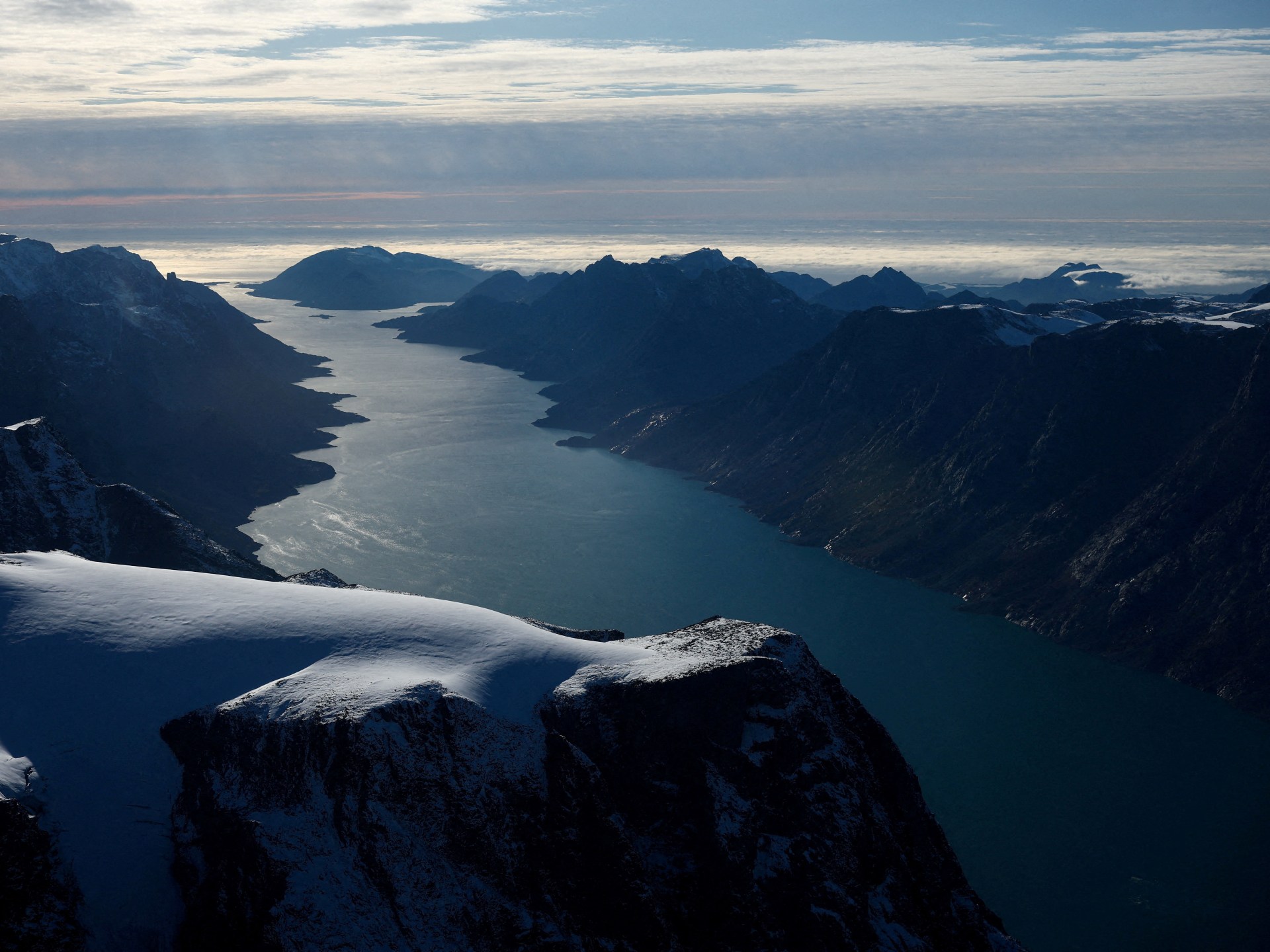
Located mostly within the Arctic Circle, Greenland is the world’s largest island, with 80 percent of its land covered by glaciers. Nuuk, the capital, is the most populated area, home to about one-third of the population.
Trump’s officials have discussed sending payments to Greenlanders – ranging from $10,000 to $100,000 per person – according to a Reuters report, in a bid to convince them to secede from Denmark and potentially join Washington.
Advertisement
Greenland is formally a part of Denmark, with its own elected government and rules over most of its internal affairs, including control over natural resources and governance. Copenhagen still handles foreign policy, defence and Greenland’s finances.
But since 2009, Greenland has the right to secede if its population votes for independence in a referendum. In theory, payouts to Greenland residents could be an attempt to influence their vote.
Trump shared his ambitions of annexing Greenland during his first term as well, terming it “essentially a large real estate deal.”
If the US government were to pay $100,000 to each Greenland resident, the total bill for this effort would amount to about $5.6bn.

Can the US ‘buy’ Greenland?
Earlier this week, White House spokesperson Karoline Leavitt confirmed to reporters on Wednesday that Trump’s officials are “actively” discussing a potential offer to buy the Danish territory.
During a briefing on Monday with lawmakers from both chambers of Congress, US Secretary of State Marco Rubio told them that Trump would prefer to buy Greenland rather than invade it. Rubio is scheduled to hold talks with Danish leaders next week.
Both Nuuk and Copenhagen have repeatedly insisted that the island “is not for sale”.
There are few modern historical precedents to compare Trump’s threats with Greenland, much like the abduction of Maduro on his orders.
The US purchased Louisiana from France in 1803 for $15m and Alaska from Russia in 1867 for $7.2m. However, both France and Russia were willing sellers — unlike Denmark and Greenland today.
Washington has also purchased territory from Denmark in the past. In 1917, the US, under President Woodrow Wilson, bought the Danish West Indies for $25m during World War I, later renaming them the United States Virgin Islands.

Can Trump really just pay off his way?
While Greenlanders have been open to departing from Denmark, the population has repeatedly refused to be a part of the US. Nearly 85 percent of the population rejects the idea, according to a 2025 poll commissioned by the Danish paper Berlingske.
Meanwhile, another poll, by YouGov, shows that only 7 percent of Americans support the idea of a US military invasion of the territory.
Jeffrey Sachs, an American economist and a professor at Columbia University, told Al Jazeera, “The White House wants to buy out Greenlanders, not to pay for what Greenland is worth, which is way beyond what the US would ever pay.”
Advertisement
“Trump thinks he can buy Greenland on the cheap, not for what it’s worth to Denmark or Europe,” he said. “This attempt to negotiate directly with the Greenlanders is an affront and threat to Danish and European sovereignty.”
Denmark and the European Union “should make clear that Trump should stop this abuse of European sovereignty,” said Sachs. “Greenland should not be for sale or capture by the US.”
Sachs added that the EU needs to assess “[Greenland’s] enormous value as a geostrategic region in the Arctic, filled with resources, vital for Europe’s military security.” And, he added, “certainly not a plaything of the United States and its new emperor”.
Denmark and the US were among the 12 founding members of the North Atlantic Treaty Organization (NATO) in 1949 to provide collective security against Soviet expansion.
“Europe should tell the US imperialists to go away,” Sachs said. “[Today] Europe is far more likely to be invaded from the West (US) than from the East,” the economist told Al Jazeera.

Has the US tried to buy Greenland earlier?
Yes, on more than one occasion.
The first such proposal surfaced in 1867 under Secretary of State William Seward, during discussions to successfully purchase Alaska. By 1868, he was reportedly prepared to offer $5.5m in gold to acquire both Greenland and Iceland.
In 1910, a three-way land swap was discussed that would involve the US acquiring Greenland in exchange for giving Denmark parts of the US-held Philippines, and the return of Northern Schleswig from Germany back to Denmark was proposed.
A more formal attempt was made in 1946, immediately following World War II. Recognising Greenland’s critical role in monitoring Soviet movements, President Harry Truman’s administration offered Denmark $100m in gold for the island.
But Denmark flatly rejected the idea.

Can the US attack Greenland?
While political analysts say that a US attack to annex Greenland would be a direct violation of the NATO treaty, the White House has said that using military force to acquire Greenland is among the options.
Denmark, a NATO ally, has also said that any such attack would end the military alliance.
“We need Greenland from the standpoint of national security, and Denmark isn’t going to be able to do it,” Trump told reporters on Air Force One on Sunday. “It’s so strategic.”
Greenland is one of the world’s most sparsely populated, geographically vast regions.
But through a 1951 agreement with Denmark, the US military already has a significant presence on the island.
The US military is stationed at the Pituffik Space Base, formerly known as Thule Air Base, in the northwestern corner of Greenland, and the 1951 pact allows Washington to set up additional “defence areas” on the island.
Advertisement
The Thule base supports missile warning, missile defence, space surveillance missions, and satellite command and control.
Nearly 650 personnel are stationed at the base, including US Air Force and Space Force members, with Canadian, Danish and Greenlandic civilian contractors. Under the 1951 deal, Danish laws and taxation don’t apply to American personnel on the base.
Denmark also has a military presence in Greenland, headquartered in Nuuk, where its main tasks are surveillance and search and rescue operations, and the “assertion of sovereignty and military defense of Greenland and the Faroe Islands”, according to Danish Defence.
But the US forces at Thule are comfortably stronger than the Danish military presence on the island. Many analysts believe that if the US were to use these troops to try to occupy Greenland, they could do so without much military resistance or bloodshed.
Trump told reporters on Sunday that “Greenland is covered with Russian and Chinese ships all over the place”. Both global powers have a presence in the Arctic Circle; however, there is no evidence of their ships anywhere near Greenland.

Is there another option for the US?
As Trump’s officials mull plans to annex Greenland, there have reportedly been discussions in the White House on entering into a type of agreement that defines a unique structure of sovereignty-sharing.
Reuters reported that officials have discussed putting together a Compact of Free Association, an international agreement between the US and three independent, sovereign Pacific island nations: the Federated States of Micronesia, the Republic of the Marshall Islands and the Republic of Palau.
The political arrangement grants the US responsibility for defence and security in exchange for economic assistance. The precise details of COFA agreements vary depending on the signatory.
For a COFA agreement, in theory, Greenland would need to separate from Denmark.
Asked why the Trump administration had previously said it was not ruling out using military force to acquire Greenland, Leavitt replied that all options were always on the table, but Trump’s “first option always has been diplomacy”.

Why does Trump want Greenland badly?
Trump has cited national security as his motivation for wanting to take Greenland.
For the US, Greenland offers the shortest route from North America to Europe. The US has expressed interest in expanding its military presence in Greenland by placing radars in the waters connecting Greenland, Iceland and the United Kingdom. These waters are a gateway for Russian and Chinese vessels, which Washington aims to track.
But Greenland is also home to mineral riches, including rare earths. According to a 2023 survey, 25 of 34 minerals deemed “critical raw materials” by the European Commission were found in Greenland. Scientists believe the island could also have significant oil and gas reserves.
However, Greenland does not carry out the extraction of oil and gas, and its mining sector is opposed by its Indigenous population. The island’s economy is largely reliant on its fishing industry at the moment.
Related News

Pro-Palestine activists target UK Labour offices over hunger strikers
Thai army says Cambodia claims new border strike was accident amid truce

What are Saudi Arabia’s plans in southern Yemen?